These icons are designed to help you quickly understand and learn important information about our products.
Teaching Method
Traditional
Teacher-centered curriculum commonly used in classrooms that may include a text, teacher manual, tests, etc.
Charlotte Mason
A methodology based on the work of a 19th century educator who maintained that children learn best from literature (Living Books), not textbooks.
Classical
A methodology based on the Latin Trivium (three stages of learning), including the grammar stage (memorization and facts), logic stage (critical thinking), and rhetoric stage (developing/defending ideas).
Unit Study
A thematic or topical approach centered around one topic that integrates multiple subject areas.
Montessori (Discovery)
A methodology based on the work of a 20th century educator that emphasizes student and sensory-driven discovery learning and real-life applications.
Other
Other methodologies
Religious Content
Secular
Contains content contrary to common Christian beliefs (i.e. evolution).
Neutral
Avoids religious or theoretical topics or presents multiple viewpoints without preference.
Christian/Religious
Faith-based or including instructional religious content.
Learning Modality
Auditory
Learns through listening, talking out loud or reading out loud.
Visual
Learns through seeing, prefers written instructions and visual materials.
Kinesthetic/Tactile (Hands-On)
Learns through moving, doing and touching.
Multi-Sensory
Curriculum that employ a variety of activities/components.
Presentation
Sequential
Curriculum progresses through well-defined learning objectives. Emphasizes mastery before moving to the next topic.
Spiral
Topics and concepts are repeated from level to level, adding more depth at each pass and connecting with review.
Conceptual/Topical
Focus is on the “why,” often with a unifying concept as well as specific skills; coverage may be broader.
Teacher Involvement
Low Teacher Involvement
Student-led materials; parent acts as a facilitator.
Medium Teacher Involvement
A mix of teacher-led time and independent student work.
High Teacher Involvement
Teacher-led lessons; may utilize discussions, hands-on activities and working together.
Additional Materials Required
No other materials needed
Everything you need is included.
Other Materials Required
There are additional required resources that are a separate purchase.
Other Materials Optional
There are additional resources mentioned or recommended but are not absolutely necessary.
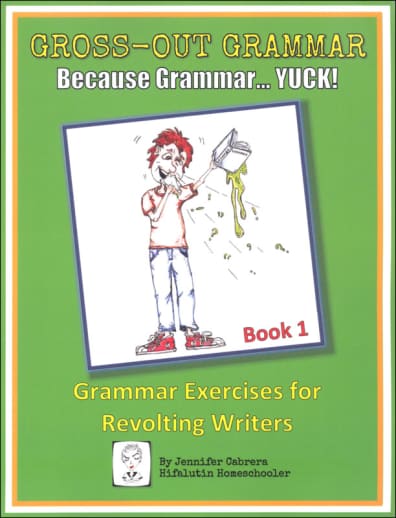
This engaging Gross-Out GrammarBook 1 consumable text by homeschool humorist, Jennifer Cabrera,
embraces the “gross” of grammar, putting a comical spin on learning the skill. The
author embraces and capitalizes on that “middle school” sense of humor: sentence
types are “snotty;” adjectives are taught in the chapter entitled, “The Art of
the Fart.” Practice grammar skills with varied activities such as an adlib
style fill-in-the-blank, unscrambling words, or even drawing. The book ends
with a 45-question review challenge. Aligning with the skills taught by Revolting Writing, this
composition book serves as the first semester of grammar. To continue in
grammar in the second semester, move to Gross-Out Grammar: Book 2.
Answer keys and a Certificate of Completion are provided in the back of
the book. Consumable, 116 pages, softcover. ~ Ruth
Publisher's Description of Gross-Out Grammar: Book 1
Does your student groan over grammar? Why not teach through laughter instead of boredom or tears? Gross-Out Grammar uses kid-rousing topics and humor to build grammar skills and spark creativity in reluctant middle school writers.
What's inside book 1: A full semester of kid-rousing grammar lessons including: sentence types and basic structures; sentence punctuation; parts of speech; synonyms, antonymns, homophones, etc; commonly misused and confusing words.
Overcome grammar aversion with this 2-volume series built on
middle-school humor (an engaging level of yuck—even “revolting.” The varied Book
1 lessons overview parts of speech, punctuation, and special words. Book 2 picks
up where the first stops: including mechanics, poetry, and figurative language.
Students lay the foundation for essays. Use the final review and challenge quiz
to complete your year. Use alongside the author’s Revolting Writing to
make a complete grammar/writing course. Includes an answer key and encourages
your student to use a dictionary, thesaurus or similar resource.