
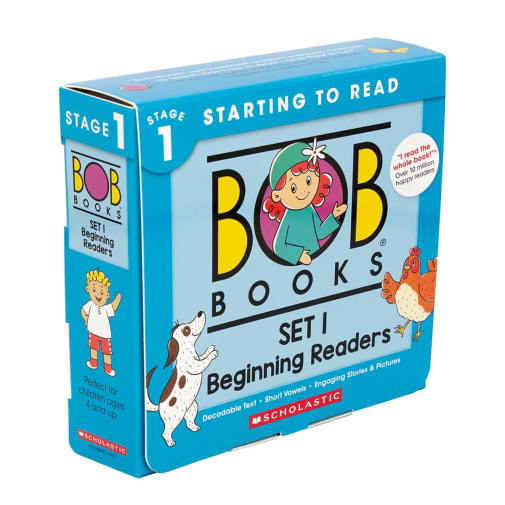
For kindergarten readers, Bob Books Set 1 for Beginning Readers introduces all letter sounds except for “Q” and instills confidence in early readers as they begin to read books on their own. Each little book indicates what letter sounds will be covered in the sound/picture dictionary. There are just 5 sight words that are introduced in the whole set. With just these few letter sounds, students will be off reading three-letter words and short sentences. Cute, single-color pen illustrations journey with readers from page to page. There are 12 books included in this box set. Each box set includes a postcard to the parents with hints for teaching your child to read and to love reading.
Bob Books Set 1: Beginning Readers (Stage 1)
SKU
019364
ISBN
9780439845007
Grade PK-3
Neutral
Non-Consumable
These icons are designed to help you quickly understand and learn important information about our products.
Teaching Method
Traditional
Teacher-centered curriculum commonly used in classrooms that may include a text, teacher manual, tests, etc.
Charlotte Mason
A methodology based on the work of a 19th century educator who maintained that children learn best from literature (Living Books), not textbooks.
Classical
A methodology based on the Latin Trivium (three stages of learning), including the grammar stage (memorization and facts), logic stage (critical thinking), and rhetoric stage (developing/defending ideas).
Unit Study
A thematic or topical approach centered around one topic that integrates multiple subject areas.
Montessori (Discovery)
A methodology based on the work of a 20th century educator that emphasizes student and sensory-driven discovery learning and real-life applications.
Other
Other methodologies
Religious Content
Secular
Contains content contrary to common Christian beliefs (i.e. evolution).
Neutral
Avoids religious or theoretical topics or presents multiple viewpoints without preference.
Christian/Religious
Faith-based or including instructional religious content.
Learning Modality
Auditory
Learns through listening, talking out loud or reading out loud.
Visual
Learns through seeing, prefers written instructions and visual materials.
Kinesthetic/Tactile (Hands-On)
Learns through moving, doing and touching.
Multi-Sensory
Curriculum that employ a variety of activities/components.
Presentation
Sequential
Curriculum progresses through well-defined learning objectives. Emphasizes mastery before moving to the next topic.
Spiral
Topics and concepts are repeated from level to level, adding more depth at each pass and connecting with review.
Conceptual/Topical
Focus is on the “why,” often with a unifying concept as well as specific skills; coverage may be broader.
Teacher Involvement
Low Teacher Involvement
Student-led materials; parent acts as a facilitator.
Medium Teacher Involvement
A mix of teacher-led time and independent student work.
High Teacher Involvement
Teacher-led lessons; may utilize discussions, hands-on activities and working together.
Additional Materials Required
No other materials needed
Everything you need is included.
Other Materials Required
There are additional required resources that are a separate purchase.
Other Materials Optional
There are additional resources mentioned or recommended but are not absolutely necessary.
Consumable
Consumable
Designed to be written in; not reusable.
Non-Consumable
Not designed to be written in; reusable.
Our Price
$17.99 $17.99 $11.50
Rainbow Savings: $6.49
Product Overview
- Bob Books Set 1 is full of 12 fun, confidence-building books for beginning readers!
- Colorful characters and the sound/picture dictionary encourage student engagement
- Books contain 2-3 letter words and introduce all letters except “Q”
- Designed for Stage 1 readers who are just beginning to read
Description
Publisher's Description of Bob Books Set 1: Beginning Readers (Stage 1)
Bob Books Set 1: Beginning ReadersTeach a child letter sounds with Bob Books Set 1! With four letters in the first story, children can read a whole book. Consistent new sounds are added gradually, until young readers have read books with all letters of the alphabet (except Q). Short vowels and three-letter words in simple sentences make Bob Books Set 1 a fun confidence builder. With little books, come big success. (TM)
Category Description for Steps to Reading
Steps to Reading is an open-and-go phonics program that is user-friendly and fun! Written by developmental psychologist Dr. Irene Daria, this research-based reading program includes four books that should be used in sequential order. Book One teaches short vowels; Book Two teaches blends; Book Three teaches digraphs; Book Four teaches long vowels and “y” at the end of a word. Sight words are taught in order of use throughout all four books. It is assumed that students know their letter sounds before beginning the program. Instructions are scripted for the parent and presented directly in each book. The author refers to an excellent website that is wonderful for beginning readers as an additional resource in some of the lessons. She also recommends several book series, such as Bob Books Set 1, Primary Phonics Set 1 and 2A, The Alphabet Series Volume 1, and others to use as reading practice. She even includes when and where to bring in these readers! Throughout each book, there are engaging activity pages, including tracing letters and words, coloring, making sentences from cut-out words, selecting correct words or letters that go with a picture, vocabulary exercises, and more. Games like phonics bingo and phonics board games are also included. There is not a weekly schedule, which gives you freedom to go at your child’s pace. You can typically cover all four books in one year; however, if you need to take longer, that is perfectly acceptable. After finishing all four books, kids should be at a first-grade reading level. A small amount of handwriting practice is included, but you will want to have a separate handwriting book. We offer Steps to Reading books as a bundle or separately with the recommended readers. This is a research-backed way to teach your child to read in an open-and-go format! Pages are non-reproducible. ~ Gina
Details
| Product Format: | Other |
|---|---|
| Grades: | PK-3 |
| Brand: | Scholastic |
| ISBN: | 9780439845007 |
| Length in Inches: | 5.8125 |
| Width in Inches: | 5.5 |
| Height in Inches: | 1.75 |
| Weight in Pounds: | 0.642 |
| Ages: | 4 - 8 |
| Edition: | Illustrated |
| Illustrated by: | John Maslen |
| Pages: | 16 |
| Publication Date: | 5/6/2013 |
Videos
Reviews