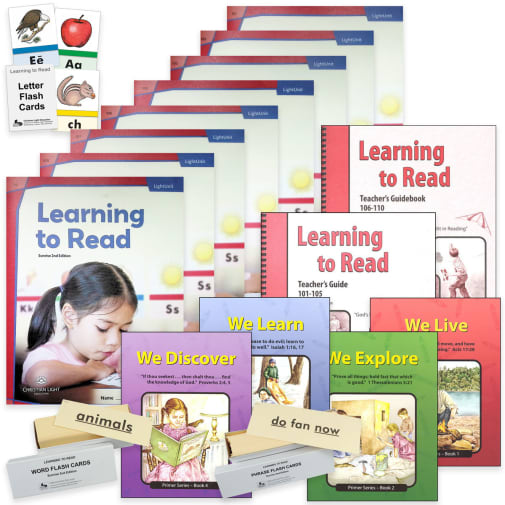
Designed to prepare students for Christian Light’s well-constructed grade 1–8
Reading program, Learning to Read is phonics well-done! The general “feel” of
the program is wholesome, God-honoring, and rural.
Learning to Read teaches all consonant sounds, consonant
digraphs, long and short vowels, most two-letter vowel sounds, and many sight
words. Each sound is introduced with a picture card, followed by a story and a
fun rhyme about the picture and new sound. Learning to Read integrates Christian Light
Language Arts 1 for a full Language Arts credit, beginning with LightUnit
105. However, families may choose to simply use Learning to Read to focus on
phonics mastery and reading. After completing Learning to Read, students will
be ready for Christian Light Reading Grade 1, I
Wonder.
The four paperback Primers have black-and-white
illustrations and are 50–70 pages each. They progress from single words to
multi-page stories. (May I take a moment to rave about the illustrations? They
are excellent! Well-proportioned drawings are very detailed with meticulous
shading.) The stories contain new sounds and sight words. Small icon-like
pictures substitute for words students have not yet learned. (Some stories
contain challenge words—words that have not been taught but can be sounded out—which
are bolded and listed in footnotes.)
LightUnits are the consumable worktexts that provide phonics
reinforcement, reading comprehension, and handwriting activities. One unusual
activity is the Dot Maps, which become progressively more complex and develop
hand-eye coordination. There are ten LightUnits in the Learn to Read program.
These are available individually or in convenient packages.
There are two Teacher Guides that align to the Learn to Read
LightUnits: one for 101–105
and one for 106–110. Essential
to the program, the Teacher’s Guides provide answers and instructions for each
lesson. Also included are a comprehensive outline; a summary of sounds,
markings, and phonetic rules; teaching tips; activity ideas; games for
reinforcement; and more. Daily schedules are included, as well as yearly
schedules to assist in planning.
Optional Practice Sheets are blackline masters (removable
answer key in middle) that provide additional practice and activities.
Additional teaching supports include Letter Flash Cards, Word Flash Cards, Sight Word Flash Cards,
and Phrase Flash Cards.
Also available is the Sound
Slider, which is an ingenious device for practicing beginning and ending
blends.
It’s hard to imagine a more let’s-get-down-to-business-and-learn-to-read
program. Although designed for a classroom, the easy-to-use materials will lend
themselves well to home use, and the total cost is reasonable. Necessary
components include the Primers, the LightUnits, and the Teacher’s Guides. Nice
to have, but optional, are the flashcards and sound slider. Expect to spend
about two weeks on each Light Unit, which leaves just the right amount of time
(about 10–12 weeks) to finish up the year with the I
Wonder Program.