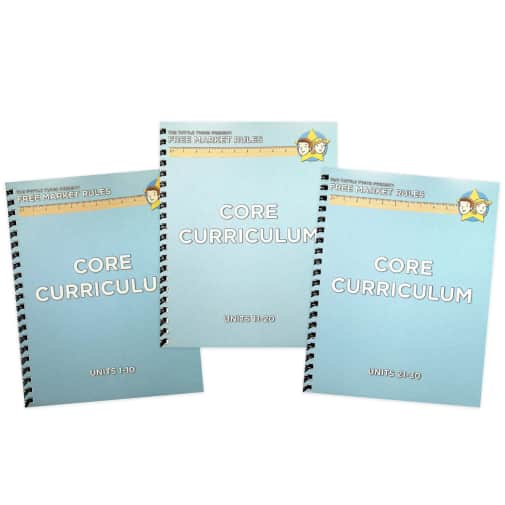
The complete set includes the three core curriculum unit books. Each book has 10 units and together they total 30 units, 120 lessons. Spiralbound. ~Amber
Free Market Rules Economics Curriculum Complete Set
SKU
FRMRKT
Grade K-12
These icons are designed to help you quickly understand and learn important information about our products.
Teaching Method
Traditional
Teacher-centered curriculum commonly used in classrooms that may include a text, teacher manual, tests, etc.
Charlotte Mason
A methodology based on the work of a 19th century educator who maintained that children learn best from literature (Living Books), not textbooks.
Classical
A methodology based on the Latin Trivium (three stages of learning), including the grammar stage (memorization and facts), logic stage (critical thinking), and rhetoric stage (developing/defending ideas).
Unit Study
A thematic or topical approach centered around one topic that integrates multiple subject areas.
Montessori (Discovery)
A methodology based on the work of a 20th century educator that emphasizes student and sensory-driven discovery learning and real-life applications.
Other
Other methodologies
Religious Content
Secular
Contains content contrary to common Christian beliefs (i.e. evolution).
Neutral
Avoids religious or theoretical topics or presents multiple viewpoints without preference.
Christian/Religious
Faith-based or including instructional religious content.
Learning Modality
Auditory
Learns through listening, talking out loud or reading out loud.
Visual
Learns through seeing, prefers written instructions and visual materials.
Kinesthetic/Tactile (Hands-On)
Learns through moving, doing and touching.
Multi-Sensory
Curriculum that employ a variety of activities/components.
Presentation
Sequential
Curriculum progresses through well-defined learning objectives. Emphasizes mastery before moving to the next topic.
Spiral
Topics and concepts are repeated from level to level, adding more depth at each pass and connecting with review.
Conceptual/Topical
Focus is on the “why,” often with a unifying concept as well as specific skills; coverage may be broader.
Teacher Involvement
Low Teacher Involvement
Student-led materials; parent acts as a facilitator.
Medium Teacher Involvement
A mix of teacher-led time and independent student work.
High Teacher Involvement
Teacher-led lessons; may utilize discussions, hands-on activities and working together.
Additional Materials Required
No other materials needed
Everything you need is included.
Other Materials Required
There are additional required resources that are a separate purchase.
Other Materials Optional
There are additional resources mentioned or recommended but are not absolutely necessary.
Consumable
Consumable
Designed to be written in; not reusable.
Non-Consumable
Not designed to be written in; reusable.
Our Price
$225.00 $225.00 $202.95
Rainbow Savings: $22.05
Description
Publisher's Description of Free Market Rules Economics Curriculum Complete Set
Our award-winning economic curriculum helps children of all ages learn about the free market. This complete set contains all 30 units, each of which has 4 lessons. So you’ll get all 120 lessons, each of which contains:
- Quick introductory content for parents to get up to speed on that week’s concept
- Lesson or activity for young children
- Lesson or activity for older children
- Discussion prompts for the entire family
- “Go deeper” material for those who want to learn even more
Each 4-week unit centers around a specific question. Here are the topics for the entire curriculum:
- Do you really need that?
- What makes something useful?
- Why can’t you always get what you want?
- Can you have your cake and eat it too?
- Why do people do what they do?
- Where does value come from?
- Where does value go?
- Why do people produce certain things?
- How does production create wealth?
- What are the costs of trade?
- How do we trade?
- What does money do?
- What should money be?
- How do we decide what to buy?
- What determines demand?
- How do we decide what to sell?
- How do supply and demand work together?
- What’s the price of time?
- How do banks work?
- What is Keynesianism?
- What can central banks do to our money?
- How do boom and bust cycles actually work?
- How does a business work?
- What is a monopoly?
- What are taxes?
- How do people from different countries trade?
- How do people invest their money?
- How do people make political decisions?
- What’s the best economic system?
- How can we use economics?
Each of our lessons are presented in a kid-friendly format so that your kids will understand the basics of free markets and specific ideas that will help them understand how the world really works!
Category Description for Tuttle Twins Free Market Rules for Economics
Free Market Rules is an engaging economics curriculum inspired by the Tuttle Twins that teaches children of all ages about the principles of the free market. Using thought-provoking questions, family discussions, and hands-on activities, it helps students understand economic concepts and their real-world implications from a Christian perspective.
The program is flexible for multi-age learning and can be
used as a high school elective when completed as a full series.
Key Curriculum Features:
- 3 books with 10 units each and 4 lessons per unit for a total of 120 lessons
- Can serve as a full-year high school economics elective when all three books are completed
- Each unit centers around a thought-provoking question (e.g., "Do you really need that?" or "What’s the best economic system?")
- Ideal for multi-age families — activities are differentiated for younger and older children with family discussion prompts
- Topics include needs vs. wants, trade, money, demand, products, banks, monopolies, taxes, Keynesianism, and more
- Consumable student pages and discussion guides for parents/teachers
- Focus on discussion and application with no answer key needed
Program Components:
- Three Student Books: Each with 10 units covering core free market principles (consumable student pages included)
- Discussion Guides: Parent/teacher prompts for family conversations and deeper exploration
Free Market Rules stands out for its family-friendly, discussion-based approach that makes economics accessible and relevant. It is an excellent choice for Christian homeschool families seeking an engaging, multi-age economics curriculum that builds understanding of free market principles.
Browse all Free Market Rules units and sets below!
Details
| Product Format: | Product Bundle |
|---|---|
| Grades: | K-12 |
| Brand: | Rainbow Resource Center |
Videos
Reviews