Art of Argument Streaming Program

SKU
ARTAGS
Grade 7-12
Teaching Method
Traditional
Teacher-centered curriculum commonly used in classrooms that may include a text, teacher manual, tests, etc.
Charlotte Mason
A methodology based on the work of a 19th century educator who maintained that children learn best from literature (Living Books), not textbooks.
Classical
A methodology based on the Latin Trivium (three stages of learning), including the grammar stage (memorization and facts), logic stage (critical thinking), and rhetoric stage (developing/defending ideas).
Unit Study
A thematic or topical approach centered around one topic that integrates multiple subject areas.
Montessori (Discovery)
A methodology based on the work of a 20th century educator that emphasizes student and sensory-driven discovery learning and real-life applications.
Other
Other methodologies
Religious Content
Secular
Contains content contrary to common Christian beliefs (i.e. evolution).
Neutral
Avoids religious or theoretical topics or presents multiple viewpoints without preference.
Christian/Religious
Faith-based or including instructional religious content.
Learning Modality
Auditory
Learns through listening, talking out loud or reading out loud.
Visual
Learns through seeing, prefers written instructions and visual materials.
Kinesthetic/Tactile (Hands-On)
Learns through moving, doing and touching.
Multi-Sensory
Curriculum that employ a variety of activities/components.
Presentation
Sequential
Curriculum progresses through well-defined learning objectives. Emphasizes mastery before moving to the next topic.
Spiral
Topics and concepts are repeated from level to level, adding more depth at each pass and connecting with review.
Conceptual/Topical
Focus is on the “why,” often with a unifying concept as well as specific skills; coverage may be broader.
Teacher Involvement
Low Teacher Involvement
Student-led materials; parent acts as a facilitator.
Medium Teacher Involvement
A mix of teacher-led time and independent student work.
High Teacher Involvement
Teacher-led lessons; may utilize discussions, hands-on activities and working together.
Additional Materials Required
No other materials needed
Everything you need is included.
Other Materials Required
There are additional required resources that are a separate purchase.
Other Materials Optional
There are additional resources mentioned or recommended but are not absolutely necessary.
Consumable
Consumable
Designed to be written in; not reusable.
Non-Consumable
Not designed to be written in; reusable.
Our Price
$132.95 $132.95 $110.95
Rainbow Savings: $22.00
Package Contents
Art of Argument Streaming Program
SKU
ARTAGS
Grade 7-12
Our Price
$132.95 $132.95 $110.95
Rainbow Savings: $22.00

Description

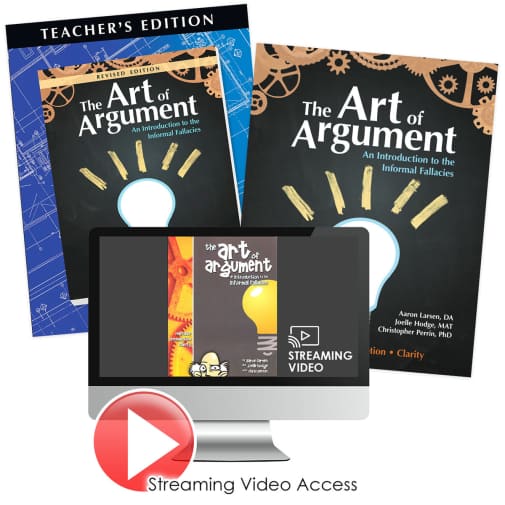
This complete set includes the Student Book, the Teacher’s Edition, and the Streaming Video.

NOTE: You will receive an email with your access information from Rainbow Resource Center in 1-2 business days after your order is placed. 

Publisher's Description of Art of Argument Streaming Program
Middle and high school students will argue (and sometimes quarrel), but they won’t argue well without good training. Students who complete The Art of Argument will learn how to reason with clarity, relevance, and purpose . . . and will have fun along the way! Informal logic is a foundational subject by which other subjects are evaluated, assessed, and learned. Therefore, students' study and mastery of the 28 logical fallacies will provide an essential lifetime framework for filtering good and bad reasoning as well as writing and speaking effectively. 

Full program includes:

    • The Art of Argument (consumable student edition) This newly revised book teaches 28 informal fallacies, such as begging the question, the straw man, ad hominem, etc. Comprehensive instruction, clear explanations and illustrations, along with dialogues, worksheets, and dialectic discussion questions, make this text easy to follow and make the fallacies fun to learn. The fallacies become relevant with practical applications through an analysis of current social, commercial, and political issues, as well as nearly 60 comical and clever phony advertisements. Fun extras are included, such as a humorous skit for students to perform and the famous short story “Love Is a Fallacy” by Max Shulman.  *Please note: The revised version is not compatible with the older version.
    • The Art of Argument Teacher's Edition This edition contains all of the content from The Art of Argument student, along with answer keys, teaching tips, and invaluable chapter and unit tests. However, it is not compatible with the older version. *Please note: The Art of Argument Teacher's Edition does not include a chapter 2 test. To rectify this error, we created a digital packet that contains all the tests and quizzes you'll need to complete the class. This downloadable PDF will be included with your purchase of the Teacher’s Edition and accessible in your My Library account.
    • The Art of Argument Streaming Video Compatible with our newly revised books, this video series features 3 experienced logic teachers and 4 capable, engaged students discussing each fallacy presented in The Art of Argument. Each video segment features one fallacy, which is presented, defined, and then discussed and explored using a blend of enthusiasm, contemplation, and humor. Each discussion seeks to make a practical application of the fallacy to student life, advertisements, political speech, or various kinds of ethical and philosophical debates. The streaming option provides the convenience of instant access, as well as desktop, smart TV, and mobile viewing capabilities. For Homeschoolers, streaming access lasts for the life of the product.
Category Description for Art of Argument

Socrates is the "go to" person when it comes to fallacies (occurrence of bad or incorrect reasoning) and his perspective on the three basic categories - fallacies of irrelevance (points that don't relate to the issue), of presumption (assumptions that are not justified or necessary), and of clarity (language that confuses and muddies) - is sought via time-travel. Several examples of each are provided plus the student has the opportunity to identify fallacies in cleverly fabricated magazine advertisements. Fallacies are printed on the inside covers of the Student Text for easy reference. Both Student and TE (each about 230 pgs, pb) have appendices that include a play and a short story that illustrate fallacies as well as a Glossary and Bibliography. TE includes reproducible chapter, unit, and final exams (with answer key). DVDs include 28 sessions (one for each fallacy) in which three teachers and 4 students present, define, discuss and explain the fallacy. As in the text, the DVDs emphasize a practical application to the student's life through advertisements, political speeches, and various moral/ethical debates.

Details
More Information
Product Format:Product Bundle
Grades:7-12
Brand:Rainbow Resource Center
Videos
This product doesn't have a video
Reviews
Product Q&A