
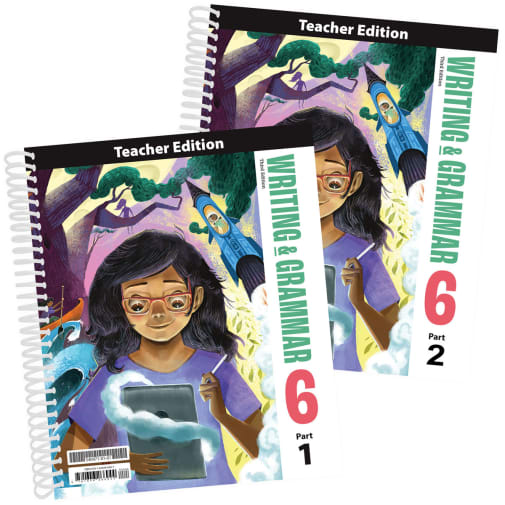
BJU Writing & Grammar Grade 6 Teacher Edition Parts 1 & 2 include instruction for 180 lessons divided into fifteen chapters (seven grammar chapters, two research chapters, and six writing chapters). Reduced student pages with answers along with a helpful lesson plan overview for each unit are also provided. Teaching instruction is very thorough and includes a four-step process (Engage – activate prior knowledge; Instruct – discussion time; Apply – practice skills learned; Assess – evaluate understanding through quizzes and tests). Supplemental exercise answers and instructional aids (including writing rubrics) are in the back of the teacher editions. HomeschoolHub.com also offers free digital resources.
BJU Press Writing & Grammar 6 Teacher Edition 3rd Edition
SKU
540971
ISBN
9781646266944
Grade 6
These icons are designed to help you quickly understand and learn important information about our products.
Teaching Method
Traditional
Teacher-centered curriculum commonly used in classrooms that may include a text, teacher manual, tests, etc.
Charlotte Mason
A methodology based on the work of a 19th century educator who maintained that children learn best from literature (Living Books), not textbooks.
Classical
A methodology based on the Latin Trivium (three stages of learning), including the grammar stage (memorization and facts), logic stage (critical thinking), and rhetoric stage (developing/defending ideas).
Unit Study
A thematic or topical approach centered around one topic that integrates multiple subject areas.
Montessori (Discovery)
A methodology based on the work of a 20th century educator that emphasizes student and sensory-driven discovery learning and real-life applications.
Other
Other methodologies
Religious Content
Secular
Contains content contrary to common Christian beliefs (i.e. evolution).
Neutral
Avoids religious or theoretical topics or presents multiple viewpoints without preference.
Christian/Religious
Faith-based or including instructional religious content.
Learning Modality
Auditory
Learns through listening, talking out loud or reading out loud.
Visual
Learns through seeing, prefers written instructions and visual materials.
Kinesthetic/Tactile (Hands-On)
Learns through moving, doing and touching.
Multi-Sensory
Curriculum that employ a variety of activities/components.
Presentation
Sequential
Curriculum progresses through well-defined learning objectives. Emphasizes mastery before moving to the next topic.
Spiral
Topics and concepts are repeated from level to level, adding more depth at each pass and connecting with review.
Conceptual/Topical
Focus is on the “why,” often with a unifying concept as well as specific skills; coverage may be broader.
Teacher Involvement
Low Teacher Involvement
Student-led materials; parent acts as a facilitator.
Medium Teacher Involvement
A mix of teacher-led time and independent student work.
High Teacher Involvement
Teacher-led lessons; may utilize discussions, hands-on activities and working together.
Additional Materials Required
No other materials needed
Everything you need is included.
Other Materials Required
There are additional required resources that are a separate purchase.
Other Materials Optional
There are additional resources mentioned or recommended but are not absolutely necessary.
Consumable
Consumable
Designed to be written in; not reusable.
Non-Consumable
Not designed to be written in; reusable.
Our Price
$96.11 Product Overview
- Includes detailed instruction for teaching writing and grammar lessons
- Includes a reduced copy of the student worktext with answers
- Additional instructional aids are found in the back of the Teacher Edition
Description
Publisher's Description of BJU Press Writing & Grammar 6 Teacher Edition 3rd Edition
The Teacher Edition provides clear instructions for teaching writing and grammar well. This TE includes a variety of teaching strategies that you can use to bring learning to life. In addition to this, learning targets are included in each chapter, so you can easily keep track of your student’s progress.
Key Features of the Teacher Edition- Differentiated instruction boxes that you can use if your student is struggling or an ESL learner
- Writing Rubrics so you can easily grade your student’s assignments
- Learning targets to easily keep track of your student’s progress
- Ideas for Writer’s Notebook for fun writing activities
- Biblical worldview shaping themes in each chapter to bring your student to a deeper understanding of God’s hand in all things, including grammar and writer
Category Description for BJU Press Writing & Grammar 6 (3rd Edition)
BJU Writing & Grammar 6 (3rd Edition) includes 15 reorganized chapters that integrate Biblical Worldview Shaping into the lessons. Students learn to write and speak effectively, creating informative, persuasive, narrative, and poetry papers. Students also apply research strategies with print and digital sources. This edition has stronger differentiated instruction and shorter writing assignments to allow more time for students to revise their written texts. The 3rd edition is not compatible with older editions.
Details
| Product Format: | Paperback Book |
|---|---|
| Grade: | 6 |
| Brand: | BJU Press |
| ISBN: | 9781646266944 |
| Length in Inches: | 11 |
| Width in Inches: | 11 |
| Height in Inches: | 1.5 |
| Weight in Pounds: | 3.75 |
Videos
Reviews