
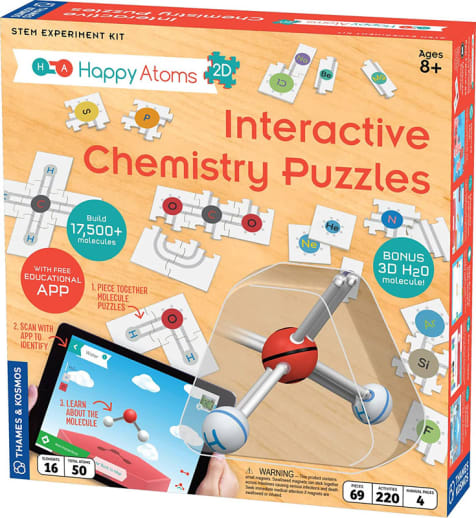

What an affordable introduction to the world of molecules! Containing 50 puzzle pieces to represent 16 elements, this 2D Kit uses cardboard puzzle pieces to help kids explore the complex world of atoms and molecules. Along with the puzzle pieces, kit includes a 3D H20 molecule, Quick Start Guide, and access to the Happy Atoms app with image activation software. With 220 activities, children will gain a solid understanding of chemistry fundamentals. Contains magnets. App compatible with Android, iPhone and Kindle devices.
Happy Atoms 2D: Interactive Chemistry Puzzle
SKU
083972
Grade 3-7
These icons are designed to help you quickly understand and learn important information about our products.
Teaching Method
Traditional
Teacher-centered curriculum commonly used in classrooms that may include a text, teacher manual, tests, etc.
Charlotte Mason
A methodology based on the work of a 19th century educator who maintained that children learn best from literature (Living Books), not textbooks.
Classical
A methodology based on the Latin Trivium (three stages of learning), including the grammar stage (memorization and facts), logic stage (critical thinking), and rhetoric stage (developing/defending ideas).
Unit Study
A thematic or topical approach centered around one topic that integrates multiple subject areas.
Montessori (Discovery)
A methodology based on the work of a 20th century educator that emphasizes student and sensory-driven discovery learning and real-life applications.
Other
Other methodologies
Religious Content
Secular
Contains content contrary to common Christian beliefs (i.e. evolution).
Neutral
Avoids religious or theoretical topics or presents multiple viewpoints without preference.
Christian/Religious
Faith-based or including instructional religious content.
Learning Modality
Auditory
Learns through listening, talking out loud or reading out loud.
Visual
Learns through seeing, prefers written instructions and visual materials.
Kinesthetic/Tactile (Hands-On)
Learns through moving, doing and touching.
Multi-Sensory
Curriculum that employ a variety of activities/components.
Presentation
Sequential
Curriculum progresses through well-defined learning objectives. Emphasizes mastery before moving to the next topic.
Spiral
Topics and concepts are repeated from level to level, adding more depth at each pass and connecting with review.
Conceptual/Topical
Focus is on the “why,” often with a unifying concept as well as specific skills; coverage may be broader.
Teacher Involvement
Low Teacher Involvement
Student-led materials; parent acts as a facilitator.
Medium Teacher Involvement
A mix of teacher-led time and independent student work.
High Teacher Involvement
Teacher-led lessons; may utilize discussions, hands-on activities and working together.
Additional Materials Required
No other materials needed
Everything you need is included.
Other Materials Required
There are additional required resources that are a separate purchase.
Other Materials Optional
There are additional resources mentioned or recommended but are not absolutely necessary.
Consumable
Consumable
Designed to be written in; not reusable.
Non-Consumable
Not designed to be written in; reusable.
Description
Publisher's Description of Happy Atoms 2D: Interactive Chemistry Puzzle
Making sense of the world of atoms and molecules is now as easy as piecing together a jigsaw puzzle! Now you can use Happy Atoms, the revolutionary chemistry teaching tool, in a low-cost, two-dimensional jigsaw-puzzle-style edition. In this version, the three-dimensional plastic atoms have been replaced with flat, cardboard puzzle pieces. Just like in the original versions, you can build more than 17,000 molecules by combining the atoms of 16 elements and scanning them with the app to identify the molecules and learn about them. This kit comes with the same full-featured version of the Happy Atoms app that comes with the original versions of Happy Atoms. Bonus: Includes a sample 3D Happy Atoms water molecule — H2O!
Using the Happy Atoms app and the camera on your tablet or smartphone running iOS or Android, you can scan the molecules you piece together. The app then uses state-of-the-art image recognition technology to identify the molecules. After a molecule is discovered, the app presents information about it, including its composition, usage, properties, hazards, formula, and structure. The app can recognize more than 17,000 molecules. It presents in-depth information about 160 molecules and general information about the rest. This app is a fun and interactive chemistry curriculum. It takes you on guided quests to discover new molecules and learn about them. You can track your progress with the app, collecting sets of molecules that you have built and explored.
Category Description for Happy Atoms
I've never seen an introduction to atoms and molecules quite like this one. Great for middle school and beyond, students will learn about atoms and properties of atoms, molecules, bonding, and much more.
The Complete Kit includes 50 atoms - 14 hydrogen, 1 helium, 2 lithium, 2 beryllium, 6 carbon, 3 nitrogen, 6 oxygen, 2 fluorine, 1 neon, 2 sodium, 2 magnesium, 2 silicon, 2 phosphorus, 2 sulfur, 2 chlorine, and 1 argon. It also includes a periodic table (truncated with only 16 elements or atoms), white drawstring bag for storage, guide and over 200 activities.
The Atoms and Molecules Introductory Set includes 17 atoms - 8 hydrogen, 3 carbon, 2 oxygen, 2 nitrogen, 1 chlorine, and 1 sodium, and a 16-page guide and 73 activities.
To use these products to the fullest extent, you need the Happy Atoms App, found on the App Store (for Apple products) or the Google Play Store (for Android products). I downloaded the app to my iPhone to try out this product - oh what fun! Ramsey (almost 6) and I built molecules from the atoms in the kit and snapped their pictures. After capturing the molecule image, we tapped on each atom, which placed a marker or target on the image. We scanned the image, then synthesized it to see a virtual representation of our molecule with identification. We touched the "examine" icon to see the name of our molecule, the atoms that construct it, the type of bond, molecular geometry, state of matter, use or application, and the breakdown of our molecule's name. As we built and scanned our molecules, we filled our molecule map. The map also gave 'hints' to guide us to our next atom-building project - there are 150 molecules on the map. Activities can also be completed by entering the labs of Harper and Andee, the animated chemist who guides through activities!
Atoms connect together magnetically to represent bonding and to form molecules. Each atom sphere has strategically placed magnetic spots for attachment of the flexible rubbery arms protruding from some of the spheres. At the end of each arm is a magnetic tip that represents valence electrons.
This would be a great visual for high school students taking physical science/chemistry. Since this is a great kinesthetic way to learn about and understand atoms, molecules, bonding, etc., with adult supervision, middle or even younger students would have a fun, unique introduction. Atoms are happiest when they are connecting with other atoms. Obviously, there are far more molecules than those identified with this program, but what an awesome introduction! ~ Donna
Details
| Product Format: | Other |
|---|---|
| Grades: | 3-7 |
| Brand: | Thames and Kosmos |
| EAN/UPC: | 814743015821 |
| Length in Inches: | 9.5 |
| Width in Inches: | 9.25 |
| Height in Inches: | 3 |
| Weight in Pounds: | 0.9 |
Videos
Reviews