These icons are designed to help you quickly understand and learn important information about our products.
Teaching Method
Traditional
Teacher-centered curriculum commonly used in classrooms that may include a text, teacher manual, tests, etc.
Charlotte Mason
A methodology based on the work of a 19th century educator who maintained that children learn best from literature (Living Books), not textbooks.
Classical
A methodology based on the Latin Trivium (three stages of learning), including the grammar stage (memorization and facts), logic stage (critical thinking), and rhetoric stage (developing/defending ideas).
Unit Study
A thematic or topical approach centered around one topic that integrates multiple subject areas.
Montessori (Discovery)
A methodology based on the work of a 20th century educator that emphasizes student and sensory-driven discovery learning and real-life applications.
Other
Other methodologies
Religious Content
Secular
Contains content contrary to common Christian beliefs (i.e. evolution).
Neutral
Avoids religious or theoretical topics or presents multiple viewpoints without preference.
Christian/Religious
Faith-based or including instructional religious content.
Learning Modality
Auditory
Learns through listening, talking out loud or reading out loud.
Visual
Learns through seeing, prefers written instructions and visual materials.
Kinesthetic/Tactile (Hands-On)
Learns through moving, doing and touching.
Multi-Sensory
Curriculum that employ a variety of activities/components.
Presentation
Sequential
Curriculum progresses through well-defined learning objectives. Emphasizes mastery before moving to the next topic.
Spiral
Topics and concepts are repeated from level to level, adding more depth at each pass and connecting with review.
Conceptual/Topical
Focus is on the “why,” often with a unifying concept as well as specific skills; coverage may be broader.
Teacher Involvement
Low Teacher Involvement
Student-led materials; parent acts as a facilitator.
Medium Teacher Involvement
A mix of teacher-led time and independent student work.
High Teacher Involvement
Teacher-led lessons; may utilize discussions, hands-on activities and working together.
Additional Materials Required
No other materials needed
Everything you need is included.
Other Materials Required
There are additional required resources that are a separate purchase.
Other Materials Optional
There are additional resources mentioned or recommended but are not absolutely necessary.
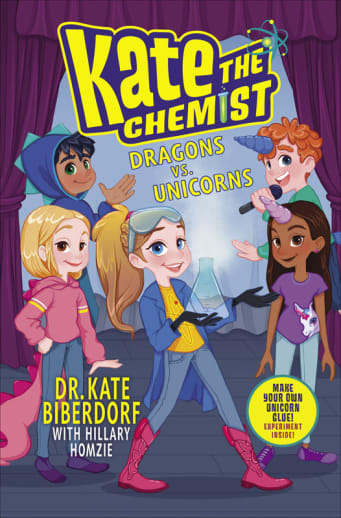
Kate’s school is putting on a magical musical, and Kate is chosen as the
assistant director and her best friend as the lead unicorn! But when someone
starts sabotaging the show, will Kate and science be able to save the day? With
short chapters, easy-to-read text, and fun black-and-white embellishments, this
book is excellent for any aspiring scientist or for any student who might
benefit from exposure to science in a more casual format. Throughout the story,
basic scientific principles are explained in brief, kid-friendly language, and
the start of each chapter includes a definition of a scientific term. At the
end of the book are instructions for making your own unicorn glue at home.
Written by Dr. Kate Biberoff, a science professor who also holds the position
of Professor for the Public Understanding of Science at University of Notre
Dame.
Publisher's Description of Kate the Chemist: Dragons vs. Unicorns
Kate the Chemist is a ten-year-old science problem solver. There’s no problem Kate can’t fix! When her best friend, Birdie, is cast as the lead unicorn in their school’s musical Dragons vs. Unicorns, and Kate is chosen to be the assistant director, they agree this is going to be the best musical EVER! Kate is a natural assistant director; like all good scientists, she’s smart and organized, but she also comes up with great ideas. But when everything starts going wrong with the musical and Kate realizes someone is sabotaging the show, will her special science sleuthing skills help save the day–and the show?
Follow ten-year-old Kate and her best friend Birdie through this engaging series of readers. Kate finds science in all things, especially chemistry, while Birdie is an artist at heart. The books are hardcover, and each story is introduced by the grown-up Dr. Kate Biberdorf. All of the books present a problem, ask you to make a prediction, then follow the tale to see if your hypothesis was correct. There is a chemistry lab activity at the end of each story you can do with adult supervision. Edible Experiments is a cookbook where you can compare 2 versions of a recipe!