These icons are designed to help you quickly understand and learn important information about our products.
Teaching Method
Traditional
Teacher-centered curriculum commonly used in classrooms that may include a text, teacher manual, tests, etc.
Charlotte Mason
A methodology based on the work of a 19th century educator who maintained that children learn best from literature (Living Books), not textbooks.
Classical
A methodology based on the Latin Trivium (three stages of learning), including the grammar stage (memorization and facts), logic stage (critical thinking), and rhetoric stage (developing/defending ideas).
Unit Study
A thematic or topical approach centered around one topic that integrates multiple subject areas.
Montessori (Discovery)
A methodology based on the work of a 20th century educator that emphasizes student and sensory-driven discovery learning and real-life applications.
Other
Other methodologies
Religious Content
Secular
Contains content contrary to common Christian beliefs (i.e. evolution).
Neutral
Avoids religious or theoretical topics or presents multiple viewpoints without preference.
Christian/Religious
Faith-based or including instructional religious content.
Learning Modality
Auditory
Learns through listening, talking out loud or reading out loud.
Visual
Learns through seeing, prefers written instructions and visual materials.
Kinesthetic/Tactile (Hands-On)
Learns through moving, doing and touching.
Multi-Sensory
Curriculum that employ a variety of activities/components.
Presentation
Sequential
Curriculum progresses through well-defined learning objectives. Emphasizes mastery before moving to the next topic.
Spiral
Topics and concepts are repeated from level to level, adding more depth at each pass and connecting with review.
Conceptual/Topical
Focus is on the “why,” often with a unifying concept as well as specific skills; coverage may be broader.
Teacher Involvement
Low Teacher Involvement
Student-led materials; parent acts as a facilitator.
Medium Teacher Involvement
A mix of teacher-led time and independent student work.
High Teacher Involvement
Teacher-led lessons; may utilize discussions, hands-on activities and working together.
Additional Materials Required
No other materials needed
Everything you need is included.
Other Materials Required
There are additional required resources that are a separate purchase.
Other Materials Optional
There are additional resources mentioned or recommended but are not absolutely necessary.
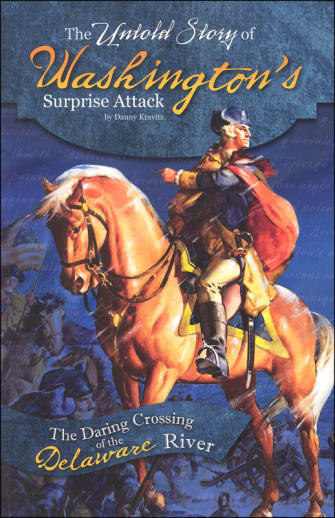
This reading selection would be a great addition to any history unit covering the Revolutionary War. Follow George Washington’s rise to fame as he commands the patriots through the War for Independence. Learn about what led to the turning point in morale for the colonies in the war, at the crossing of the Delaware. Filled with early life factoids of Washington’s life, maps of battle plans, and works of art. Also, great life lessons on how retreats can lead to victories and how to see the big picture rather than just the battle raging in the moment. The last few pages are dedicated to a timeline, further reading selections, internet fact sites, critical thinking questions, as well as a glossary and index. Within the readings are direct quotes taken from letters and journals of Washington. Pgs. 64 | pb ~Rebecca
Publisher's Description of Untold Story of Washington's Surprise Attack
General George Washington's crossing of the Delaware River lives on in a famous painting, but the unforgettable true story of that night is unfamiliar to many people. Washington's daring act boosted sagging morale, shocked the British, and convinced potential allies such as France that the Americans meant business.
As you are working through your early American history lessons, add on some additional readers about some key people, battles, and regiments from the Revolutionary War. These brief and informational books are full of notable pieces of artwork, pages from primary source journals and letters, and plenty of "Did you Know" factoids. There is shared information between each book, yet each book is specific to its topic. There is no intended order for reading these books and so they are easy to just pick up and read. Utilize the books for your vocab or spelling activities as each is equipped with its own glossary. The texts also include timelines, source notes, bibliographies, and additional readings. Get a glimpse of early colonial life through these books and engage with history through the words of famous founding fathers. ~Rebecca