
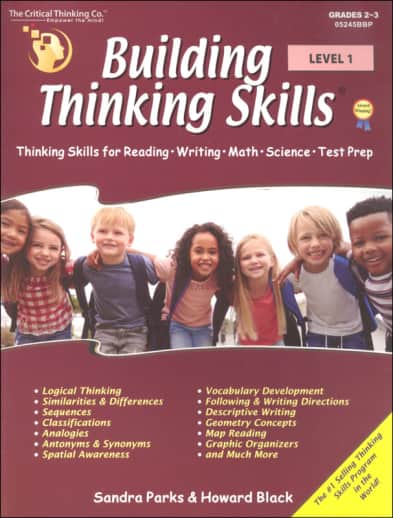

Recently updated, Building Thinking Skills Level 1 offers revised activities with freshly updated colorful images, while retaining it's effective and comprehensive coverage of verbal and nonverbal reasoning skills. Lessons cover describing and comparing shapes and figures, diagrams (including Venn), mental patterns, directionality, analogies, graphic organizers, spelling and vocabulary, writing, following directions, deductive and inductive reasoning, auditory memory, and more. Developmentally sequenced, the activities build from semi-concrete to abstract verbal forms, but equally important, they are fun, engaging and visually appealing! A win-win for younger learners. New editions are not compatible with the previous edition. Answers included in the back of the book. Reproducible for family or single classroom use. ~Deanne
Building Thinking Skills Level 1 Grades 2-3
Description
This engaging 320-page book develops the critical thinking skills necessary for success in reading, writing, math, science, social studies, and standardized tests in Grades 2-3. The Building Thinking Skills® series is the bestselling thinking skills program in the world! The engaging, highly-effective activities are developmentally sequenced. Each skill (for example, classifying) is presented first in the semi-concrete, figural-spatial form and then in the abstract verbal form. Students also learn important academic vocabulary, concepts, and skills as they analyze relationships between objects, between words, and between objects and words by: Observing, recognizing, and describing characteristics; Distinguishing similarities and differences; and Identifying and completing sequences, classifications, and analogies
These processes help students develop superior thinking and communication skills that lead to deeper content learning in all subjects.
Use after completion of Primary book or as soon as children can read (or you can read directions to them). Strictly pencil and paper activities here with practice in such things as identifying figural and verbal similarities and differences, sequencing, classifying, developing analogies, following directions and logical connectives (AND, OR). Answers included. 363 pgs. Revised in 2006.
An optional Teacher CD is also available. It contains the full text of the Teacher's Edition in PDF format. Although answers are already included in the worktext, the Teacher CD also features objectives, focus questions and additional background information for the teacher.
The software version features the same activities in an interactive format. There are 10 levels of activities, and players can choose from "mission" mode where they complete activities in order or "practice" mode for review. Approximately 40 activities are included in the software, with over 800 questions in all. Instructions are both spoken and written. System requirements: Windows 98/NT/Me/2000/XP/Vista or Mac OS X (10.3+), PowerPC. 128 MB RAM for either.
| Product Format: | Paperback |
|---|---|
| Grades: | 2-4 |
| Brand: | Critical Thinking Company |
| ISBN: | 9781601449948 |
| Length in Inches: | 11 |
| Width in Inches: | 8.5 |
| Height in Inches: | 0.875 |
| Weight in Pounds: | 2.2 |