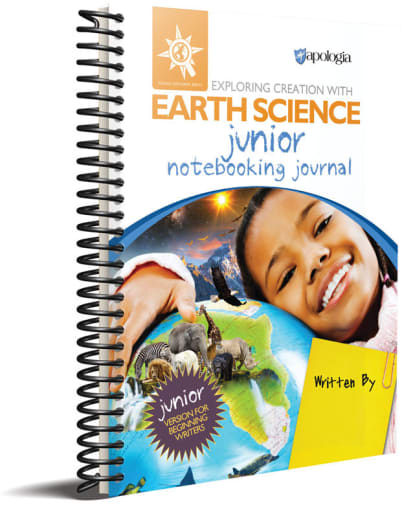
Exploring Creation with Earth Science Junior Notebooking Journal
Description
A perfect complement to Exploring Creation with Earth Science, the Earth Science Junior Notebooking Journal provides everything your student needs to complete this study of earth science. The Junior Notebooking Journals can be used with multiple ages within a family with great ease. The Junior Notebooking Journals are specifically designed with the elementary student in mind. They are fun and interactive with an abundance of colorful, hands-on activities to add to your child's excitement with science. This Junior Notebooking Journal will serve as your child's individual notebook, providing a place for them to complete every assignment in the text. Each lesson begins with a coloring page for the student to color while he or she listens to the reading of the text. These pages provide opportunities for active learning while reinforcing the lesson's content. Following are pages with templates designed to encourage creative expression and written narration. The student can illustrate what they've learned and write a sentence or two about the topic. Next, the student is given the opportunity to work with and learn key vocabulary words presented in the text. Also included are helpful and easy-to-follow graphics, engaging mini-books, areas for creative writing, crosswords, and much more. These learning activities are not only interesting, but they also increase the student's retention of both the important terms and the subject matter presented in the lessons. To make planning a breeze, a detailed schedule is included in the Notebooking Journal and Junior Notebooking Journal. This schedule lists the pages to read in the textbook and the pages to complete in the journal.
The Benefits of Using the Junior Notebooking Journal
Keeping a scientific notebook has always been standard scientific practice. Apologia's Junior Notebooking Journals have been designed to:
- Facilitate retention and provide documentation of your student's education. The unique personal written and artistic expressions incorporate both sides of the brain
- Be flexible and allow for multilevel learning. A twelve-year-old student may write an essay and make an elaborate illustration, while a six-year-old may write one sentence with a stick-figure drawing
- Help students record experiences, observations, and thoughts
- Engage students in the scientific process
- Provide a written history that students can reference as they explore new subject areas
- Give your student a place where they can record and organize experiences and observations
- Provide a place to review their notes to create opinions and draw conclusions about the way their world works
Apologia Science courses are written from a Biblical worldview with the homeschool in mind. At the elementary level, courses follow a Charlotte Mason-inspired methodology, with lessons organized around narration, notebooking exercises and hands-on activities or projects. Children at different ages can use these together, learning at their own level. Each course is designed to be teacher-student interactive, so teacher involvement is fairly high at this level. At the junior high and high school levels, science courses are more traditional in nature, with the textbook written to the student. Teacher involvement time at this level is much less than at the elementary level. Textbooks contain student reading, lab instructions, "On Your Own" questions and Study Guide questions. A Solutions Manual provides the answers to these and the test questions. Lab kits are available separately for both the elementary and upper-level science courses which include most of the harder to find items you will need.
| Product Format: | Paperback |
|---|---|
| Grades: | K-3 |
| Brand: | Apologia |
| ISBN: | 9781946506740 |
| Length in Inches: | 11 |
| Width in Inches: | 9.25 |
| Height in Inches: | 1 |
| Weight in Pounds: | 2 |