
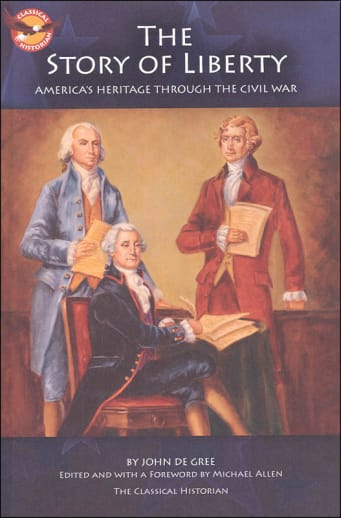
The Reader (i.e. Text) from its beginning chapters on America's ancient and medieval heritage sets the stage for a thorough narrative of colonization, the War for Independence, the constitution, the early years of the nation, beginning government, western expansion (manifest destiny), growing sectionalism, the slavery crisis, and the resultant Civil War. With the goal of providing a "sensible account, the text relates the many good qualities and accomplishments of our nation as well as the setbacks we have endured during our long history. 288 pgs, pb.
Story of Liberty: America's Heritage Through the Civil War
SKU
073307
ISBN
9781725981591
Grade 6-AD
Classical
Neutral
High Teacher Involvement
Visual
Other Materials Required
These icons are designed to help you quickly understand and learn important information about our products.
Teaching Method
Traditional
Teacher-centered curriculum commonly used in classrooms that may include a text, teacher manual, tests, etc.
Charlotte Mason
A methodology based on the work of a 19th century educator who maintained that children learn best from literature (Living Books), not textbooks.
Classical
A methodology based on the Latin Trivium (three stages of learning), including the grammar stage (memorization and facts), logic stage (critical thinking), and rhetoric stage (developing/defending ideas).
Unit Study
A thematic or topical approach centered around one topic that integrates multiple subject areas.
Montessori (Discovery)
A methodology based on the work of a 20th century educator that emphasizes student and sensory-driven discovery learning and real-life applications.
Other
Other methodologies
Religious Content
Secular
Contains content contrary to common Christian beliefs (i.e. evolution).
Neutral
Avoids religious or theoretical topics or presents multiple viewpoints without preference.
Christian/Religious
Faith-based or including instructional religious content.
Learning Modality
Auditory
Learns through listening, talking out loud or reading out loud.
Visual
Learns through seeing, prefers written instructions and visual materials.
Kinesthetic/Tactile (Hands-On)
Learns through moving, doing and touching.
Multi-Sensory
Curriculum that employ a variety of activities/components.
Presentation
Sequential
Curriculum progresses through well-defined learning objectives. Emphasizes mastery before moving to the next topic.
Spiral
Topics and concepts are repeated from level to level, adding more depth at each pass and connecting with review.
Conceptual/Topical
Focus is on the “why,” often with a unifying concept as well as specific skills; coverage may be broader.
Teacher Involvement
Low Teacher Involvement
Student-led materials; parent acts as a facilitator.
Medium Teacher Involvement
A mix of teacher-led time and independent student work.
High Teacher Involvement
Teacher-led lessons; may utilize discussions, hands-on activities and working together.
Additional Materials Required
No other materials needed
Everything you need is included.
Other Materials Required
There are additional required resources that are a separate purchase.
Other Materials Optional
There are additional resources mentioned or recommended but are not absolutely necessary.
Consumable
Consumable
Designed to be written in; not reusable.
Non-Consumable
Not designed to be written in; reusable.
Our Price
$24.99 Description
Publisher's Description of Story of Liberty: America's Heritage Through the Civil War
This book is part of a series devoted to teaching the story of liberty throughout history. Liberty means at least two things: having freedom to and having freedom not to. A goal of liberty is to provide maximum development of an individual's capacity to be human, to love, to think, to choose to be charitable, to believe in God and follow a religion or not to, to start and run a business, to have a family or to choose not to. It is the freedom an individual has to live his life to its full potential. The story of liberty is as old as the human race, and for much of our world's history, including today, the great majority of people have not lived in liberty. Only recently, within the last few hundred years, have some people enjoyed a great deal of this freedom.
In modern times, the United States of America has been the leader of liberty. This is why France gave the Statue of Liberty to the United States in the 1800s. It is why immigrants have come first to the United States of America, over other countries, since its inception in 1776. It is the reason that, even though the United States trails China and India in population by about 1.3 billion to 325 million, the U.S. has the greatest economy on Earth. Liberty is a universal idea that continues to fill the hearts and minds of people around the world.
The American Founding Fathers defined liberty in the American founding documents, the Declaration of Independence and the Constitution. Like John Locke before him, Thomas Jefferson believed liberty rested on the principles that "all men are created equal," and "that they are endowed by their Creator with certain unalienable Rights, that among these are Life, Liberty, and the pursuit of Happiness." The founders believed that the rights of Americans rested on the idea that the Creator formed man with rights that no government had the authority to remove. God existed as the authority above government, above man, and the government was always subject to uphold and defend the rights given to man by the Creator. Jefferson and the other Founders fought Great Britain to establish a limited government so that individuals would have maximum freedom.
In the Constitution, liberty is defined in the Bill of Rights, the first ten amendments. The First Amendment guarantees the right to free speech, freedom of the press, religious freedom, and the right to assemble. The founders were very concerned about freedom of political speech, meaning the right to campaign or financially support the candidate of one's choice without limitation. They wanted to make sure that government would never become so strong that it would limit Americans' ability to participate in politics. Regarding freedom of religion, the founders wanted to make sure the government would not enforce a state religion, however, at the same time, they wanted Americans to never be limited in their practice of religious worship. There are other important rights in the first ten amendments, such as the right to bear arms, and the right to be free from unreasonable searches and seizures. However, the main point of the Bill of Rights was to make sure that government would never take away the liberty of Americans.
The story of liberty is the story of Western Civilization. It begins with early man, develops over the centuries, and in many ways, it comes to fruition with the birth of America. In ancient times, most humans on Earth believed in many gods; leaders imposed unfair laws on their subjects; and life was short and miserable for those without power. Unfortunately, this remains the case in some places today. However, about 4,000 years ago, the Hebrews believed in one God, in justice, and in morality, regardless of the circumstance of one's birth. Then, around 2,500 years ago, the ancient Athenians created democracy, the idea that citizens had the right to vote for their leaders and laws and not be subject to a king. At about the same time, the Romans established a republic. Citizens had rights the government had to respect. As the Roman Republic spread, liberty decreased. In 27 B.C., the Roman Empire arose and the liberties people had under the Roman Republic greatly diminished. However, within the Roman Empire, Jesus Christ established a new religious belief where God loved everyone in an equal manner. For the first time in history, a religion offered salvation to all people, not just people of a certain nationality or tribe. This religious understanding of equality under God was transformed over time into the idea that all people should be treated the same by the law. And thus, Thomas Jefferson wrote, "all men are created equal."
The story of liberty in America has not been a perfect one. From 1776 to 1865, slavery was legal in half of the country. How could a person have liberty if he were owned by another person? In addition, women were not allowed to vote and did not have the same property rights as men. From 1861-1865, Americans fought their greatest war, the Civil War, which resolved this paradox of liberty and slavery. Though it took 89 years, the rights Jefferson spoke about in the Declaration of Independence finally did spread to all men, black and white. In addition, throughout the 1800s and early 1900s, the political rights of women expanded to be equal with men. However, liberty in America is still not perfect. It remains today an ideal that Americans strive for.
This volume of history is the story of liberty, specifically as it relates to American history. It traces the influence of ancient and medieval civilizations on the establishment and development of the United States of America through the Civil War. It is written with the hope that young Americans will appreciate the uniqueness of America as a leader of liberty. It is these young people who are called to further the cause of liberty within our country and throughout the world.
Category Description for Classical Historian American History
From the Classical Historian, this program for middle and high school students has the goal of not only learning the history content but also how to read various history sources, to debate, to listen to others, to engage in Socratic discussions, to become a lifelong learner, and to practice the skills of partially and diligently searching for the truth in history. From its classical roots (Hebrew, Greek, Roman, and Western European), this examination of America's Heritage places a special emphasis on her place in the history of the advancing western civilization. The Reader provides the historical narrative while the Teacher and Student books cover vocabulary, important terms/people, reading comprehension/inference questions, geography, and timelines as well as a thorough exploration of the tools of the historian (determining fact or opinion, judgment, supporting evidence) through short essay questions, multiple choice questions, written essays, and Socratic discussions.
The Reader (i.e. Text) from its beginning chapters on America's ancient and medieval heritage sets the stage for a thorough narrative of colonization, the War for Independence, the constitution, the early years of the nation, beginning government, western expansion (manifest destiny), growing sectionalism, the slavery crisis, and the resultant Civil War. With the goal of providing a "sensible" account, the text relates the many good qualities and accomplishments of our nation as well as the setbacks we have endured during our long history.
The consumable Student Worktext provides a guide through the reading chapters with sections covering the grammar (what you need to know), the logic (reading comprehension and inference questions), and the rhetoric (short answer questions) of each chapter along with map work. Unit activities delve more deeply into the thinking and writing tools of the historian (source analysis, research, and written papers). The Teacher Editions include copies of all student pages (with answers filled in) along with teacher notes, grading instructions/rubrics, and possible answers to open-ended questions.
Reader/Text, 288 pgs, pb. Student, 230 pgs, pb. Teacher, 235 pgs, pb. ~ Janice
Details
| Product Format: | Paperback |
|---|---|
| Grades: | 6-AD |
| Brand: | Classical Historian |
| Author: | John De Gree |
| ISBN: | 9781725981591 |
| Length in Inches: | 9 |
| Width in Inches: | 6 |
| Height in Inches: | 0.6875 |
| Weight in Pounds: | 1.1 |
Videos
Reviews