
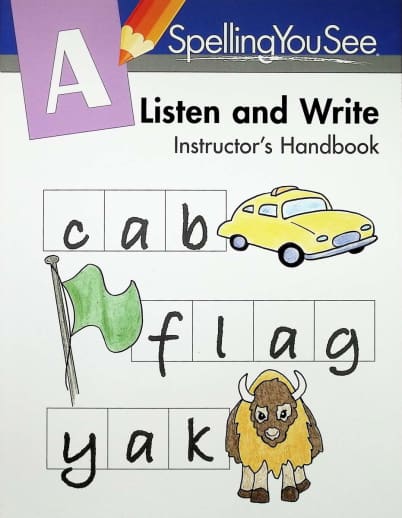

Spelling You See Listen and Write Instructor’s Handbook correlates with the Listen and Write Student Book. First giving an overview of the philosophy of the program along with a Getting Started section, the handbook then has simple weekly lesson plans for 36 weeks that include the dictation words for each day. The first 15 lessons introduce three-letter words and one short vowel at a time. Four and five letter words are then featured. Using a correct pencil grip and writing with lowercase letters are also emphasized. Frequently Asked Questions and a General Dictation List is included in the back. Demmelearning.com includes videos and downloads to support Listen and Write lessons. ~ Gina
Spelling You See Level A: Listen and Write Instructor's Handbook
SKU
071183
ISBN
9781608265930
Grade K-1
Neutral
High Teacher Involvement
Multi-Sensory
Sequential
These icons are designed to help you quickly understand and learn important information about our products.
Teaching Method
Traditional
Teacher-centered curriculum commonly used in classrooms that may include a text, teacher manual, tests, etc.
Charlotte Mason
A methodology based on the work of a 19th century educator who maintained that children learn best from literature (Living Books), not textbooks.
Classical
A methodology based on the Latin Trivium (three stages of learning), including the grammar stage (memorization and facts), logic stage (critical thinking), and rhetoric stage (developing/defending ideas).
Unit Study
A thematic or topical approach centered around one topic that integrates multiple subject areas.
Montessori (Discovery)
A methodology based on the work of a 20th century educator that emphasizes student and sensory-driven discovery learning and real-life applications.
Other
Other methodologies
Religious Content
Secular
Contains content contrary to common Christian beliefs (i.e. evolution).
Neutral
Avoids religious or theoretical topics or presents multiple viewpoints without preference.
Christian/Religious
Faith-based or including instructional religious content.
Learning Modality
Auditory
Learns through listening, talking out loud or reading out loud.
Visual
Learns through seeing, prefers written instructions and visual materials.
Kinesthetic/Tactile (Hands-On)
Learns through moving, doing and touching.
Multi-Sensory
Curriculum that employ a variety of activities/components.
Presentation
Sequential
Curriculum progresses through well-defined learning objectives. Emphasizes mastery before moving to the next topic.
Spiral
Topics and concepts are repeated from level to level, adding more depth at each pass and connecting with review.
Conceptual/Topical
Focus is on the “why,” often with a unifying concept as well as specific skills; coverage may be broader.
Teacher Involvement
Low Teacher Involvement
Student-led materials; parent acts as a facilitator.
Medium Teacher Involvement
A mix of teacher-led time and independent student work.
High Teacher Involvement
Teacher-led lessons; may utilize discussions, hands-on activities and working together.
Additional Materials Required
No other materials needed
Everything you need is included.
Other Materials Required
There are additional required resources that are a separate purchase.
Other Materials Optional
There are additional resources mentioned or recommended but are not absolutely necessary.
Consumable
Consumable
Designed to be written in; not reusable.
Non-Consumable
Not designed to be written in; reusable.
Our Price
$20.70 Product Overview
- Provides a 36-week teaching plan that includes daily dictation words that coordinate with the Listen and Write Student Book
- Introduces three-letter words and one short vowel at a time before progressing to four- and five-letter words
- Offers program philosophy, getting-started guidance, FAQs, a general dictation list, and online videos and downloads for extra support
Description
Publisher's Description of Spelling You See Level A: Listen and Write Instructor's Handbook
Unlock the power of visual spelling with Spelling You See. This research-based program takes a multi-sensory approach to spelling, helping students learn in a way that feels natural and intuitive. With Spelling You See, there are no word lists, no tests, and no rote memorization. Instead, students learn through four core activities and meaningful practice. The Level A Listen and Write Instructor's Handbook includes the instructor materials you’ll need to complete this level.
Guide your student's spelling journey with the Spelling You See: Listen and Write Instructor's Handbook. This necessary component contains an introduction to the philosophy behind Spelling You See and the five development stages of spelling. The Handbook also contains a “Getting Started” guide with an overview of the organization of the 36 lessons and information about the important skills and concepts that will be learned in this level. Designed as a companion to the Spelling You See Level A Student Workbook, this handbook is filled with valuable English spelling materials for teaching beginning spellers.
The Level A Listen and Write Instructor's Handbook is ideal for instructors who need the teaching material and whose students already have the Student Workbooks.
Category Description for Spelling You See Level A
For the beginning reader who is learning letter names and sounds and how to hold a pencil properly. This level is designed as a transition from phonics/reading skills to writing skills. Without an overall understanding of the program, this level might seem more phonics than spelling and part of the emphasis is on beginning handwriting skills. Resources include a Daily Dictation List, a General Dictation List, a Glossary, and a Bibliography. Please note that this is no longer sold as a Universal Set, so you will need to purchase the package item SYSAST to get both the Instructor's Handbook and the Student Pack. Online placement test available at https://spellingyousee.com/levels/#placement
Details
| Product Format: | Paperback |
|---|---|
| Grades: | K-1 |
| Brand: | Spelling You See |
| ISBN: | 9781608265930 |
| Length in Inches: | 11 |
| Width in Inches: | 8.5 |
| Height in Inches: | 0.1875 |
| Weight in Pounds: | 0.4 |
Videos
Reviews