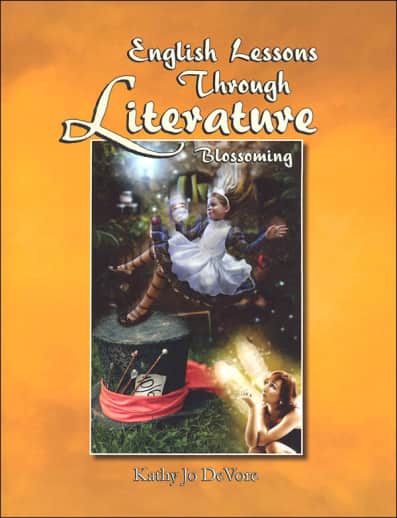
English Lessons Through Literature Level B: Blossoming

SKU
069090
ISBN
9781545302842
Grade 2-3
Charlotte Mason
Neutral
Medium Teacher Involvement
Multi-Sensory
Other Materials Required
Teaching Method
Traditional
Teacher-centered curriculum commonly used in classrooms that may include a text, teacher manual, tests, etc.
Charlotte Mason
A methodology based on the work of a 19th century educator who maintained that children learn best from literature (Living Books), not textbooks.
Classical
A methodology based on the Latin Trivium (three stages of learning), including the grammar stage (memorization and facts), logic stage (critical thinking), and rhetoric stage (developing/defending ideas).
Unit Study
A thematic or topical approach centered around one topic that integrates multiple subject areas.
Montessori (Discovery)
A methodology based on the work of a 20th century educator that emphasizes student and sensory-driven discovery learning and real-life applications.
Other
Other methodologies
Religious Content
Secular
Contains content contrary to common Christian beliefs (i.e. evolution).
Neutral
Avoids religious or theoretical topics or presents multiple viewpoints without preference.
Christian/Religious
Faith-based or including instructional religious content.
Learning Modality
Auditory
Learns through listening, talking out loud or reading out loud.
Visual
Learns through seeing, prefers written instructions and visual materials.
Kinesthetic/Tactile (Hands-On)
Learns through moving, doing and touching.
Multi-Sensory
Curriculum that employ a variety of activities/components.
Presentation
Sequential
Curriculum progresses through well-defined learning objectives. Emphasizes mastery before moving to the next topic.
Spiral
Topics and concepts are repeated from level to level, adding more depth at each pass and connecting with review.
Conceptual/Topical
Focus is on the “why,” often with a unifying concept as well as specific skills; coverage may be broader.
Teacher Involvement
Low Teacher Involvement
Student-led materials; parent acts as a facilitator.
Medium Teacher Involvement
A mix of teacher-led time and independent student work.
High Teacher Involvement
Teacher-led lessons; may utilize discussions, hands-on activities and working together.
Additional Materials Required
No other materials needed
Everything you need is included.
Other Materials Required
There are additional required resources that are a separate purchase.
Other Materials Optional
There are additional resources mentioned or recommended but are not absolutely necessary.
Consumable
Consumable
Designed to be written in; not reusable.
Non-Consumable
Not designed to be written in; reusable.
Our Price
$40.00 $40.00 $30.95
Rainbow Savings: $9.05
Bargain Version Available
Discover

Description

Covers an introduction to parts of speech, capitalization, and punctuation.

Level 2/Blossoming Literature List: Wonderful Wizard of Oz, Blue Fairy Book, Peter Pan, Wind in the Willows, Alice's Adventures in Wonderland, Through the Looking-Glass and What Alice Found There, Wonder-Book for Girls and Boys.347 pgs. pb

Publisher's Description of English Lessons Through Literature Level B: Blossoming

English Lessons Through Literature is a complete language arts program for elementary and middle school students. Each level has a textbook and an optional workbook which can be purchased separately.

What's different about English Lessons Through Literature?

  • Short, three day per week lessons keep language arts from taking all of your time.
  • Students interact with books, not just passages from books.
  • Writing is taught through imitation.
  • Spelling is taught through prepared dictation.
  • Copywork is included from the literature, maxims, and poetry.
  • Diagramming sentences is used as an exercise to both demonstrate understanding of the material and to constantly review what has been learned.
  • Students rewrite sentences from the stories, changing the sentences through grammatical changes. This old exercise from Erasmus teaches students to say the same thing in many different ways.
  • Students write outlines and write papers from their outlines, just as Benjamin Franklin taught himself to write.

In a typical ELTL lesson:

  • Students listen or read the literature, depending upon their age.
  • A brief lesson explores a grammatical concept. Examples are taken from the literature.
  • In levels 3 and up, there's a short writing exercise. The student might analyze words from the new narration story, change a sentence from the story, or imitate a descriptive paragraph.
  • Students listen or read the poem and a short story; the stories come from various world traditions.
  • The lesson ends with a short exercise and copywork. The exercise sentences are also from the literature.
  • Once per week, there is either a written narration or a picture study.

About the Levels

Here is a brief description of each level. The list has a recommended grade range for each book; we follow a "better late than early" philosophy in our household, so we stay at the upper end of the grade range and start Level A in 2nd grade.


Category Description for English Lessons Through Literature

English Lessons Through Literature (ELTL) is a gentle yet thorough Charlotte Mason-inspired language arts curriculum for grades 1–8. This literature-rich program uses high-quality living books, poetry, and picture studies as the foundation for teaching language arts while incorporating systematic grammar, classical writing methods, and narration.

Instead of worksheets and busywork, ELTL focuses on short, meaningful lessons that help students appreciate great literature, develop observation skills, express thoughts clearly, and master English grammar and mechanics. Lessons are designed for teacher-student interaction and require minimal prep time, making the program very homeschool-friendly.

How the Program Works

Each level contains 108 lessons (3 lessons per week over 36 weeks). A typical lesson includes:

  • A read-aloud from a quality book, fable, poem, or short story
  • Discussion and narration
  • Copywork (replaced by commonplace book entries in upper levels)
  • A focused grammar or mechanics “nugget”
  • Picture study to develop observation and descriptive writing skills

Curriculum Highlights:

  • Living books and timeless literature selections used as the heart of the curriculum
  • Systematic grammar instruction that begins gently and grows more advanced each year, including sentence diagramming starting in Level C (Cultivating)
  • Classical writing using the Progymnasmata sequence, starting with fables and narratives and progressing to chreia and maxim in the upper levels
  • Picture studies that build observation skills and provide excellent practice in putting thoughts into words
  • Memory work for important grammar rules and definitions
  • Optional student workbooks that significantly reduce teacher preparation time

Eight Levels (Grades 1–8)

English Language Through Literature offers eight levels, A-H, named with words that begin with each letter. These levels include Aspiring, Blossoming, Cultivating, Discerning, Enlightening, Flourishing, Growing, and Harvesting. Levels loosely correspond to grades 1 through 8. The author recommends starting with Aspiring in 2nd grade, though many families successfully use it in 1st grade as well.

Program Components:

  • Teacher Volumes: The heart of the program containing all lesson plans, grammar instruction, discussion prompts, picture studies, and helpful appendices (including memory work, diagramming guides, and writing protocols)
  • Optional Student Workbooks: Highly recommended for Aspiring through Flourishing. They contain all copywork, exercises, and writing pages (available in multiple handwriting styles: Manuscript, Slant Cursive, Vertical Cursive, Basic Italic, and Cursive Italic)
  • Read-Aloud Literature Books: Many are classic public domain titles, though some will need to be purchased or borrowed from the library

English Lessons Through Literature curriculum strikes an excellent balance between the gentle, literature-rich Charlotte Mason philosophy and the need for solid, systematic grammar and writing instruction. It is considered secular but inclusive, drawing from a wide variety of cultural and religious traditions presented as literature rather than doctrine.

Many families pair ELTL with the author’s Reading Lessons Through Literature to create a complete language arts program covering phonics, reading, spelling, grammar, and writing.

Details
More Information
Product Format:Paperback
Grades:2-3
Brand:Kathy Jo DeVore
Author:Kathy Jo DeVore
ISBN:9781545302842
Length in Inches:11
Width in Inches:8.5
Height in Inches:1
Weight in Pounds:1.95
Videos
This product doesn't have a video
Reviews
Product Q&A