These icons are designed to help you quickly understand and learn important information about our products.
Teaching Method
Traditional
Teacher-centered curriculum commonly used in classrooms that may include a text, teacher manual, tests, etc.
Charlotte Mason
A methodology based on the work of a 19th century educator who maintained that children learn best from literature (Living Books), not textbooks.
Classical
A methodology based on the Latin Trivium (three stages of learning), including the grammar stage (memorization and facts), logic stage (critical thinking), and rhetoric stage (developing/defending ideas).
Unit Study
A thematic or topical approach centered around one topic that integrates multiple subject areas.
Montessori (Discovery)
A methodology based on the work of a 20th century educator that emphasizes student and sensory-driven discovery learning and real-life applications.
Other
Other methodologies
Religious Content
Secular
Contains content contrary to common Christian beliefs (i.e. evolution).
Neutral
Avoids religious or theoretical topics or presents multiple viewpoints without preference.
Christian/Religious
Faith-based or including instructional religious content.
Learning Modality
Auditory
Learns through listening, talking out loud or reading out loud.
Visual
Learns through seeing, prefers written instructions and visual materials.
Kinesthetic/Tactile (Hands-On)
Learns through moving, doing and touching.
Multi-Sensory
Curriculum that employ a variety of activities/components.
Presentation
Sequential
Curriculum progresses through well-defined learning objectives. Emphasizes mastery before moving to the next topic.
Spiral
Topics and concepts are repeated from level to level, adding more depth at each pass and connecting with review.
Conceptual/Topical
Focus is on the “why,” often with a unifying concept as well as specific skills; coverage may be broader.
Teacher Involvement
Low Teacher Involvement
Student-led materials; parent acts as a facilitator.
Medium Teacher Involvement
A mix of teacher-led time and independent student work.
High Teacher Involvement
Teacher-led lessons; may utilize discussions, hands-on activities and working together.
Additional Materials Required
No other materials needed
Everything you need is included.
Other Materials Required
There are additional required resources that are a separate purchase.
Other Materials Optional
There are additional resources mentioned or recommended but are not absolutely necessary.
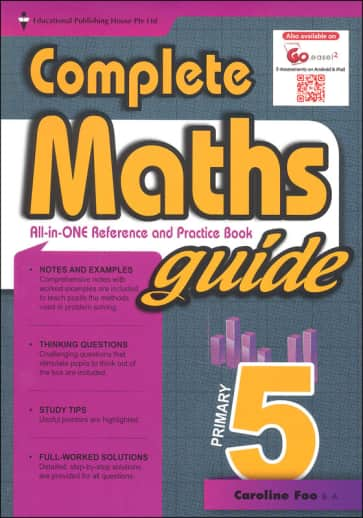
Publisher's Description of Complete Maths Guide P5
Complete Maths Guide is a comprehensive study guide specially written for pupils to gain a thorough knowledge of the various topics taught in school. The guide adopts a systematic coverage of Mathematics concepts. It is written in accordance with the latest Primary Mathematics Syllabus issued by the Ministry of Education.
This book provides comprehensive notes and worked examples that teach pupils the methods used in problem solving. Short exercises are included for pupils to practice immediately after they learn the concepts. Challenging thinking questions are also given to stimulate pupils' interest in Mathematics. Useful study tips are provided for pupils to facilitate their understanding in Mathematics concepts. This book aims to boost pupils' confidence and competency in their preparation for their school examinations.
Special features in this guide help enrich pupils' learning process by making the application of concepts identifiable and versatile. These features include:
Learning Outcomes A list of learning outcomes is given at the start of each topic to show the different areas of focus.
Notes and Examples Comprehensive notes with worked examples are included to teach pupils the methods used in problem solving.
Thinking Questions Challenging questions that stimulate pupils to think out of the box are included.
Study Tips Useful pointers are highlighted.
Full-Worked Solutions Detailed, step-by-step solutions are provided for all questions.
Countries around the world first became interested in
Singapore's math approach when results of the Third International Math and
Science Study (TIMSS) were published in 1995. Conducted by the International
Study Center at Boston College, achievement tests in both math and science were
administered to students in over 40 countries. Students from Singapore ranked
highly in mathematics achievement: 1st in the fourth, seventh, and eighth grade
levels and 2nd at the third grade level. Results for the U.S. were disappointing:
10th in the third grade, 11th in the fourth grade, 23rd in the seventh grade,
and 27th at the eighth grade level. In a follow-up study in 1999, Singapore
again ranked 1st in eighth grade math achievement while U.S. eighth graders
ranked 19th. These results indicated that something about Singapore's math
program was working. Thirty years later, there are multiple editions of Singapore Math curriculum available in the U.S., each is based on a Singapore
Ministry of Education syllabus.
We offer several Singapore Math programs available for homeschoolers or adapted for home use:
Primary
Math US/Standards Edition/Common Core Editions: Grades 1-6
Primary
Math 2022 Edition: Grades K-6
Earlybird
Kindergarten Math: PK-K
New
Elementary Math: Grades 7-8
Math
in Focus: Grades K-8
For information about these programs, our Singapore Math
Curriculum page provides a helpful overview of each along with links
to free practice tests and other helpful resources!