
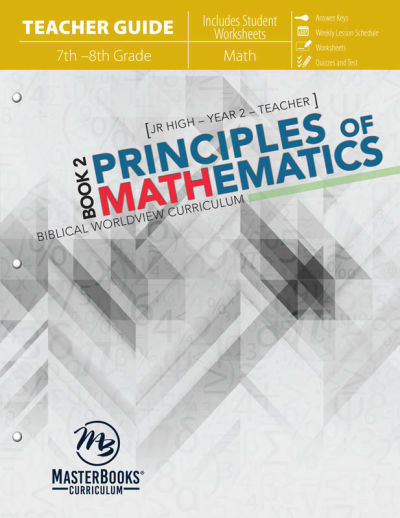

The Teacher Guide is a very important part of this program. You will find a course schedule, worksheets for each lesson, answer keys (a mix of answers and solutions), quizzes, and tests. Also included in the worksheets are math problems from historical text books, such as Applied Mathematics for Junior High Schools and High Schools and Secondary Arithmetic: Commercial and Industrial for High, Industrial, Commercial, Normal Schools, and Academics and Practical Algebra: First Year Course. These problems help students understand the role of math throughout history, but they are also good thinking math problems. There are two versions of the schedule - two-year and one-year. The two-year schedule is basically one lesson per day using both books to equal two years of junior high math. If you have a student who is really motivated and wants to finish both books in one year, there is a schedule for that. In this option, students complete about 2 to 3 lessons per day - depending on the length. The Student Workbook is consumable (not reproducible); pages are perforated with plenty of space for students to show their work and answer questions.
Principles of Mathematics Book 2 Teacher Guide
Description
Teacher Guide for Book 2 of the for junior high!
Here at last is a math curriculum with a biblical worldview focus that will help students understand why they're learning what they're learning, and ultimately why math matters, how to apply what they're learning outside a textbook, and, above all, see God's handiwork in math and His creation. The resources in the Teacher Guide will help students master and apply the skills learned in the Student Textbook.
What does this workbook include?
- Worksheets, Quizzes, and Tests: These perforated, three-hole punched pages help provide practice on the principles taught in the main student text.
- Answers Keys: The answers are included for the worksheets, quizzes, and tests found in this Teacher Guide.
- Schedule: A suggested calendar schedule is provided for completing the material in one year, though this can be adapted to meet individual student needs.
Are there any prerequisites for this course?
This curriculum is aimed at grades 6-8 (pre-algebra), fitting into most math approaches the year or two years prior to starting high school algebra. If following traditional grade levels, Book 1 should be completed in grade 6 or 7, and Book 2 in grade 7 or 8.
[Book 2] It is strongly recommended that students complete Book 1 before beginning Book 2: Principles of Mathematics- Biblical Worldview Curriculum as math builds on itself. Students don't just learn how to manipulate numbers on paper, but starting with arithmetic and laying the groundwork for geometry and algebra (covered in year 2), this curriculum both firms up the foundational concepts and prepares students for upper-level math in a logical, step-by-step way that helps students understand concepts, build problem-solving skills, and see how different aspects of math connect.
Principles of Mathematics from Master Books is a
comprehensive, two-year junior high math course that
covers the basics of arithmetic and pre-algebra from a biblical worldview. It
thoroughly prepares students for Algebra 1 while emphasizing conceptual
understanding and problem-solving.
Most families will use Principles of Mathematics with 7th and 8th grade students. However, the program is flexible and can be completed in one year by
motivated students or used as a review for advanced 6th graders. It can also be used by high school
students needing foundational reinforcement.
Key Curriculum Features:
- Biblical integration and a Christian perspective on math
- Clear, conversational instruction with step-by-step explanations
- Focus on conceptual understanding, mental math, and real problem-solving
- Progressive review and practice to build mastery
- Calculator instruction included
- Two-year or one-year pacing options provided
Program Components:
- Student Book: Non-consumable textbook with core instruction and examples
- Student Workbook/Teacher Guide: Consumable worksheets, course schedules (one-year and two-year), answer keys, quizzes, and tests
- Required Materials: Calculator, graph paper, binder with notebook paper, abacus in Book 1, measuring tape, compass, and protractor in Book 1
Principles of Mathematics curriculum stands out for its biblical
discipleship approach, thorough conceptual teaching, and flexibility for
different student needs. It is an excellent choice for Christian homeschool
families seeking a solid, faith-integrated math program that bridges elementary
math and high school algebra.
Shop all Principles of Mathematics levels and sets below!
| Product Format: | Paperback |
|---|---|
| Grade: | 8 |
| Brand: | Master Book Publishers |
| Author: | Katherine A. Loop |
| ISBN: | 9780890519073 |
| Length in Inches: | 10.875 |
| Width in Inches: | 8.375 |
| Height in Inches: | 1 |
| Weight in Pounds: | 2.3 |