
Principles of Mathematics Book 2 Student

SKU
065939
ISBN
9780890519066
Grade 8
Traditional
Christian/Religious
Low Teacher Involvement
Multi-Sensory
Other Materials Optional
Sequential
Teaching Method
Traditional
Teacher-centered curriculum commonly used in classrooms that may include a text, teacher manual, tests, etc.
Charlotte Mason
A methodology based on the work of a 19th century educator who maintained that children learn best from literature (Living Books), not textbooks.
Classical
A methodology based on the Latin Trivium (three stages of learning), including the grammar stage (memorization and facts), logic stage (critical thinking), and rhetoric stage (developing/defending ideas).
Unit Study
A thematic or topical approach centered around one topic that integrates multiple subject areas.
Montessori (Discovery)
A methodology based on the work of a 20th century educator that emphasizes student and sensory-driven discovery learning and real-life applications.
Other
Other methodologies
Religious Content
Secular
Contains content contrary to common Christian beliefs (i.e. evolution).
Neutral
Avoids religious or theoretical topics or presents multiple viewpoints without preference.
Christian/Religious
Faith-based or including instructional religious content.
Learning Modality
Auditory
Learns through listening, talking out loud or reading out loud.
Visual
Learns through seeing, prefers written instructions and visual materials.
Kinesthetic/Tactile (Hands-On)
Learns through moving, doing and touching.
Multi-Sensory
Curriculum that employ a variety of activities/components.
Presentation
Sequential
Curriculum progresses through well-defined learning objectives. Emphasizes mastery before moving to the next topic.
Spiral
Topics and concepts are repeated from level to level, adding more depth at each pass and connecting with review.
Conceptual/Topical
Focus is on the “why,” often with a unifying concept as well as specific skills; coverage may be broader.
Teacher Involvement
Low Teacher Involvement
Student-led materials; parent acts as a facilitator.
Medium Teacher Involvement
A mix of teacher-led time and independent student work.
High Teacher Involvement
Teacher-led lessons; may utilize discussions, hands-on activities and working together.
Additional Materials Required
No other materials needed
Everything you need is included.
Other Materials Required
There are additional required resources that are a separate purchase.
Other Materials Optional
There are additional resources mentioned or recommended but are not absolutely necessary.
Consumable
Consumable
Designed to be written in; not reusable.
Non-Consumable
Not designed to be written in; reusable.
Our Price
$46.99 $46.99 $37.59
Rainbow Savings: $9.40

Description

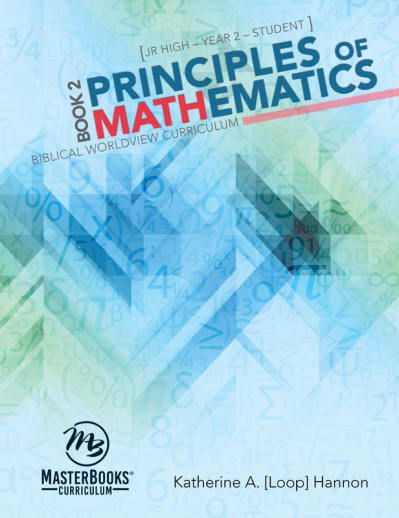
The Student Book (textbook) is the instruction, divided into chapters, then into lessons. Important notes about the curriculum and its use are found in the front of the book. Students will read the lesson in the Student Book and complete the activity page found in the Teacher Guide.
Publisher's Description of Principles of Mathematics Book 2 Student
Experience the difference understanding the principles of mathematics can make!

Now that you know the core principles of arithmetic and geometry, you're ready to move on to learning advanced skills that will allow you to explore more aspects of God's creation. In Book 2, the focus is on the essential principles of algebra, coordinate graphing, probability, statistics, functions, and other important areas of mathematics.

[General structure]
This is the second year of a two-year math program designed to give students a firm mathematical understanding, both academically and spiritually. The curriculum consists of the Student Textbook and the Teacher Guide. The textbook contains the text, and the teacher guide contains all the worksheets, quizzes, and tests, along with an answer key and suggested schedule.

[Grade level]
This curriculum is aimed at grades 7-8 (pre-algebra); however, there is plenty of material to engage older students as well who want to understand the principles of mathematics from a biblical worldview. Students should have complete Book 1 of this course or have equivalent knowledge before beginning. See the "About This Curriculum" section inside for more information.

[Features]

  • Biblical Worldview: Discover how the very existence of math proclaims the faithfulness of God...and experience the joy of using math to explore God's creation.
  • Solid Foundation for High School Math and Real Life: Don't let high school math intimidate you! By understanding the principles of math, you'll be prepared to see the purpose and understand the mechanics of high school math concepts.
  • History, Science, and Real-Life Connections: Explore exponential growth, interest rates, music, force, motion, genetics, and more. Math is much more than meaningless bookwork...and now at last you can learn it that way!

[Where to go from here]
Upon completion, students should be prepared to begin or return to any high school algebra course.

Category Description for Principles of Mathematics

Principles of Mathematics from Master Books is a comprehensive, two-year, junior high math course that covers the basics of arithmetic and pre-algebra with a Christian worldview. This course will thoroughly prepare your student for algebra.

The middle school Principles of Mathematics curriculum is intended to be used for two years for 7th and 8th grades, although advanced 6th graders could also complete it. It is designed to be used before the student starts Algebra. This curriculum would also work well for high schoolers who need a review of basic concepts and beginning algebra. The table of contents topical format allows you to use it as a reference or extra practice for someone who might be struggling.

There are two books for each level of the program: a Student Book and a Teacher Guide. The teacher guide also holds student worksheets. Book 1 reviews basic arithmetic and teaches problem-solving skills and mental math through a Biblical lens. Book 2 is considered the pre-algebra portion of the program, so students need to be competent in basic functions of fractions, decimals, percent, and basic geometry. Book 2 assumes the knowledge of content presented in Book 1.

The Student Book (textbook) is the instruction, divided into chapters, then into lessons. Important notes about the curriculum and its use are found in the front of the book. Students will read the lesson in the Student Book and complete the activity page found in the Teacher Guide. That's how easy it is to use this curriculum. Don't confuse easy-to-use with over-simplified content. It covers all pertinent topics for algebra preparation. While there is quite a bit of reading, the language is fairly easy to read and comprehend thanks to its conversational nature. Calculator instruction is included, beginning with lesson 4.5, but the parent or teacher can discern the amount of calculator use allowed. Lessons that have recommended calculator use are marked with a calculator symbol.

The Teacher Guide is a very important part of this program. In it, you will find a course schedule, student worksheets for each lesson, answer keys, quizzes, and tests. Also included in the worksheets are math problems from historical textbooks. These problems help students understand the role of math throughout history. There are two versions of the schedule: two-year and one-year. The two-year schedule is basically one lesson per day using both books to equal two years of junior high math. If you have a student who is really motivated and wants to finish both books in one year, there is a schedule for that. In this option, students complete about 2 to 3 lessons per day depending on the length. The student worksheets are consumable (not reproducible); pages are perforated with plenty of space for students to show their work and answer questions.

The Principles of Mathematics Sets include a Student Book and a Teacher Guide. 

Suggested materials for this course include the Principles of Mathematics Student Book and Teacher Guide, binder with notebook paper, abacus, blank index cards, calculator, graph paper, compass, measuring tape with Metric and US measure, ruler with Metric and US measure, and a protractor.

Details
More Information
Product Format:Paperback
Grade:8
Brand:Master Book Publishers
Author:Katherine A. Loop
ISBN:9780890519066
Length in Inches:10.875
Width in Inches:8.4375
Height in Inches:1
Weight in Pounds:2.2
Videos
This product doesn't have a video
Reviews
Product Q&A