
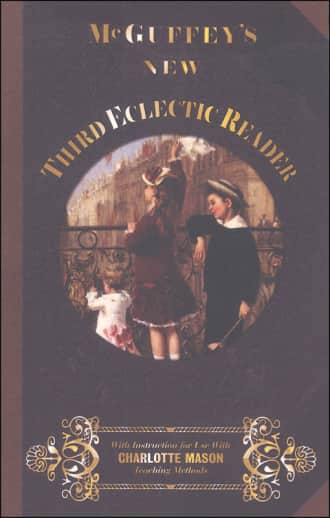

Emphasis on articulation and punctuation, with language arts lessons based upon character building stories, essays and poetry. Focus: reading and spelling (86 lessons).
McGuffey's New Third Eclectic Reader (with instructions for use with Charlotte Mason teaching methods)
SKU
065511
ISBN
9781613220177
Grade 3-5
Charlotte Mason
Christian/Religious
Medium Teacher Involvement
Multi-Sensory
No other materials needed
These icons are designed to help you quickly understand and learn important information about our products.
Teaching Method
Traditional
Teacher-centered curriculum commonly used in classrooms that may include a text, teacher manual, tests, etc.
Charlotte Mason
A methodology based on the work of a 19th century educator who maintained that children learn best from literature (Living Books), not textbooks.
Classical
A methodology based on the Latin Trivium (three stages of learning), including the grammar stage (memorization and facts), logic stage (critical thinking), and rhetoric stage (developing/defending ideas).
Unit Study
A thematic or topical approach centered around one topic that integrates multiple subject areas.
Montessori (Discovery)
A methodology based on the work of a 20th century educator that emphasizes student and sensory-driven discovery learning and real-life applications.
Other
Other methodologies
Religious Content
Secular
Contains content contrary to common Christian beliefs (i.e. evolution).
Neutral
Avoids religious or theoretical topics or presents multiple viewpoints without preference.
Christian/Religious
Faith-based or including instructional religious content.
Learning Modality
Auditory
Learns through listening, talking out loud or reading out loud.
Visual
Learns through seeing, prefers written instructions and visual materials.
Kinesthetic/Tactile (Hands-On)
Learns through moving, doing and touching.
Multi-Sensory
Curriculum that employ a variety of activities/components.
Presentation
Sequential
Curriculum progresses through well-defined learning objectives. Emphasizes mastery before moving to the next topic.
Spiral
Topics and concepts are repeated from level to level, adding more depth at each pass and connecting with review.
Conceptual/Topical
Focus is on the “why,” often with a unifying concept as well as specific skills; coverage may be broader.
Teacher Involvement
Low Teacher Involvement
Student-led materials; parent acts as a facilitator.
Medium Teacher Involvement
A mix of teacher-led time and independent student work.
High Teacher Involvement
Teacher-led lessons; may utilize discussions, hands-on activities and working together.
Additional Materials Required
No other materials needed
Everything you need is included.
Other Materials Required
There are additional required resources that are a separate purchase.
Other Materials Optional
There are additional resources mentioned or recommended but are not absolutely necessary.
Consumable
Consumable
Designed to be written in; not reusable.
Non-Consumable
Not designed to be written in; reusable.
Our Price
$16.99 Description
Publisher's Description of McGuffey's New Third Eclectic Reader (with instructions for use with Charlotte Mason teaching methods)
The third reader begins with lessons on articulation and marks and pauses (punctuation). The articulation lesson reviews some of the words from the last half of the second reader, while the punctuation instruction provides a brief overview of the basic punctuation marks and their uses. Each of these lessons includes a note to the teacher and the articulation lesson includes a model for class drill.
These introductory lessons are followed by 86 language arts lessons, each based upon character-building stories, essays, and poetry. Each paragraph or stanza is numbered, which makes it very easy to assign portions of a passage or poem as copywork, recitation, or narration. Additional short lessons and teacher notes are found throughout the text.
In this reader, students will find spelling words listed at the beginning of each lesson. The first spelling and vocabulary lesson in the third reader contains words from the story that follows, including learn, richly, culling, harvest, cause, wintry, engage, livelong, youth, summer, leaving, and brightest. Practice Spelling with McGuffey Readers provides an overview of how to use these spelling words.
Most stories and nonfiction pieces are followed by a few questions about the text. In her review of the 1857 Readers, Cathy Duffy writes about a question in the third reader, "The first instruction to relate the story is essentially asking the child for an oral narration. The following two questions require students to think beyond the content of the story for their answers. This guided discussion stretches beyond narration but still fits the spirit of Charlotte Mason's ideas.
You may choose whether or not to use the provided questions. I strongly dislike comprehension questions, so would not use any that were simply questions of fact, but would instead substitute narration or a simple conversation about the story or poem. The nice thing about the third reader, as with the rest of the series, is that you may adapt it to suit your needs.
New introduction with instructions for use with Charlotte Mason methods
You may also choose to use Charlotte Mason's language arts methods of copywork, recitation, and narration for these lessons. Instructions for each of these methods is found in the new 18-page introduction that has been added to this edition. Like Miss Mason, Mr. McGuffey believed in short lessons, learned well, so the readers provide a convenient source for material to use with Miss Mason's methods.
By the end of the third reader, your student will be working with words such as island, bilberry, brooding, fledged, captivity, busy, hobble, warbled, and grateful.
Literacy, virtue, and values
Like the other readers in the series, McGuffey's third reader helps you teach language arts using stories, poems, essays, and speeches that reinforce virtues such as courage, honor, diligence, stewardship, independence, frugality, perseverance, and kindness. Whether you use them as a primary instructional tool or simply as a supplement to your curriculum, I think you'll find the 1857 McGuffey Readers a valuable addition to your home library and classroom.
Category Description for McGuffey's New Eclectic Readers (1857 Edition with Charlotte Mason instruction)
McGuffey’s New Eclectic Readers, edited by Janice Campbell, are the beloved 1857 edition of the classic McGuffey Readers carefully adapted for modern Charlotte Mason homeschoolers.
These timeless readers combine high-quality literature,
moral lessons, and elocution practice with Charlotte Mason’s methods of
copywork, narration, dictation, and recitation. They provide a gentle yet
academically rich language arts foundation rooted in 19th-century Christian
values.
Key Curriculum Features:
- Carefully restored 1857 edition with original text, illustrations, and diacritical markings
- Strong emphasis on elocution, clear pronunciation, and expressive reading
- Charlotte Mason approach using copywork, narration, dictation, and recitation
- Rich moral and character training from a Christian perspective
- Progressive difficulty from beginning reading through advanced literature and elocution
- Excellent for developing vocabulary, articulation, and literary appreciation
Program Components:
- Six softcover 5" x 7.5" Readers covering grades PK-12
- Detailed teaching notes and instruction by Janice Campbell on implementing a Charlotte Mason approach
- Each volume includes the original McGuffey text plus helpful guidance for today’s homeschool families
McGuffey’s New Eclectic Readers stand out for their timeless literary quality, strong moral foundation, and flexible Charlotte Mason-friendly format. They are an excellent choice for families who want to combine classic literature with gentle, effective language arts instruction.
Browse all McGuffey’s New Eclectic Readers and Reader sets below!
Details
| Product Format: | Paperback |
|---|---|
| Grades: | 3-5 |
| Brand: | Everyday Education |
| ISBN: | 9781613220177 |
| Length in Inches: | 7.75 |
| Width in Inches: | 5.0625 |
| Height in Inches: | 0.625 |
| Weight in Pounds: | 0.625 |
Videos
Reviews