
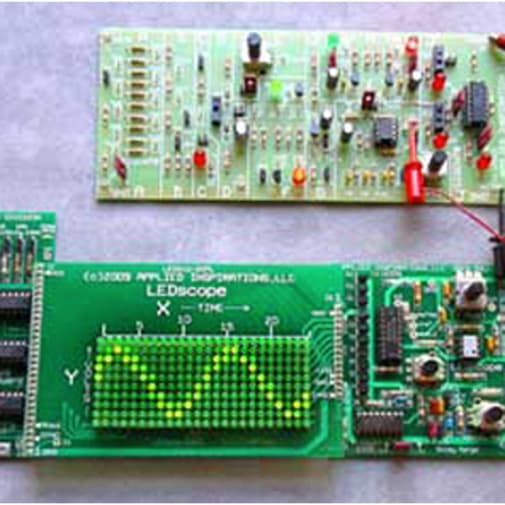
- Gives Practical Hands-on Experience for Middle School (Science Kids), High School, Adults who want to change careers, or Hobbyist.
- All parts necessary are included. Tool Set is sold separately - See our Quality Tool Set (#064780) for tools.
- Prepares students for College or entry level Electronic Technician.
- Classroom or Homeschool Co-ops.
- Independent Study for Homeschoolers - Moms, you do not need to learn Electronics. Credit recommendation with Part 2 is 1 1/2 High School Credits which includes 1/2 lab credit.
200+ pages, 200+ illustrations on a CD in .pdf format.
Part 1: Basic Electronics teaches:
- The Nature of Electricity
- Basic electronic components
- How to read a schematic diagram
- How to solder
- How to un-solder
- How to use a Digital Multimeter
- How to use Ohm's law and some basic math to analyze circuits
- Basic Semiconductor Physics of how diodes and transistors work
- Simple Operational Amplifier (op-amp) Circuits
- Simple Digital Logic Circuits
After some basic theory about the physics of electricity (1 chapter), safety, schematics, and construction techniques are explained. The rest of the 12 chapters are all hands-on to apply and explore this material. Each module consists of a small section of theory, then detailed step by step instructions are given to build the circuit that puts this theory into practice. Next, the circuit is tested (great reinforcement and excitement as LEDs blink and speakers sound) and analyzed to show that practice matches theory. In the process, the knowledge and the skills from earlier modules are reinforced. Finally, there is a page of key items learned in the chapter that can be used for review and future reference.
The ten theory/build teaching circuits start with passive components, then diodes and transistors are used to build control circuits and an audio amplifier. The final sections use analog and digital Integrated Circuits (ICs) to teach the basics of working with operational amplifiers and digital logic gates.
Part-2, the LED Array Oscilloscope, is presented in a manner similar to the story "Stone Soup." As each module is built and tested, a new feature is suggested that would improve the oscilloscope’s functionality. This leads to describing, building, and testing the next module until all the features of a commercial oscilloscope have been demonstrated. Because the results are visual, the learning is exciting with immediate gratification of applying the theory just taught. As the oscilloscope is developed, the Signal Generator board from Part-1 is used to provide test signals to demonstrate the scope's operation, and to show the need for new features that are then built in the following chapter.