These icons are designed to help you quickly understand and learn important information about our products.
Teaching Method
Traditional
Teacher-centered curriculum commonly used in classrooms that may include a text, teacher manual, tests, etc.
Charlotte Mason
A methodology based on the work of a 19th century educator who maintained that children learn best from literature (Living Books), not textbooks.
Classical
A methodology based on the Latin Trivium (three stages of learning), including the grammar stage (memorization and facts), logic stage (critical thinking), and rhetoric stage (developing/defending ideas).
Unit Study
A thematic or topical approach centered around one topic that integrates multiple subject areas.
Montessori (Discovery)
A methodology based on the work of a 20th century educator that emphasizes student and sensory-driven discovery learning and real-life applications.
Other
Other methodologies
Religious Content
Secular
Contains content contrary to common Christian beliefs (i.e. evolution).
Neutral
Avoids religious or theoretical topics or presents multiple viewpoints without preference.
Christian/Religious
Faith-based or including instructional religious content.
Learning Modality
Auditory
Learns through listening, talking out loud or reading out loud.
Visual
Learns through seeing, prefers written instructions and visual materials.
Kinesthetic/Tactile (Hands-On)
Learns through moving, doing and touching.
Multi-Sensory
Curriculum that employ a variety of activities/components.
Presentation
Sequential
Curriculum progresses through well-defined learning objectives. Emphasizes mastery before moving to the next topic.
Spiral
Topics and concepts are repeated from level to level, adding more depth at each pass and connecting with review.
Conceptual/Topical
Focus is on the “why,” often with a unifying concept as well as specific skills; coverage may be broader.
Teacher Involvement
Low Teacher Involvement
Student-led materials; parent acts as a facilitator.
Medium Teacher Involvement
A mix of teacher-led time and independent student work.
High Teacher Involvement
Teacher-led lessons; may utilize discussions, hands-on activities and working together.
Additional Materials Required
No other materials needed
Everything you need is included.
Other Materials Required
There are additional required resources that are a separate purchase.
Other Materials Optional
There are additional resources mentioned or recommended but are not absolutely necessary.
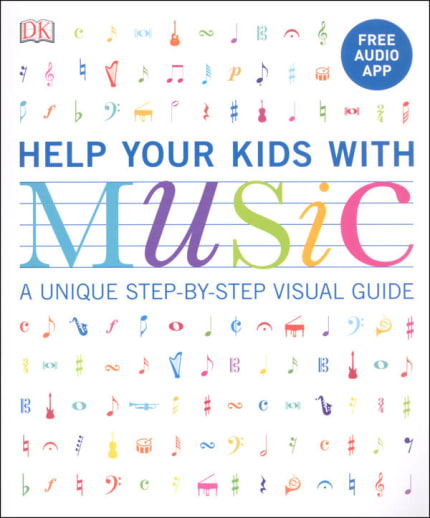
Don't let the title fool you! This wide-breadth visual guide from DK will be useful for individual students, supplementing music courses, and just learning a lot. Detailed visuals (diagrams, music notation and photos) and concise descriptions provide a systematic and methodical approach to music instruction encompassing pitch, rhythm, intervals, melody, chords and harmony, and form. The text identifies with a "sound" symbol which one of the over 90 tracks on the accompanying music will demonstrate a particular term or concept studied. Strewn throughout are also mini biographies of famous composers. Additional handy reference pages provide a quick tool to access note and rest values, time and key signatures, chords and scales, and musical terms. A glossary and index are included. 256 pp, sc. To access the music audio, download the official Help Your Kids With Music App, available on both the Google Play Store and Apple App Store. ~ Ruth
Publisher's Description of Help Your Kids with Music
Demystify the subject of music theory with this visual guide, reducing the stress of studying music and helping your child with their music homework. With free online audio.
Covering everything from semitones and note values to harmony and music appreciation, Help Your Kids with Music takes you on a clear and easy step-by-step path through all things music. With free supporting audio available.
This straightforward guide uses clear, accessible pictures and diagrams to approach even the most complex musical theory with confidence. The use of bright colors breaks up the black and white confusion of musical notes and helps you to easily understand key topics. You’ll also find a glossary of key musical terms and symbols for quick reference, and a supporting audio to help you understand the music you are seeing.
This visual guide clearly explains key concepts in five step-by-step chapters:
The Basics explains the types of instruments, notation for keyboard and stringed instruments, the “musical alphabet,” and counting a beat.
Rhythm covers the length of notes and rests, as well as basic rhythms and meters, phrasing, syncopation, tempo, and using a metronome
Tone and Melody includes everything a student needs to know about tones and how they work together to build a melody
Chords and Harmony shows how intervals work together and includes examples for horn and woodwind instruments
Form and Interpretation helps students understand how musical form can aid appreciation and interpretation for classical, jazz, blues, and other musical styles.
Suitable for those working on music at school or as an extra subject, this valuable guide covers music theory from Grades 1-5. Whether you’re approaching the subject yourself or simply supporting someone else through their studies, Help Your Kids with Music simplifies the world of musical notation and study for everyone.