
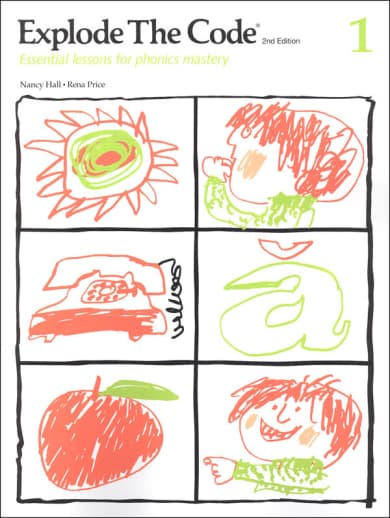

A time-tested approach for teaching phonics and reading, based on the Orton-Gillingham technique! This first book in the Explode the Code series of workbooks continues with carefully sequenced lessons for phonics mastery. This workbook reviews consonants before introducing short vowels, beginning with short “a”. Foundational skills (including phonemic awareness, phonological awareness, phonics, vocabulary, fluency, spelling, comprehension, and writing) are practiced through a variety of fun encoding, decoding, and writing exercises with cute black-and-white illustrations throughout. Lessons follow the same format each time, allowing many students to work through exercises independently, and the user-friendly Teacher Guide rounds out the program with various multisensory options for instruction and reinforcement. If additional practice is desired, Book 1 ½ offers opportunities to reinforce the skills taught in Book 1. 124 pgs. sc.
Explode the Code Book 1 (2nd Edition)
Product Overview
- Proven method for reading success with beginning or struggling readers!
- Orton-Gillingham based with direct, systematic phonics instruction
- Reviews consonants and covers short vowels
- Multisensory to build early, essential literacy skills
Description
Workbook 1 introduces students to the sounds of short vowels. The exercises begin with short a and then follow with short i, short u, short e, and short o. Students practice blending sounds to read and write CVC words.
Explode the Code is a proven Orton-Gillingham based program using systematic phonics instruction with multisensory activities. Students progress through the workbooks and build essential reading skills, including phonological and phonemic awareness, fluency, vocabulary, comprehension, writing, and more. Designed to cover skills ranging from preschool to 4th grade, the workbooks are organized by skill level without grade levels printed on the covers. This makes them perfect for remediation as well as for beginning readers, since older children can progress confidently without the pressure of feeling behind. There are three sets of workbooks that loosely correlate with the following grades:
- Preliteracy Primers: Get Ready for the Code, Get Set for the Code, and Go for the Code are all perfect for preschool through 1st grade.
- Explode the Code: Books 1-3 are ideal for 1st grade and books 4-6 can be used for 2nd grade. Books 7 and 8 are excellent for 3rd and 4th graders. There are also 1/2 level books between each level that provide extra practice before moving up.
- Beyond the Code: Book 1 for Grade 1, Book 2 for Grade 2, Book 3 for Grades 2-3, and Book 4 for Grades 3-4.
Explode the Code books are a perfect supplement to use alongside any phonics program, providing practice worksheets to reinforce skills step-by-step whether in preschool, kindergarten, or beyond! If using as a full phonics curriculum, the Teacher’s Guide rounds out the program, offering scripted lesson plans with detailed instructions for teaching concepts, and various suggestions for activities and skill reinforcement (some activities use the optional Wall Chart with Activity Book or Card Set). Includes differentiation tips for learning styles, group sizes, and English language learners, along with Answer Keys.
| Product Format: | Paperback |
|---|---|
| Grades: | K-4 |
| Brand: | Educators Publishing Service |
| ISBN: | 9780838878019 |
| Length in Inches: | 10.9375 |
| Width in Inches: | 8.3125 |
| Height in Inches: | 0.25 |
| Weight in Pounds: | 0.5125 |