Consumer Math for Real Life

SKU
059832
Grade 11-12
Teaching Method
Traditional
Teacher-centered curriculum commonly used in classrooms that may include a text, teacher manual, tests, etc.
Charlotte Mason
A methodology based on the work of a 19th century educator who maintained that children learn best from literature (Living Books), not textbooks.
Classical
A methodology based on the Latin Trivium (three stages of learning), including the grammar stage (memorization and facts), logic stage (critical thinking), and rhetoric stage (developing/defending ideas).
Unit Study
A thematic or topical approach centered around one topic that integrates multiple subject areas.
Montessori (Discovery)
A methodology based on the work of a 20th century educator that emphasizes student and sensory-driven discovery learning and real-life applications.
Other
Other methodologies
Religious Content
Secular
Contains content contrary to common Christian beliefs (i.e. evolution).
Neutral
Avoids religious or theoretical topics or presents multiple viewpoints without preference.
Christian/Religious
Faith-based or including instructional religious content.
Learning Modality
Auditory
Learns through listening, talking out loud or reading out loud.
Visual
Learns through seeing, prefers written instructions and visual materials.
Kinesthetic/Tactile (Hands-On)
Learns through moving, doing and touching.
Multi-Sensory
Curriculum that employ a variety of activities/components.
Presentation
Sequential
Curriculum progresses through well-defined learning objectives. Emphasizes mastery before moving to the next topic.
Spiral
Topics and concepts are repeated from level to level, adding more depth at each pass and connecting with review.
Conceptual/Topical
Focus is on the “why,” often with a unifying concept as well as specific skills; coverage may be broader.
Teacher Involvement
Low Teacher Involvement
Student-led materials; parent acts as a facilitator.
Medium Teacher Involvement
A mix of teacher-led time and independent student work.
High Teacher Involvement
Teacher-led lessons; may utilize discussions, hands-on activities and working together.
Additional Materials Required
No other materials needed
Everything you need is included.
Other Materials Required
There are additional required resources that are a separate purchase.
Other Materials Optional
There are additional resources mentioned or recommended but are not absolutely necessary.
Consumable
Consumable
Designed to be written in; not reusable.
Non-Consumable
Not designed to be written in; reusable.
Our Price
$49.00 $49.00 $42.50
Rainbow Savings: $6.50

Product Overview

  • Math elective course with a biblical worldview for high schoolers
  • Practical real-life skills for working with money
  • Answer Key will be emailed to you directly from the publisher
  • Incorporates project-based learning

Important

Non-returnable. Is, or contains, a digital item.

Description

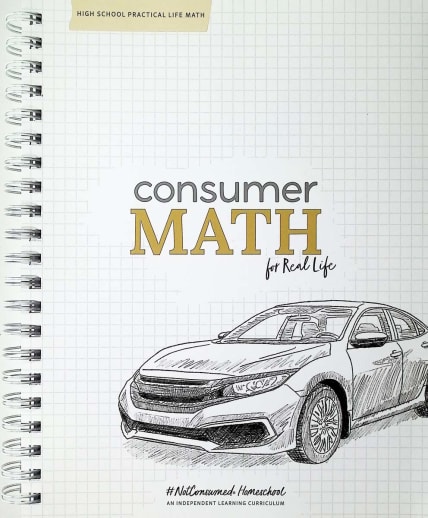
Consumer Math from Not Consumed is a yearlong math elective that focuses on practical application of math skills. Combining practical math skills with everyday life skills, this course counts as one high school math credit. The book is spiral-bound with a sturdy cover and is ready to be used independently by your student.  

Like all Not Consumed products, all the content is filtered through a strong biblical worldview and refers students to Scripture (any version) throughout the book. The authors write directly to the student and explain concepts in a readable and conversational tone.

Pages have a modern aesthetic with graph paper margins that can be used for notes or calculations. Each of the 16 lessons take a week or so to complete and cover a wide range of topics: making money, filing taxes, types of employment, starting a business, insurance, investing, budgeting, borrowing, housing, home maintenance, gardening, menu planning, transportation, clothing, and planning vacations. Some of these topics you might need to brush up on as an adult!

All the content is presented within a very modern context. For example, in the lesson that teaches how to balance a checkbook, students also learn about banking software and smartphone applications.

Older teens who are competent in middle school math and interested in preparing for their financial future can be successful in this course. Most of the lessons assign math calculations and encourage the use of a calculator. All terms are explained in detail and lessons show sample calculations. 

Although there is plenty of instruction and explanations, the heart of the program is in the 22 student projects: hands-on, brains-on projects that help a student to apply what they are learning. These are multi-day projects that bring concepts into their real life and help them be prepared for the future. Most of these projects will require outside research, including searching online, and may benefit from parent-student interaction.

For example, one project involves researching local banks and comparing what types of accounts they offer. After researching, the student decides what type might be the best for his situation and is encouraged to talk to his parents about opening an account. 

All the assignments and projects encourage your student to think carefully about their personal goals and the consequences of their choices. Softcover, 239 pages.

The digital answer key, along with teacher helps and guidelines, will be emailed to you shortly after your item ships.  Look for an email from Not Consumed to access that downloadable answer key.  Because most of the answers are personal and open-ended, they are not featured in the answer key.

Details
More Information
Product Format:Paperback Book
Grades:11-12
Brand:Not Consumed Ministries
Length in Inches:11
Width in Inches:9
Height in Inches:1
Weight in Pounds:1.7
Videos
This product doesn't have a video
Reviews
Product Q&A