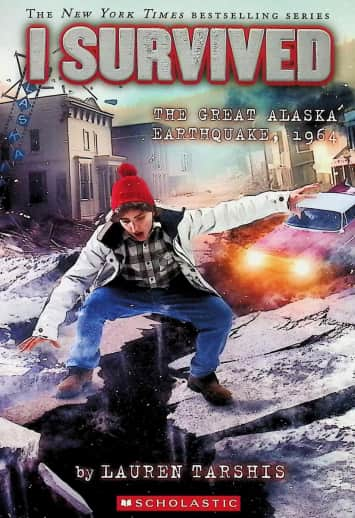
I Survived the Great Alaska Earthquake, 1964 (#23)
SKU
059161
ISBN
9781338891782
Grade 3-7
These icons are designed to help you quickly understand and learn important information about our products.
Teaching Method
Traditional
Teacher-centered curriculum commonly used in classrooms that may include a text, teacher manual, tests, etc.
Charlotte Mason
A methodology based on the work of a 19th century educator who maintained that children learn best from literature (Living Books), not textbooks.
Classical
A methodology based on the Latin Trivium (three stages of learning), including the grammar stage (memorization and facts), logic stage (critical thinking), and rhetoric stage (developing/defending ideas).
Unit Study
A thematic or topical approach centered around one topic that integrates multiple subject areas.
Montessori (Discovery)
A methodology based on the work of a 20th century educator that emphasizes student and sensory-driven discovery learning and real-life applications.
Other
Other methodologies
Religious Content
Secular
Contains content contrary to common Christian beliefs (i.e. evolution).
Neutral
Avoids religious or theoretical topics or presents multiple viewpoints without preference.
Christian/Religious
Faith-based or including instructional religious content.
Learning Modality
Auditory
Learns through listening, talking out loud or reading out loud.
Visual
Learns through seeing, prefers written instructions and visual materials.
Kinesthetic/Tactile (Hands-On)
Learns through moving, doing and touching.
Multi-Sensory
Curriculum that employ a variety of activities/components.
Presentation
Sequential
Curriculum progresses through well-defined learning objectives. Emphasizes mastery before moving to the next topic.
Spiral
Topics and concepts are repeated from level to level, adding more depth at each pass and connecting with review.
Conceptual/Topical
Focus is on the “why,” often with a unifying concept as well as specific skills; coverage may be broader.
Teacher Involvement
Low Teacher Involvement
Student-led materials; parent acts as a facilitator.
Medium Teacher Involvement
A mix of teacher-led time and independent student work.
High Teacher Involvement
Teacher-led lessons; may utilize discussions, hands-on activities and working together.
Additional Materials Required
No other materials needed
Everything you need is included.
Other Materials Required
There are additional required resources that are a separate purchase.
Other Materials Optional
There are additional resources mentioned or recommended but are not absolutely necessary.
Publisher's Description of I Survived the Great Alaska Earthquake, 1964 (#23)
It was 1964 in the brand-new state of Alaska, a vast land of staggering beauty and heart-stopping dangers. Eleven-year-old Jack had grown up living happily with his parents in an off-the-grid cabin, miles from their closest neighbors. Grizzlies and wolves outnumbered people, and dark winter days were 30 degrees below zero. Jack had always thought of himself as strong -- “Alaska tough”. But then the most powerful earthquake in American history -- the Good Friday Earthquake -- struck.
The 9.2 magnitude quake lasted nearly five minutes, destroying downtown Anchorage and sending 30-foot tsunamis into coastal cities, wiping out entire communities. Its vibrations were felt around the world. In the end, it caused billions of dollars in damage and the death of 129 people.
These works of historical fiction allow students to explore different disasters in history from a child's perspective. While the characters are fictional, the facts surrounding the tragedies are real. Black and white pictures accompany the text with facts about the events in the back of book. Approx. 100 pgs. each. ~ Alissa