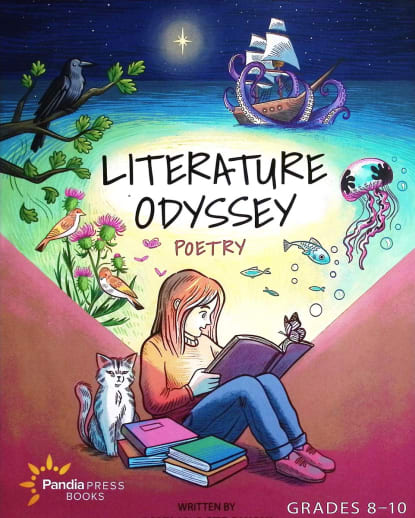
Continuing the skills learned in the first semester, Literature Odyssey: Poetry from Pandia Press applies those close reading skills and the practice of annotating with a purpose. This is a 16-week study that will expose high school students to 50 different authors and 61 different poems ranging in style from haiku and cinquain to ballads, epics, tanka, and free verse. The 50 poems are reprinted in the student materials for close reading and room for purposeful annotating. Students will explore this overarching question, what role does poetry have in our modern world?
Poetry comes to life when it is read aloud and we become active listeners. Students are encouraged to read the poems aloud and whenever they see the cat with headphones icon they can listen to the poem. Each lesson is made up of the same 4 parts:
- Content where students will have the poem printed for them to read and lesson content to study and review
- Content Assignments where students apply what they are studying in the lesson through thoughtful annotation and analysis
- Wordplay Assignments challenge students to become poets! Taking what they are learning, reading, and analyzing, they now get to practice and create poetry themselves
- Analysis Assignments which will push students to examine the poem as a whole and apply/attribute different literary analysis skills
Each of the two (2) units finishes with a Unit Project and Capstone Conversation. Unit 1 covers Poetic Elements, and the unit project is a Poetry Scavenger Hunt. Unit 2 covers Poetic Forms, and the unit project affords students the option to choose between creating a mini documentary, a Poetic Movement Guide, or an original poem. The objective of the Unit Project is to showcase what the student understands from each unit. The Final Project comes full circle in asking students the overarching question again, what role does poetry have in our modern role? Students are once again afforded the choice of what type of creative project they would like to submit in analyzing Amanda Gorman’s poem In This Place.
Rubrics for assessing these projects are found in the Teacher’s Guide (available as an eBook from the publisher). Every project (3 in total) will have a Capstone Conversation conducted with the students to evaluate their progress in understanding the material. Provided rubrics help guide and evaluate this conversation. Ending material includes a Glossary of the new literary terms covered in the course. 208 pages, Looseleaf. ~Rebecca