
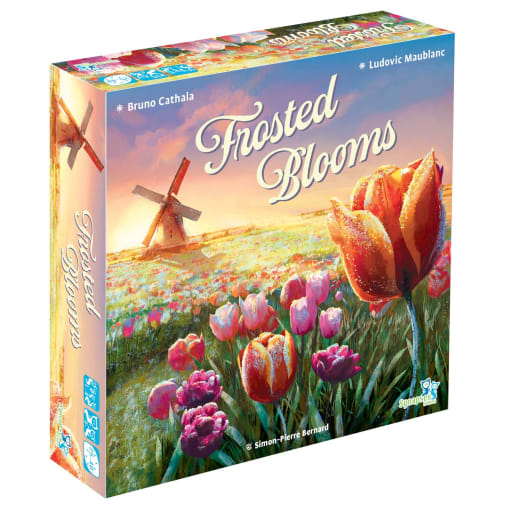
Compete to build the most beautiful and profitable Dutch tulip garden in this tile-drafting and placement game of Frosted Blooms published by Synapsis Games. Every player creates their own landscape with three different types of tulips and water spaces, which are portrayed on different shapes of tiles that they choose from a pool of five different tiles each turn. There are also improvement tokens (windmills, barns, and workers) that are placed in empty spaces inside their landscapes. The configurations of tiles and numbers of improvements determine how many points are earned over 10 rounds of play.
Points are tracked on the main board with tokens in each player’s color both during the game and at its end. Each player has a uniform deck of 10 landscape cards in their player color. Each card shows a 2-point value each for one landscape type (flower type or waterscape) or a 1-point value each for two different landscape types. On a turn, when a tile is chosen for placement, the goal is to create contiguous areas between the tile being placed and the tile it is touching of the same flower type or waterscape area. With flowers, there may be single numbers of flowers or bunches of different numbers on a tile area. Players start with 3 cards in their hand from their deck, and based on the tile placement, choose the best card to earn the most points and move their marker on the main board. After their turn, a new tile is drawn from the bag to bring the selection back to 5 and the player also draws another card from their deck for the next turn.
There are three ways to earn points that are scored at the end of the game: 1) As tiles are placed each turn, it is to a player’s advantage to create enclosed, open spaces inside of tile arrangements of various sizes to accommodate improvement tokens, which earn points at the end of the game. Worker tokens earn 3 points and one coin, barns earn 10 points, and windmills earn 25 points. 2) At the beginning of the game, objective tiles are chosen in a number based on player count across flower types, waterscapes, and improvement types. These goals range between 6, 8, and 10 contiguous flower and waterscape areas throughout a player’s landscape and various numbers of improvements by type. On any player’s turn when a goal is reached, one tile may be claimed per turn and only one of any type per game by a player. 3) Players start with a number of coins based on turn order. On a turn, a player claims the first tile available to the right of the one last chosen but can place coins next to tiles they wish to skip over to choose one they want that is farther away. When players later choose tiles that have coins next to them, they may pick up those coins. One coin each is also earned for placing a worker improvement.
After 10 rounds, when player’s card decks are all used up, the game ends and points are added to those already earned for end-game points and the person with the most points wins!
I have played many different tile-laying games over the years with various goals, themes, and levels of strategic complexity. This one stands out with the balance of being approachable for young ages but also holding interest for adults because of the variety of options to choose from with tile shapes, in-game goals, and longer-range objective options. This game plays well with 2-4 players and includes solo instructions. Depending on player count, game times range from 25 to 45 minutes. ~ Marsha