
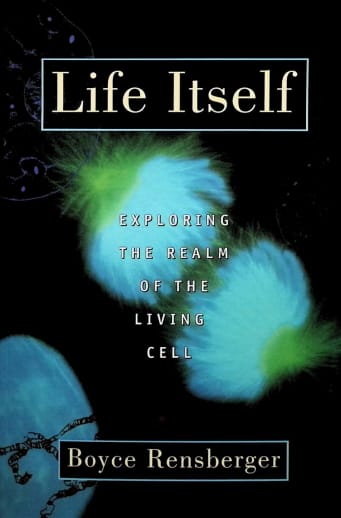
Hidden in a nondescript red-brick building in Rockville, Maryland, is the most unusual warehouse in the world, a bank of living cells called the American Type Culture Collection. Here, at 321 degrees below zero--a temperature at which life abandons its vital dance and enters limbo, but without dying--are some 30,000 vials holding 60 billion living forms in suspended animation, including mouse kidney cells, turkey blood cells, armadillo spleen cells, and some 40 billion human cells. These cultured cells are essential to modern biological research--in fact, cells today are the most intimately studied life forms in all of science, for both practical and philosophical reasons. For one, all disease--from cancer and the common cold, to arthritis and AIDS--stems from cells gone awry. And cell research not only promises a cure for a wide variety of disease--it also holds the key to the mystery of life itself.
In Life Itself, Boyce Rensberger, science writer for The Washington Post, takes readers to the frontlines of cell research with some of the brightest investigators in molecular, cellular, and developmental biology. Virtually all the hottest topics in biomedical research are covered here, such as how do cells and their minute components move? How do the body's cells heal wounds? What is cancer? Why do cells die? And what is the nature of life? Readers discover that--contrary to what we may have concluded from pictures in our high school textbooks--cells teem with activity and that, inside, they "are more crowded with components than the inside of a computer." We learn that scientists now know of at least ten molecular motors that move things about inside the cell--in most cells, this motion is short because the cell is tiny, but in the single-celled nerve fibers that run from the base of the spinal cord to the toes (measuring three or four feet in an adult human), molecular motors can take several days to make the trip. Rensberger describes the many fascinating kinds of cells found in the body, from "neural crest cells" (early in embryonic development, these cells crawl all over the embryo to the sites where they will pursue their fate--as nerve cells, or cartilage, or skin), to "dust cells" (nomadic cells in the lung that swallow and store indigestible particles, then migrate to the gullet where they themselves are swallowed and digested), to "natural killer cells" (millions of which roam the body looking for cancerous cells). We meet many of the scientists who have pioneered cell research, such as Rita Levi-Montalcini--an Italian who, shut out of her lab during World War II, continued to experiment in her bedroom at home, making the discovery ("nerve growth factor") for which she won the Nobel Prize--and American Leonard Hayflick, who proved that all human cells (except cancer cells) invariably die after about fifty divisions. Rensberger also provides an illuminating discussion of AIDS--revealing exactly why this virus is so difficult to defeat--and of cancer, explaining that before cancer can start, a whole series of rare events must occur, events so unlikely that it seems a wonder that anyone gets cancer at all.
The solutions to the most pressing challenges facing scientists today--from the efforts to conquer disease to the quest to understand life itself--will be found in the innermost workings of the cell. In Life Itself, Boyce Rensberger paints a colorful and fascinating portrait of modern research in this vital area, an account which will enthrall anyone interested in state-of-the-art science or the incredible workings of the human body.
Life Itself: Exploring the Realm of the Living Cell
SKU
056641
ISBN
9780195125009
Grade 9-12
These icons are designed to help you quickly understand and learn important information about our products.
Teaching Method
Traditional
Teacher-centered curriculum commonly used in classrooms that may include a text, teacher manual, tests, etc.
Charlotte Mason
A methodology based on the work of a 19th century educator who maintained that children learn best from literature (Living Books), not textbooks.
Classical
A methodology based on the Latin Trivium (three stages of learning), including the grammar stage (memorization and facts), logic stage (critical thinking), and rhetoric stage (developing/defending ideas).
Unit Study
A thematic or topical approach centered around one topic that integrates multiple subject areas.
Montessori (Discovery)
A methodology based on the work of a 20th century educator that emphasizes student and sensory-driven discovery learning and real-life applications.
Other
Other methodologies
Religious Content
Secular
Contains content contrary to common Christian beliefs (i.e. evolution).
Neutral
Avoids religious or theoretical topics or presents multiple viewpoints without preference.
Christian/Religious
Faith-based or including instructional religious content.
Learning Modality
Auditory
Learns through listening, talking out loud or reading out loud.
Visual
Learns through seeing, prefers written instructions and visual materials.
Kinesthetic/Tactile (Hands-On)
Learns through moving, doing and touching.
Multi-Sensory
Curriculum that employ a variety of activities/components.
Presentation
Sequential
Curriculum progresses through well-defined learning objectives. Emphasizes mastery before moving to the next topic.
Spiral
Topics and concepts are repeated from level to level, adding more depth at each pass and connecting with review.
Conceptual/Topical
Focus is on the “why,” often with a unifying concept as well as specific skills; coverage may be broader.
Teacher Involvement
Low Teacher Involvement
Student-led materials; parent acts as a facilitator.
Medium Teacher Involvement
A mix of teacher-led time and independent student work.
High Teacher Involvement
Teacher-led lessons; may utilize discussions, hands-on activities and working together.
Additional Materials Required
No other materials needed
Everything you need is included.
Other Materials Required
There are additional required resources that are a separate purchase.
Other Materials Optional
There are additional resources mentioned or recommended but are not absolutely necessary.
Consumable
Consumable
Designed to be written in; not reusable.
Non-Consumable
Not designed to be written in; reusable.
Our Price
$24.99 $24.99 $21.50
Rainbow Savings: $3.49
Description
Publisher's Description of Life Itself: Exploring the Realm of the Living Cell
Details
| Product Format: | Paperback Book |
|---|---|
| Grades: | 9-12 |
| Brand: | Oxford University Press |
| Author: | Boyce Rensberger |
| ISBN: | 9780195125009 |
| Length in Inches: | 9.25 |
| Width in Inches: | 6.125 |
| Height in Inches: | 0.625 |
| Weight in Pounds: | 0.95 |
Videos
Reviews