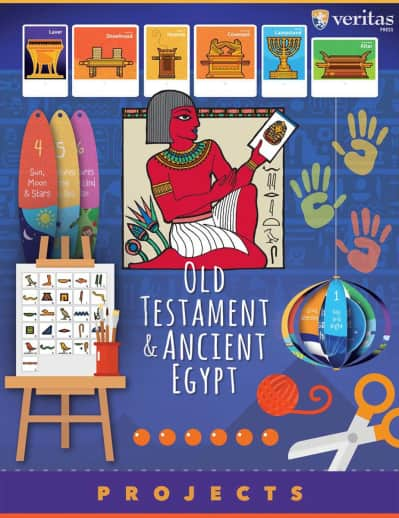
Updating the projects from the Veritas Old Testament and Ancient Egypt Teacher Manual and adding new hands-on activities, the Veritas History Old Testament and Ancient Egypt Project Workbook brings history alive with engaging, fun activities. Full-color pages with color and black-and-white templates inspire children as they recreate famous events in history, from creation through Egypt’s fall to Rome. Children build Ziggurats, model Noah’s Ark (with animals), and so much more! Background information and instructions are clearly presented and easy to follow. Aligned with the Veritas Press Elementary History Program, this supplemental workbook provides a wealth of hands-on activities that add fun learning activities to any history curriculum. Includes answer keys where necessary.
Old Testament & Ancient Egypt Project Workbook
SKU
056276
ISBN
9781951200763
Grade 2-6
These icons are designed to help you quickly understand and learn important information about our products.
Teaching Method
Traditional
Teacher-centered curriculum commonly used in classrooms that may include a text, teacher manual, tests, etc.
Charlotte Mason
A methodology based on the work of a 19th century educator who maintained that children learn best from literature (Living Books), not textbooks.
Classical
A methodology based on the Latin Trivium (three stages of learning), including the grammar stage (memorization and facts), logic stage (critical thinking), and rhetoric stage (developing/defending ideas).
Unit Study
A thematic or topical approach centered around one topic that integrates multiple subject areas.
Montessori (Discovery)
A methodology based on the work of a 20th century educator that emphasizes student and sensory-driven discovery learning and real-life applications.
Other
Other methodologies
Religious Content
Secular
Contains content contrary to common Christian beliefs (i.e. evolution).
Neutral
Avoids religious or theoretical topics or presents multiple viewpoints without preference.
Christian/Religious
Faith-based or including instructional religious content.
Learning Modality
Auditory
Learns through listening, talking out loud or reading out loud.
Visual
Learns through seeing, prefers written instructions and visual materials.
Kinesthetic/Tactile (Hands-On)
Learns through moving, doing and touching.
Multi-Sensory
Curriculum that employ a variety of activities/components.
Presentation
Sequential
Curriculum progresses through well-defined learning objectives. Emphasizes mastery before moving to the next topic.
Spiral
Topics and concepts are repeated from level to level, adding more depth at each pass and connecting with review.
Conceptual/Topical
Focus is on the “why,” often with a unifying concept as well as specific skills; coverage may be broader.
Teacher Involvement
Low Teacher Involvement
Student-led materials; parent acts as a facilitator.
Medium Teacher Involvement
A mix of teacher-led time and independent student work.
High Teacher Involvement
Teacher-led lessons; may utilize discussions, hands-on activities and working together.
Additional Materials Required
No other materials needed
Everything you need is included.
Other Materials Required
There are additional required resources that are a separate purchase.
Other Materials Optional
There are additional resources mentioned or recommended but are not absolutely necessary.
Consumable
Consumable
Designed to be written in; not reusable.
Non-Consumable
Not designed to be written in; reusable.
Our Price
$35.00 Product Overview
- Optional companion to the Veritas Press Elementary History Old Testament and Ancient Egypt Curriculum
- Adds fun and meaningful activities that bring history alive
- Make accordion books, a pan flute, play games, and make and label salt maps, and more!
Description
Publisher's Description of Old Testament & Ancient Egypt Project Workbook
This full-color collection of projects provides fun and meaningful activities to enhance your student's engagement with the lessons in our Old Testament & Ancient Egypt course, whether you are teaching it yourself or using the self-paced online course. We've updated the projects in our teacher's manual and added many more. Do as few or as many as you want. Provides projects that are specific for each event studied as well as extra resources, like a full-color map, timeline summaries, chronology review and answer keys, plus many fun memory tools that can be used over and over again.
Category Description for Veritas Press Elementary History (Grades 2-6)
Veritas Elementary History offers five different time periods, with each aimed at a different grade level beginning in grade 2 and designed to take one school year. There are a few components to this series that are offered in a kit or sold separately. The Teacher Manual is split into 32 weekly lessons. Each lesson has a worksheet, a project or two, and a test. The color-coded History Cards are an essential element of the program and contain many interesting facts from the various time periods. If the cards also relate to Bible history, they have another color and another number. Songs on the Audio CD are nicely done and designed as a type of auditory timeline.
Details
| Product Format: | Paperback Book |
|---|---|
| Grades: | 2-6 |
| Brand: | Veritas Press |
| ISBN: | 9781951200763 |
| Length in Inches: | 11 |
| Width in Inches: | 8.5 |
| Height in Inches: | 0.9375 |
| Weight in Pounds: | 2.2 |
Videos
Reviews