
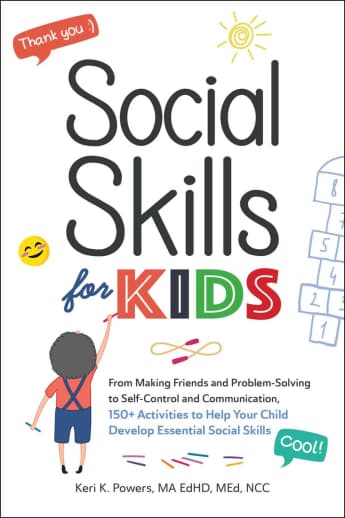
Social Skills for Kids

SKU
056035
ISBN
9781507215753
Grade K-AD
Neutral
Teaching Method
Traditional
Teacher-centered curriculum commonly used in classrooms that may include a text, teacher manual, tests, etc.
Charlotte Mason
A methodology based on the work of a 19th century educator who maintained that children learn best from literature (Living Books), not textbooks.
Classical
A methodology based on the Latin Trivium (three stages of learning), including the grammar stage (memorization and facts), logic stage (critical thinking), and rhetoric stage (developing/defending ideas).
Unit Study
A thematic or topical approach centered around one topic that integrates multiple subject areas.
Montessori (Discovery)
A methodology based on the work of a 20th century educator that emphasizes student and sensory-driven discovery learning and real-life applications.
Other
Other methodologies
Religious Content
Secular
Contains content contrary to common Christian beliefs (i.e. evolution).
Neutral
Avoids religious or theoretical topics or presents multiple viewpoints without preference.
Christian/Religious
Faith-based or including instructional religious content.
Learning Modality
Auditory
Learns through listening, talking out loud or reading out loud.
Visual
Learns through seeing, prefers written instructions and visual materials.
Kinesthetic/Tactile (Hands-On)
Learns through moving, doing and touching.
Multi-Sensory
Curriculum that employ a variety of activities/components.
Presentation
Sequential
Curriculum progresses through well-defined learning objectives. Emphasizes mastery before moving to the next topic.
Spiral
Topics and concepts are repeated from level to level, adding more depth at each pass and connecting with review.
Conceptual/Topical
Focus is on the “why,” often with a unifying concept as well as specific skills; coverage may be broader.
Teacher Involvement
Low Teacher Involvement
Student-led materials; parent acts as a facilitator.
Medium Teacher Involvement
A mix of teacher-led time and independent student work.
High Teacher Involvement
Teacher-led lessons; may utilize discussions, hands-on activities and working together.
Additional Materials Required
No other materials needed
Everything you need is included.
Other Materials Required
There are additional required resources that are a separate purchase.
Other Materials Optional
There are additional resources mentioned or recommended but are not absolutely necessary.
Consumable
Consumable
Designed to be written in; not reusable.
Non-Consumable
Not designed to be written in; reusable.
Our Price
$16.99 $16.99 $12.50
Rainbow Savings: $4.49

Product Overview

  • Easy to use guide to teach, model, and build social skills
  • Targets ages 1-8, but practical help for all ages
  • Over 150 lessons, activities, and games

Description

Social Skills for Kids helps parents prepare their children for real life! But what exactly does that mean? Strong social skills helps our chidlren feel less stress and loneliness, and paves teh way for academic and career success. But, how do you teach valuable social skills? Each activity in this resource has a target behavior such as communication, active listening, cooperation, empathy, self-control, and more. Teach through imaginative play, watching others model behavior, and personal interaction. I liked the real-life situations, such as how to behave in a restaurant or joining in a group of peers. Happy, confident kids is the goal, and you will have 150 opportunities to practice your skills!

Each activity is only 1 page long, which feels like a manageable task. Instructions are clear and well organized. For example, to become aware of your voice level, you play a fun game of hopscotch. Draw a straight hopscotch course numbered 0 to 10. Talk about how zero represents a silent voice and 10 represents the loudest voice you can muster. Starting at the zero spot, players ask, “How is my voice volume?” in various voice levels. The parent responds with something like I would call that a 6. Or maybe, Sounds like a 9. Players then hop to that number. Go back to zero and try a different volume, asking, “How is my voice volume?” Then hop there. Keep going until you have tried as many volumes as you like. When the hopping is done, have a discussion with your child about when each voice is appropriate. When is it not ok to use a 10 voice? How can you remember which voice to use? The numbers and hopping add a point of reference for a child. A few hops is a nice inside voice. More hops is not ok for an inside voice.

A great resource for parents who just need a little direction to teach valuable social skills. 

Publisher's Description of Social Skills for Kids
From taking turns to making eye contact to staying engaged during conversations, developing appropriate social skills is an important factor for kids to be able to succeed in school and life in general. But how can you tell if your child is really making progress while you read the same stories, have the same conversations, and chaperone the same playdates? The answer is to add some variety to your child’s daily activities with these 150 exercises specially designed to keep your child (and their friends) entertained, all while teaching them effective social skills.

In Social Skills for Kids, you’ll learn everything you need to know about how social skills develop in children and what you can do to support their growth. In this book, you’ll find games to encourage them in group settings, activities that you (or another caregiver) can do alone with your child, and ways to make the most of virtual interactions for social skill development.   

 So whether you’re looking for new activities to entertain a few friends during playtime, searching for fun (and educational) games you and your child can play together, or even interested in ways to include people you can’t physically visit, Social Skills for Kids has all the tools you need to help your child develop the social skills they need to succeed.
Category Description for Social Skills
Our Social Skills resources focus on teaching children age-appropriate skills to use in various social settings. They typically target relationships with others and other interactive skills, rather than the full SEL scope of topics. See our Social Emotional Learning category for additional resources.

Details
More Information
Product Format:Paperback Book
Grades:K-AD
Brand:Adams Media Corporation
Author:Keri K. Powers
ISBN:9781507215753
Length in Inches:9
Width in Inches:6
Height in Inches:0.5
Weight in Pounds:0.75
Videos
This product doesn't have a video
Reviews
Product Q&A