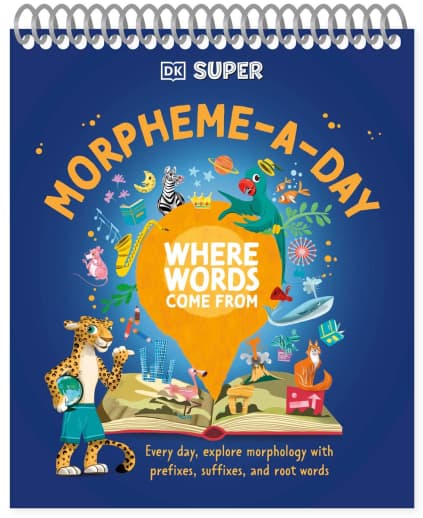
Where Words Come From: Morpheme-A-Day from DK Learning teaches us word origins using morphemes. Use it as a stand-alone addition to your day, perhaps as a conversation starter to your ELA lesson. Or, add the Textbook and Activities to dive deeper into a vocabulary lesson. Kids will enjoy the whimsical animal illustrations! The hard cover flip book has a sturdy base and large spiral binding. Each page has 2 sides, one with the daily morpheme and the other with examples and prompts for the student. ~Sara
Where Words Come From: Morpheme-A-Day
SKU
055758
ISBN
9780593962299
Grade 3-5
These icons are designed to help you quickly understand and learn important information about our products.
Teaching Method
Traditional
Teacher-centered curriculum commonly used in classrooms that may include a text, teacher manual, tests, etc.
Charlotte Mason
A methodology based on the work of a 19th century educator who maintained that children learn best from literature (Living Books), not textbooks.
Classical
A methodology based on the Latin Trivium (three stages of learning), including the grammar stage (memorization and facts), logic stage (critical thinking), and rhetoric stage (developing/defending ideas).
Unit Study
A thematic or topical approach centered around one topic that integrates multiple subject areas.
Montessori (Discovery)
A methodology based on the work of a 20th century educator that emphasizes student and sensory-driven discovery learning and real-life applications.
Other
Other methodologies
Religious Content
Secular
Contains content contrary to common Christian beliefs (i.e. evolution).
Neutral
Avoids religious or theoretical topics or presents multiple viewpoints without preference.
Christian/Religious
Faith-based or including instructional religious content.
Learning Modality
Auditory
Learns through listening, talking out loud or reading out loud.
Visual
Learns through seeing, prefers written instructions and visual materials.
Kinesthetic/Tactile (Hands-On)
Learns through moving, doing and touching.
Multi-Sensory
Curriculum that employ a variety of activities/components.
Presentation
Sequential
Curriculum progresses through well-defined learning objectives. Emphasizes mastery before moving to the next topic.
Spiral
Topics and concepts are repeated from level to level, adding more depth at each pass and connecting with review.
Conceptual/Topical
Focus is on the “why,” often with a unifying concept as well as specific skills; coverage may be broader.
Teacher Involvement
Low Teacher Involvement
Student-led materials; parent acts as a facilitator.
Medium Teacher Involvement
A mix of teacher-led time and independent student work.
High Teacher Involvement
Teacher-led lessons; may utilize discussions, hands-on activities and working together.
Additional Materials Required
No other materials needed
Everything you need is included.
Other Materials Required
There are additional required resources that are a separate purchase.
Other Materials Optional
There are additional resources mentioned or recommended but are not absolutely necessary.
Consumable
Consumable
Designed to be written in; not reusable.
Non-Consumable
Not designed to be written in; reusable.
Our Price
$21.99 $21.99 $15.50
Rainbow Savings: $6.49
Product Overview
- Boost vocabulary, improve spelling skills, and grow reading comprehension!
- Morphemes are the smallest part of a word that tells us something
- Includes root words, bases, prefixes and suffixes
Description
Publisher's Description of Where Words Come From: Morpheme-A-Day
Delve into the fascinating world of morphemes, word formation, and discovery with this visual flip book designed for curious young readers.
DK Super Where Words Come From Morpheme-a-Day is the fundamental guide for children aged 7-11 who want to learn about morphology and the origins of words.
Every day, flip the page and discover a new, beautifully illustrated morpheme. Ideal for front-of-class interventions or small group instruction, this linguistics book breaks down key morphemes and provides activity ideas to build and develop students’ knowledge.
This morphology book for children offers:
- A guide to understanding word formation through prefixes, suffixes, and root words.
- A highly visual approach that makes association between words and where they originate easier to understand.
- Follows up on learning etymology, prefixes, suffixes, and Latin and Greek roots to enhance children’s decoding, spelling, and vocabulary.
Discover over 100 morphemes in this book and improve morphological awareness, a powerful tool in supporting the five pillars of reading. This also includes boosting vocabulary, improving spelling skills and enhancing reading comprehension.
Don’t just read words, understand them!
Category Description for Where Words Come From
Where Words Come From by DK Learning uses colorful illustrated animals to teach morphemes, the smallest part of a word that tells us something. You will find a range of word families from Latin, Greek, even Old English origins! It’s a fun way to teach vocabulary, with benefits in spelling and reading comprehension too. Learn a root word and see the range of vocabulary words connected to the root with various prefixes and suffixes. Since this is made for elementary students, descriptions are brief and age-appropriate. I like it for an introduction to word families.
The 3 components can be used separately or together. There is a hardcover Textbook, a consumable reproducible Activities book with puzzles, and a stand-up flip book called Morpheme-A-Day.
Details
| Product Format: | Hardcover Book |
|---|---|
| Grades: | 3-5 |
| Brand: | DK Children |
| ISBN: | 9780593962299 |
| Length in Inches: | 10 |
| Width in Inches: | 7.25 |
| Height in Inches: | 1.625 |
| Weight in Pounds: | 2.6 |
Videos
Reviews