
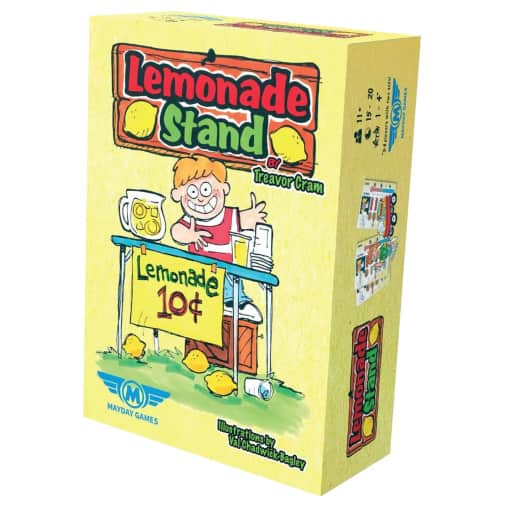
Lemonade Stand Game

SKU
055662
Grade 8-AD
Teaching Method
Traditional
Teacher-centered curriculum commonly used in classrooms that may include a text, teacher manual, tests, etc.
Charlotte Mason
A methodology based on the work of a 19th century educator who maintained that children learn best from literature (Living Books), not textbooks.
Classical
A methodology based on the Latin Trivium (three stages of learning), including the grammar stage (memorization and facts), logic stage (critical thinking), and rhetoric stage (developing/defending ideas).
Unit Study
A thematic or topical approach centered around one topic that integrates multiple subject areas.
Montessori (Discovery)
A methodology based on the work of a 20th century educator that emphasizes student and sensory-driven discovery learning and real-life applications.
Other
Other methodologies
Religious Content
Secular
Contains content contrary to common Christian beliefs (i.e. evolution).
Neutral
Avoids religious or theoretical topics or presents multiple viewpoints without preference.
Christian/Religious
Faith-based or including instructional religious content.
Learning Modality
Auditory
Learns through listening, talking out loud or reading out loud.
Visual
Learns through seeing, prefers written instructions and visual materials.
Kinesthetic/Tactile (Hands-On)
Learns through moving, doing and touching.
Multi-Sensory
Curriculum that employ a variety of activities/components.
Presentation
Sequential
Curriculum progresses through well-defined learning objectives. Emphasizes mastery before moving to the next topic.
Spiral
Topics and concepts are repeated from level to level, adding more depth at each pass and connecting with review.
Conceptual/Topical
Focus is on the “why,” often with a unifying concept as well as specific skills; coverage may be broader.
Teacher Involvement
Low Teacher Involvement
Student-led materials; parent acts as a facilitator.
Medium Teacher Involvement
A mix of teacher-led time and independent student work.
High Teacher Involvement
Teacher-led lessons; may utilize discussions, hands-on activities and working together.
Additional Materials Required
No other materials needed
Everything you need is included.
Other Materials Required
There are additional required resources that are a separate purchase.
Other Materials Optional
There are additional resources mentioned or recommended but are not absolutely necessary.
Consumable
Consumable
Designed to be written in; not reusable.
Non-Consumable
Not designed to be written in; reusable.
Our Price
$15.00 $15.00 $10.95
Rainbow Savings: $4.05

Product Overview

  • Run a lemonade stand for a week and compete to make the biggest profit
  • Learn about supply, demand, and investment factors for business
  • Make decisions based on a weather forecast only
  • For 1-4 players in 15-20 minutes, with solo instructions and expandable up to 8 players

Description

Mayday Games has successfully recreated business lessons about investment and sales for kids in their Lemonade Stand card game. In the span of a virtual week, each turn takes place on one day, when you have a weather forecast to base your decisions on how much lemonade to make, how much to spend on advertising, and what to charge per glass, hoping to make a profit. The forecast also gives you possible ranges of the number of customers you could have and what they might want to pay per glass of lemonade for different weather outcomes. After all players secretly make their decisions, find out the actual weather for the first day.

Once the weather card is revealed, players calculate their sales by looking at how much lemonade they made, how many actual customers they had, and what the selling price was. If there was a profit, they collect cards in denominations equal to that amount. These cards are used next turn to make lemonade and advertise. If they lose money and have none left, they can get 5 cents to stay in business the next day. The current weather card turns into a forecast for tomorrow and everyone makes their business decisions for the next day.

At the end of 7 days of play, everyone counts their money, and the person with the most money wins!

This game can be played by 1-4 people; to increase the count from 5-8, add another game deck, leaving out the added weather cards. There are two different solo mode variations in the manual. Expect to spend 15–20 minutes per game or a bit more if you increase player count. ~ Marsha

Publisher's Description of Lemonade Stand Game

Did you ever play the old computer game “Lemonade Stand” on the Apple IIe computer?  Well we did and we loved it!  It was a simple, fun, educational game that really influenced a lot of people growing up in the early 80s.  We have been trying for a couple of years to recreate the simplicity yet realistic feel of this classic game.  We wanted to recreate this experience in a card game, yet keep the supply and demand calculations and complex math to a minimum.    Designer Trevor Cram was able to create what we hope you will agree is a simple, unique game that allows young and old alike to participate in their own business of setting prices, stocking inventory and making advertising decisions.  Each of these decisions will affect the profits or losses each player realizes, coupled with external forces like the weather and other players special action cards. 

In the end the player with the most money after seven turns will win and become the envy of the other would-be entrepreneurs.  This game plays 1-4 players (or up to 8 players with a 2nd copy of the game) in about 20 minutes and no two games are alike.  Will you suffer bad luck from poor weather or will you play too aggressively or conservatively?  Find out as you venture back to your wonder years gone by and compete with the other kids on the block to build the best Lemonade Stand.

Details
More Information
Product Format:Other
Grades:8-AD
Brand:Mayday Games
EAN/UPC:080162879652
Length in Inches:5.75
Width in Inches:4
Height in Inches:1.875
Weight in Pounds:0.6
Videos
This product doesn't have a video
Reviews
Product Q&A