
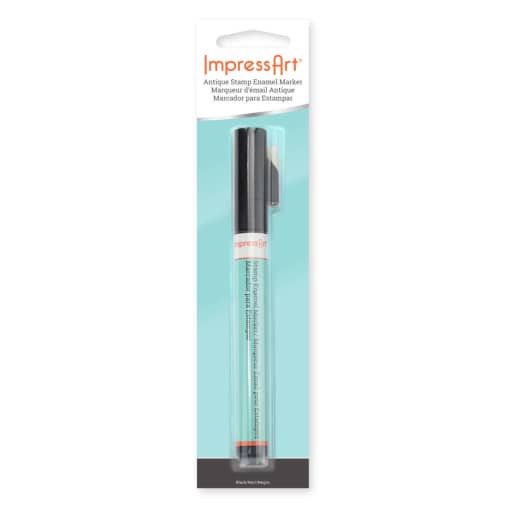
The ImpressArt Paint Marker Black provides a refill for the paint marker in the ImpressArt Starter Kit. It can also be used to fill in engravings in other aluminum bracelets. Easy to use, simply shake, pump the tip, trace the desired letters, let dry for 1-3 minutes, and wipe off the excess paint. This is a very helpful process for helping the engravings to stand out against the rest of the bracelet to help with readability by providing high contrast.
ImpressArt Paint Marker Black
SKU
055487
Grade 8-AD
These icons are designed to help you quickly understand and learn important information about our products.
Teaching Method
Traditional
Teacher-centered curriculum commonly used in classrooms that may include a text, teacher manual, tests, etc.
Charlotte Mason
A methodology based on the work of a 19th century educator who maintained that children learn best from literature (Living Books), not textbooks.
Classical
A methodology based on the Latin Trivium (three stages of learning), including the grammar stage (memorization and facts), logic stage (critical thinking), and rhetoric stage (developing/defending ideas).
Unit Study
A thematic or topical approach centered around one topic that integrates multiple subject areas.
Montessori (Discovery)
A methodology based on the work of a 20th century educator that emphasizes student and sensory-driven discovery learning and real-life applications.
Other
Other methodologies
Religious Content
Secular
Contains content contrary to common Christian beliefs (i.e. evolution).
Neutral
Avoids religious or theoretical topics or presents multiple viewpoints without preference.
Christian/Religious
Faith-based or including instructional religious content.
Learning Modality
Auditory
Learns through listening, talking out loud or reading out loud.
Visual
Learns through seeing, prefers written instructions and visual materials.
Kinesthetic/Tactile (Hands-On)
Learns through moving, doing and touching.
Multi-Sensory
Curriculum that employ a variety of activities/components.
Presentation
Sequential
Curriculum progresses through well-defined learning objectives. Emphasizes mastery before moving to the next topic.
Spiral
Topics and concepts are repeated from level to level, adding more depth at each pass and connecting with review.
Conceptual/Topical
Focus is on the “why,” often with a unifying concept as well as specific skills; coverage may be broader.
Teacher Involvement
Low Teacher Involvement
Student-led materials; parent acts as a facilitator.
Medium Teacher Involvement
A mix of teacher-led time and independent student work.
High Teacher Involvement
Teacher-led lessons; may utilize discussions, hands-on activities and working together.
Additional Materials Required
No other materials needed
Everything you need is included.
Other Materials Required
There are additional required resources that are a separate purchase.
Other Materials Optional
There are additional resources mentioned or recommended but are not absolutely necessary.
Consumable
Consumable
Designed to be written in; not reusable.
Non-Consumable
Not designed to be written in; reusable.
Our Price
$8.75 $8.75 $7.95
Rainbow Savings: $0.80
Product Overview
- Features black enamel paint
- For use with engraved metal jewelry and accessories
- A refill for the ImpressArt Starter Kit Marker
Description
Publisher's Description of ImpressArt Paint Marker Black
ImpressArt's new stamp enamel marker is a black acrylic ink used to
darken stamped impressions so your design will be clearly seen.
Convenient applicator marker makes highlighting impressions quicker,
easier and cleaner.
Simply run the tip of your marker over the stamped area from left to right, wait 3-5 minutes, and wipe away excess ink with a paper towel.
Category Description for ImpressArt Bracelet Stamping
Personalize your very own wearable jewelry with these stamping kits! The Starter Kit includes a hammer, bracelet bending pliers, 3mm letter stamps A-Z, stamp enamel, and an alignment tool with built in ruler to hold the bracelet in place while it’s being stamped. There are also 12 6” x ¼” and 12 6” x 3/8” aluminum strips to be turned into bracelets. A QR code offers a free class tutorial. Homeroom Numbers includes number stamps for 0-9. The Paint Marker has black ink that can be used to darken engravings.
Details
| Product Format: | Other |
|---|---|
| Grades: | 8-AD |
| Brand: | ImpressArt |
| EAN/UPC: | 011499028673 |
| Length in Inches: | 7.875 |
| Width in Inches: | 1.875 |
| Height in Inches: | 0.625 |
| Weight in Pounds: | 0.05 |
Videos
Reviews