
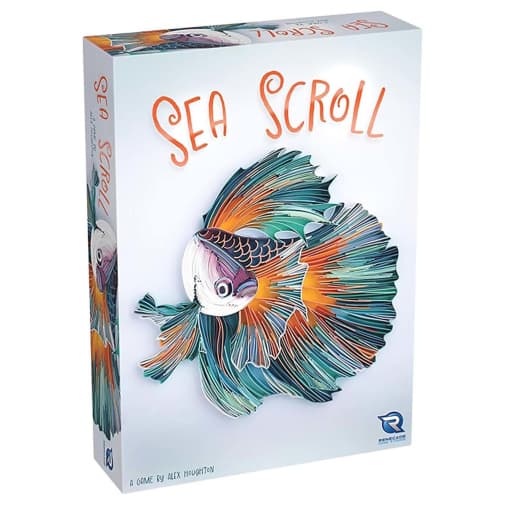
Sea Scroll by Renegade Games fits perfectly into family game night rotation as an easy-to-learn, fast-moving card game for 2-6 players that takes only 15 minutes per game. There are 72 cards numbered 4 to 12, which beautifully display nine different species of fish. Each card number belongs to a specific fish, indicates how many of that type of fish are included in the deck, and represents the point value received by the player who collects the largest set, or “school,” of that fish species. For example, number 11 is the Royal Angelfish, there are 11 Angelfish in the deck, and the largest school is worth 11 points at the end of the game.
Adjust the deck of 72 fish cards based on included setup
instructions according to player count. Shuffle the deck and deal out two
starting cards to each player. Next, create a display of cards equal to the
player count plus one. Group cards in the same school together as a central
display also known as “the reef.” The goal is to end the game with the largest
schools to earn the number of points shown for that type of fish. If you end
the game with any cards in a school of fish that is not the largest, you lose
the number of points represented by that card. Players take turns as follows:
- You must draw two cards from the deck and place them in your hand. Optionally, take one school of fish from the display and place it in front of you in your personal display. You must discard one card from your hand to the reef, keeping schools of fish together. Note that you may only take three schools of fish from the display during the game, so choose them wisely.
- Play continues with everyone taking turns until the deck runs out. All players have one final turn where they may take a school of fish, if they have less than three, and discard a final card before the game ends. Next, combine any claimed schools in your personal display with those in your hand, and scoring begins.
- Starting with number 4, the Regal Tang Fish, and continuing through the highest numbered school number in the game score, learn who has the largest school for each. That person scores the number of points indicated on the corresponding card. For example, the Lionfish cards have the number 9 on them, so the player with the largest school of Lionfish scores 9 points. If two players tie for the largest school, they both score 9 points. Any players who have at least 1 Lionfish but less than the largest school subtract 9 from their score. When all numbered cards are scored, the player with the most points wins!
In addition to the basic rules of this game, there are 13 variant cards that modify rules and can be combined, mixed, matched, or randomly chosen to make the game more challenging and interesting. This is one of my favorite new card games I have played this year, and it receives my enthusiastic recommendation! ~ Marsha