
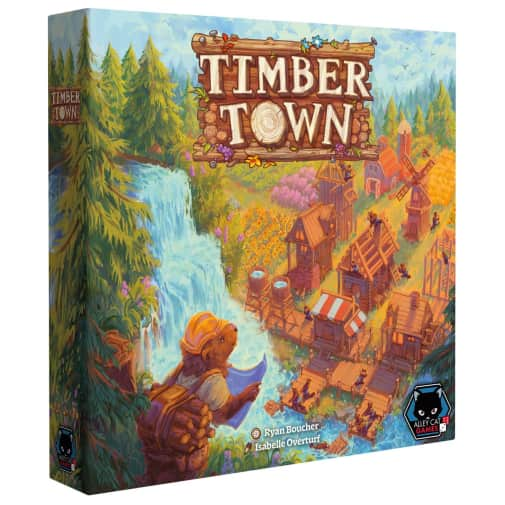
The eager beavers of Timber Town from Alley Cat Games are busy finding tile components needed to build a town and stacking them up to float them down the river towards the 2 players who wait on its opposite sides. With optimum tile selection and placement, players compete to earn points for building the best town along the river. As soon as someone finishes their town or neither player can place any more tiles, the game ends and the person with the most points wins!
To set up this two-player-only game, four river boards with three tile spaces each and alternating player icons are placed in the center of the table to create a “moving” river. Shuffle building tiles and place them in three piles to the left of the river. Populate the leftmost river board with three building tiles drawn from these piles. Both players put their town boards on opposite sides of the river, which flows between them. Town boards have four columns that line up with the river board’s four column tiles and have three rows in each column, giving players a 3x4 tile grid on which to build their town.
There are seven different types of building tiles in the game and two of these have components that provide benefits during the game and help towards end-game scoring. Put these in a general supply. The last part of set up is to randomly select one of each of the 7 different types of scoring cards, which match the building tile types by their colors and names, and place them in an area where all players can see them. These cards provide scoring criteria for each building type at the end of the game.
In Timber Town, a turn consists of claiming a building tile and putting it on your town board, but if there are no tiles that can be placed, you must pass your turn. Basic placement rules are that you must put tiles in the same column on your town board as the one that lines up with the river board you took it from, and that all boardwalks must connect to another boardwalk or be on the edge of the player board. On the first round, there will only be tiles in one river board column. After both players have taken or passed a turn, the round ends and any tiles remaining on the last river board are discarded as the now-empty river tile moves to become the first column. Draw new building tiles to populate the first river tile and start the next round. Throughout the game, players draw tiles as they move across the river, being mindful of meeting scoring card point criteria. At game end, count points for each scoring card as it relates to their corresponding building tile placement on each player’s town board. The player with the most points wins!
Timber Town is easy to learn and understand, but with tile placement rules and scorecard challenges, it creates a nice multi-dimensional puzzle. This game is one of the favorites in my collection and when I don’t have much time for a game, I love that it plays in 30-45 minutes. Because I often have only one person to play with, it is nice that it is designed as a two-player-only experience. ~ Marsha