
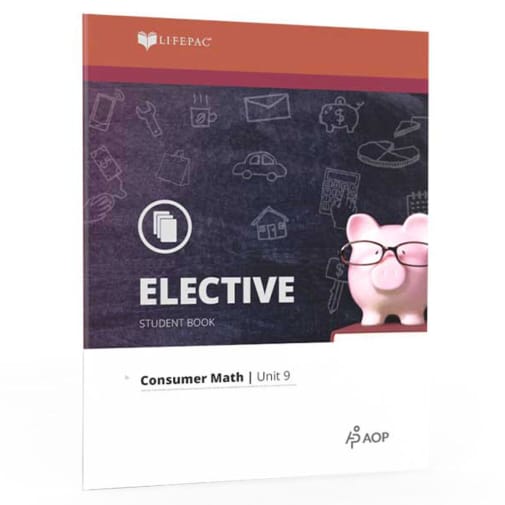
LIFEPAC Consumer Math: Unit 9 Student Book

SKU
054705
ISBN
9780740342806
Grade 10-12
Teaching Method
Traditional
Teacher-centered curriculum commonly used in classrooms that may include a text, teacher manual, tests, etc.
Charlotte Mason
A methodology based on the work of a 19th century educator who maintained that children learn best from literature (Living Books), not textbooks.
Classical
A methodology based on the Latin Trivium (three stages of learning), including the grammar stage (memorization and facts), logic stage (critical thinking), and rhetoric stage (developing/defending ideas).
Unit Study
A thematic or topical approach centered around one topic that integrates multiple subject areas.
Montessori (Discovery)
A methodology based on the work of a 20th century educator that emphasizes student and sensory-driven discovery learning and real-life applications.
Other
Other methodologies
Religious Content
Secular
Contains content contrary to common Christian beliefs (i.e. evolution).
Neutral
Avoids religious or theoretical topics or presents multiple viewpoints without preference.
Christian/Religious
Faith-based or including instructional religious content.
Learning Modality
Auditory
Learns through listening, talking out loud or reading out loud.
Visual
Learns through seeing, prefers written instructions and visual materials.
Kinesthetic/Tactile (Hands-On)
Learns through moving, doing and touching.
Multi-Sensory
Curriculum that employ a variety of activities/components.
Presentation
Sequential
Curriculum progresses through well-defined learning objectives. Emphasizes mastery before moving to the next topic.
Spiral
Topics and concepts are repeated from level to level, adding more depth at each pass and connecting with review.
Conceptual/Topical
Focus is on the “why,” often with a unifying concept as well as specific skills; coverage may be broader.
Teacher Involvement
Low Teacher Involvement
Student-led materials; parent acts as a facilitator.
Medium Teacher Involvement
A mix of teacher-led time and independent student work.
High Teacher Involvement
Teacher-led lessons; may utilize discussions, hands-on activities and working together.
Additional Materials Required
No other materials needed
Everything you need is included.
Other Materials Required
There are additional required resources that are a separate purchase.
Other Materials Optional
There are additional resources mentioned or recommended but are not absolutely necessary.
Consumable
Consumable
Designed to be written in; not reusable.
Non-Consumable
Not designed to be written in; reusable.
Our Price
$8.50

Description

Publisher's Description of LIFEPAC Consumer Math: Unit 9 Student Book

In Consumer Mathematics Unit 9, students will study ways to begin responsible habits now, exploring options becoming more financially literate from a young age. Students learn strategies for completing research on financial topics, including identifying reliable resources and evaluating sources for reliability and credibility. Lastly, students will explore considerations for retirement and learn about tools for calculating retirement savings.

In this course, students will study:

·         Responsible financial habits

·         Consequences of financial irresponsibility

·         How to find reliable financial information

·         Strategies to evaluate sources of financial information

·         What to consider for retirement savings

·         How to calculate retirement income

·         Tools for saving for retirement

Course Objectives

·         Identify ways to be a financially responsible individual.

·         Give examples of the benefits of financial responsibility.

·         Give examples of the costs of financial irresponsibility.

·         Identify effects of responsibility and irresponsibility on the local and global community.

·         Understand there are a variety of sources for financial information.

·         Understand why financial resources should be evaluated for validity.

·         Know the characteristics of reliable financial resources.

·         Know the characteristics of unreliable financial resources.

·         Learn tools for evaluating sources of financial information.

·         Practice evaluating financial information for reliability and relevance.

·         Understand common retirement savings plan options.

·         Recognize the different rules and requirements of common retirement savings plans.

·         Explore retirement considerations.

·         Become familiar with retirement savings calculators.

Category Description for Alpha Omega LIFEPAC Consumer Math

Practical application of math in the areas of family finances, occupations, business, and transportation. Helps students to solve real-life problems in budgeting, banking, and taxes. Boxed set includes ten LIFEPAC workbooks, review test and a solution key (which includes answers to the Lifepac questions), self-test, and test. LIFEPACS ONLY set includes just the Lifepacs, and workbooks and solution key are also sold individually. Prerequisites are Algebra I and Geometry.

Details
More Information
Product Format:Paperback
Grades:10-12
Brand:Alpha Omega Publications
ISBN:9780740342806
Length in Inches:10.875
Width in Inches:8.375
Height in Inches:0.1875
Weight in Pounds:0.4
Videos
This product doesn't have a video
Reviews
Product Q&A