
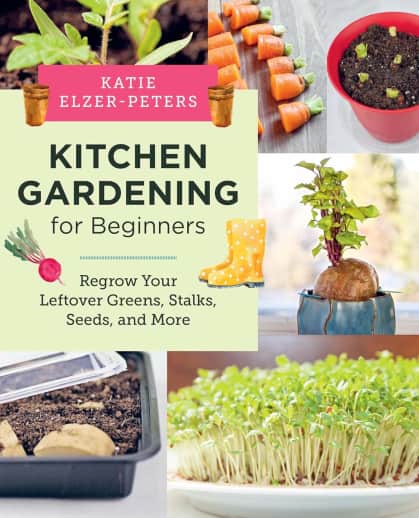
Kids can eat what they grow using kitchen refuse! Kitchen Gardening for Beginners is full of practical application and edible “experiments” to complete right in your kitchen. Remember to include adults! Regrow vegetables from cuttings; grow your own sprouts and microgreens; grow fruit trees from seeds; and much more. Step-by-step instructions, growing tips, fun facts, and an index help you select the kitchen scraps you’ll grow from next. 112 pgs, softcover.
Kitchen Gardening for Beginners
SKU
054409
ISBN
9780760390986
Grade 4-12
These icons are designed to help you quickly understand and learn important information about our products.
Teaching Method
Traditional
Teacher-centered curriculum commonly used in classrooms that may include a text, teacher manual, tests, etc.
Charlotte Mason
A methodology based on the work of a 19th century educator who maintained that children learn best from literature (Living Books), not textbooks.
Classical
A methodology based on the Latin Trivium (three stages of learning), including the grammar stage (memorization and facts), logic stage (critical thinking), and rhetoric stage (developing/defending ideas).
Unit Study
A thematic or topical approach centered around one topic that integrates multiple subject areas.
Montessori (Discovery)
A methodology based on the work of a 20th century educator that emphasizes student and sensory-driven discovery learning and real-life applications.
Other
Other methodologies
Religious Content
Secular
Contains content contrary to common Christian beliefs (i.e. evolution).
Neutral
Avoids religious or theoretical topics or presents multiple viewpoints without preference.
Christian/Religious
Faith-based or including instructional religious content.
Learning Modality
Auditory
Learns through listening, talking out loud or reading out loud.
Visual
Learns through seeing, prefers written instructions and visual materials.
Kinesthetic/Tactile (Hands-On)
Learns through moving, doing and touching.
Multi-Sensory
Curriculum that employ a variety of activities/components.
Presentation
Sequential
Curriculum progresses through well-defined learning objectives. Emphasizes mastery before moving to the next topic.
Spiral
Topics and concepts are repeated from level to level, adding more depth at each pass and connecting with review.
Conceptual/Topical
Focus is on the “why,” often with a unifying concept as well as specific skills; coverage may be broader.
Teacher Involvement
Low Teacher Involvement
Student-led materials; parent acts as a facilitator.
Medium Teacher Involvement
A mix of teacher-led time and independent student work.
High Teacher Involvement
Teacher-led lessons; may utilize discussions, hands-on activities and working together.
Additional Materials Required
No other materials needed
Everything you need is included.
Other Materials Required
There are additional required resources that are a separate purchase.
Other Materials Optional
There are additional resources mentioned or recommended but are not absolutely necessary.
Consumable
Consumable
Designed to be written in; not reusable.
Non-Consumable
Not designed to be written in; reusable.
Our Price
$14.99 $14.99 $11.50
Rainbow Savings: $3.49
Description
Publisher's Description of Kitchen Gardening for Beginners
Discover how to easily regrow vegetable
discards and scraps and turn them into harvestable, edible plants—even
if you have no gardening experience.
Stop tossing your carrot tops, leafless herb sprigs, lettuce and celery stumps, and beet greens in the trash! Cut back on your food waste and cultivate your own homegrown veggies easily with advice from Kitchen Gardening for Beginners, a beginner-friendly edition of No-Waste Kitchen Gardening.
Learn how to grow indoors and maintain your regrown plants until they are ready for harvest. The accompanying photos highlight each step of the process, showing you what the root section, seed, leaf, stem, or other plant part should look like when you replant it and then what it should look like when it’s ready for harvest. Many of the featured vegetables can be regrown in water or in soil. Full instructions are supplied.
A diverse selection of large and small edibles—some that are quick to regrow and others that take a bit longer—are included, so you can decide what regrown foods are the best fit for your family. A few of the many plants featured include:
Stop tossing your carrot tops, leafless herb sprigs, lettuce and celery stumps, and beet greens in the trash! Cut back on your food waste and cultivate your own homegrown veggies easily with advice from Kitchen Gardening for Beginners, a beginner-friendly edition of No-Waste Kitchen Gardening.
Learn how to grow indoors and maintain your regrown plants until they are ready for harvest. The accompanying photos highlight each step of the process, showing you what the root section, seed, leaf, stem, or other plant part should look like when you replant it and then what it should look like when it’s ready for harvest. Many of the featured vegetables can be regrown in water or in soil. Full instructions are supplied.
A diverse selection of large and small edibles—some that are quick to regrow and others that take a bit longer—are included, so you can decide what regrown foods are the best fit for your family. A few of the many plants featured include:
- Green onions
- Ginger
- Celery
- Tomatoes
- Melons
- Herbs
- Avocados
- Potatoes
- Carrots
Details
| Product Format: | Paperback Book |
|---|---|
| Grades: | 4-12 |
| Brand: | New Shoe Press |
| ISBN: | 9780760390986 |
| Length in Inches: | 9.25 |
| Width in Inches: | 7.5 |
| Height in Inches: | 0.3125 |
| Weight in Pounds: | 0.65 |
Videos
Reviews