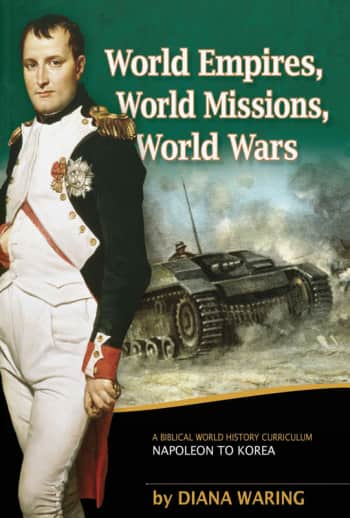
World Empires, World Missions, World Wars Student Book
SKU
053972
ISBN
9781930514690
Grade 3-12
Unit Study
Christian/Religious
Medium Teacher Involvement
Multi-Sensory
Other Materials Optional
These icons are designed to help you quickly understand and learn important information about our products.
Teaching Method
Traditional
Teacher-centered curriculum commonly used in classrooms that may include a text, teacher manual, tests, etc.
Charlotte Mason
A methodology based on the work of a 19th century educator who maintained that children learn best from literature (Living Books), not textbooks.
Classical
A methodology based on the Latin Trivium (three stages of learning), including the grammar stage (memorization and facts), logic stage (critical thinking), and rhetoric stage (developing/defending ideas).
Unit Study
A thematic or topical approach centered around one topic that integrates multiple subject areas.
Montessori (Discovery)
A methodology based on the work of a 20th century educator that emphasizes student and sensory-driven discovery learning and real-life applications.
Other
Other methodologies
Religious Content
Secular
Contains content contrary to common Christian beliefs (i.e. evolution).
Neutral
Avoids religious or theoretical topics or presents multiple viewpoints without preference.
Christian/Religious
Faith-based or including instructional religious content.
Learning Modality
Auditory
Learns through listening, talking out loud or reading out loud.
Visual
Learns through seeing, prefers written instructions and visual materials.
Kinesthetic/Tactile (Hands-On)
Learns through moving, doing and touching.
Multi-Sensory
Curriculum that employ a variety of activities/components.
Presentation
Sequential
Curriculum progresses through well-defined learning objectives. Emphasizes mastery before moving to the next topic.
Spiral
Topics and concepts are repeated from level to level, adding more depth at each pass and connecting with review.
Conceptual/Topical
Focus is on the “why,” often with a unifying concept as well as specific skills; coverage may be broader.
Teacher Involvement
Low Teacher Involvement
Student-led materials; parent acts as a facilitator.
Medium Teacher Involvement
A mix of teacher-led time and independent student work.
High Teacher Involvement
Teacher-led lessons; may utilize discussions, hands-on activities and working together.
Additional Materials Required
No other materials needed
Everything you need is included.
Other Materials Required
There are additional required resources that are a separate purchase.
Other Materials Optional
There are additional resources mentioned or recommended but are not absolutely necessary.
The Student Manuals contain introductory articles for each unit to provide an overview of that period of history, lots of options for hands-on projects and topics for further research, book lists organized by age group, discussion questions, and self-evaluation questions at the end of each phase in every lesson.
Publisher's Description of World Empires, World Missions, World Wars Student Book
Product Details
World Empires, World Missions, World Wars – an idea-packed, multidisciplinary, family-style study guide. At the same time that the Napoleonic Wars usher in the era of the Late Modern Period, the Modern Missions Movement begins with William Carey's awe-inspiring work in India. From this revolutionary and redefining moment, World Empires, World Missions, World Wars continues to weave together the historic events in the world and in the Church through the Industrial Revolution, the British Empire, the growth of the United States, and the World Wars all the way to the conclusion of the Korean War in 1953 and Jim Elliot's historic journey in 1956 to the Waodani people of Ecuador. Discover not only the kings and politicians, the artists and musicians, the scientists and inventors, but also the amazing fingerprints of our redeeming God and His people during one of the most tumultuous times in world history. 1800 – 1950s.
Idea packed, multi-disciplinary, family-style study guide from the Napoleonic Wars to the Korean War
Explore this era of history with an integrated inclusion of the Modern Missions movement, revivals, and other Church history events
Discover kings, politicians, artists, musicians, scientists, inventors, and most importantly the fingerprints of God in history
List of Chapters
Unit One: Napoleon & Early Missions
Unit Two: Industrialization & the Church's Response
Unit Three: The British Empire & Awakenings
Unit Four: Napoleon III & Christian Outreach
Unit Five: Alliances & Revivals
Unit Six: World War I & the Russian Revolutions
Unit Seven: Fascism & Fundamentals
Unit Eight: World War II & Miraculous Deliverances
The third volume in Diana Waring's history course begins with the Napoleonic era and continues through the early years of the Cold War (1800 - 1950s). Discover how God works through the lives of specific people, through events the world over, and through His Church - even in our tumultuous modern time.