These icons are designed to help you quickly understand and learn important information about our products.
Teaching Method
Traditional
Teacher-centered curriculum commonly used in classrooms that may include a text, teacher manual, tests, etc.
Charlotte Mason
A methodology based on the work of a 19th century educator who maintained that children learn best from literature (Living Books), not textbooks.
Classical
A methodology based on the Latin Trivium (three stages of learning), including the grammar stage (memorization and facts), logic stage (critical thinking), and rhetoric stage (developing/defending ideas).
Unit Study
A thematic or topical approach centered around one topic that integrates multiple subject areas.
Montessori (Discovery)
A methodology based on the work of a 20th century educator that emphasizes student and sensory-driven discovery learning and real-life applications.
Other
Other methodologies
Religious Content
Secular
Contains content contrary to common Christian beliefs (i.e. evolution).
Neutral
Avoids religious or theoretical topics or presents multiple viewpoints without preference.
Christian/Religious
Faith-based or including instructional religious content.
Learning Modality
Auditory
Learns through listening, talking out loud or reading out loud.
Visual
Learns through seeing, prefers written instructions and visual materials.
Kinesthetic/Tactile (Hands-On)
Learns through moving, doing and touching.
Multi-Sensory
Curriculum that employ a variety of activities/components.
Presentation
Sequential
Curriculum progresses through well-defined learning objectives. Emphasizes mastery before moving to the next topic.
Spiral
Topics and concepts are repeated from level to level, adding more depth at each pass and connecting with review.
Conceptual/Topical
Focus is on the “why,” often with a unifying concept as well as specific skills; coverage may be broader.
Teacher Involvement
Low Teacher Involvement
Student-led materials; parent acts as a facilitator.
Medium Teacher Involvement
A mix of teacher-led time and independent student work.
High Teacher Involvement
Teacher-led lessons; may utilize discussions, hands-on activities and working together.
Additional Materials Required
No other materials needed
Everything you need is included.
Other Materials Required
There are additional required resources that are a separate purchase.
Other Materials Optional
There are additional resources mentioned or recommended but are not absolutely necessary.
If your student will be taking the ACT soon, prepare them
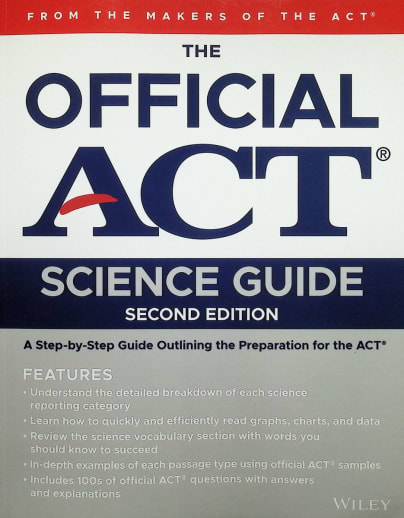
well for the Science section with The Official ACT Science Guidefrom Wiley. Help your student know what to expect and how to prepare
for success! The Guide includes test-taking tips, instruction of concepts, and
plenty of practice. The first ten chapters teach and review core concepts that
will be on the test. Your student will review key definitions, data
representation, the scientific method, conflicting viewpoints, and other topics
from the test. Within the instructional section are plenty of example charts
and tables that your student will encounter on the ACT. Below each diagram is
the scientific concept your student needs to understand.
Chapter 11 includes 302 sample questions from the Science
portion of the ACT. This section is not set up as a practice test and is not in
any specific order or intended to be done in any specific timeframe. The last
chapter of the book has all the answers with full explanations to each
question. Pages are newsprint, which allows for easy use with a pencil. Softcover,
376 pages. ~Tara
Publisher's Description of Official Guide ACT Science, Third Edition
The ACT official subject guides are a step by step guide for outlining the preparation for the ACT section tests. These prep guides provide students a concept-based outline for the subjects they plan to focus on. Each one of the official guides, is an efficient prep tool comprised of the most current and relevant test information packed into one guide. In addition to the book, the entire pool of questions are available online for a customizable learning experience. The ACT official subject guides are the best resource to get detailed input and practice to help you in preparation for the ACT. By using this guide, students can feel comfortable and confident that they are preparing to do their best!
Features of the ACT® Official Science Guide Includes: Understand the detailed breakdown of each science reporting category; Learn how to quickly and efficiently read graphs, charts, and data; Review the science vocabulary section with words you should know to success; In-depth examples of each passage type using official ACT samples; Detailed solutions and explanations for every official ACT science question in the book.