These icons are designed to help you quickly understand and learn important information about our products.
Teaching Method
Traditional
Teacher-centered curriculum commonly used in classrooms that may include a text, teacher manual, tests, etc.
Charlotte Mason
A methodology based on the work of a 19th century educator who maintained that children learn best from literature (Living Books), not textbooks.
Classical
A methodology based on the Latin Trivium (three stages of learning), including the grammar stage (memorization and facts), logic stage (critical thinking), and rhetoric stage (developing/defending ideas).
Unit Study
A thematic or topical approach centered around one topic that integrates multiple subject areas.
Montessori (Discovery)
A methodology based on the work of a 20th century educator that emphasizes student and sensory-driven discovery learning and real-life applications.
Other
Other methodologies
Religious Content
Secular
Contains content contrary to common Christian beliefs (i.e. evolution).
Neutral
Avoids religious or theoretical topics or presents multiple viewpoints without preference.
Christian/Religious
Faith-based or including instructional religious content.
Learning Modality
Auditory
Learns through listening, talking out loud or reading out loud.
Visual
Learns through seeing, prefers written instructions and visual materials.
Kinesthetic/Tactile (Hands-On)
Learns through moving, doing and touching.
Multi-Sensory
Curriculum that employ a variety of activities/components.
Presentation
Sequential
Curriculum progresses through well-defined learning objectives. Emphasizes mastery before moving to the next topic.
Spiral
Topics and concepts are repeated from level to level, adding more depth at each pass and connecting with review.
Conceptual/Topical
Focus is on the “why,” often with a unifying concept as well as specific skills; coverage may be broader.
Teacher Involvement
Low Teacher Involvement
Student-led materials; parent acts as a facilitator.
Medium Teacher Involvement
A mix of teacher-led time and independent student work.
High Teacher Involvement
Teacher-led lessons; may utilize discussions, hands-on activities and working together.
Additional Materials Required
No other materials needed
Everything you need is included.
Other Materials Required
There are additional required resources that are a separate purchase.
Other Materials Optional
There are additional resources mentioned or recommended but are not absolutely necessary.
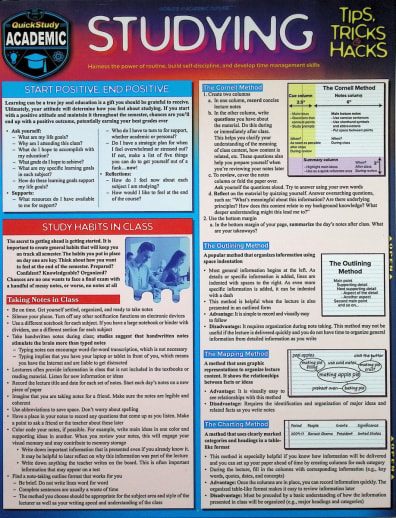
Studying:
Tips, Trick & Hacks Quick Study
is a wonderful resource for students to help them not only study but be
successful in many areas of life. It is the size of a piece of paper (8.5”x11”)
that is laminated and opens in a trifold (25”x 11.5”) with information on the
front and back. The contents include the following topics:
Start
Positive, End Positive – how to approach a semester of study with a good
attitude
Study
Habits in Class – Taking notes (Cornell Method, Outlining Method, Mapping
Method, Charting Method, Sentence Method), Practicing Active Listening,
Participating in Class
Reading
at Home – Reading Comprehension methods (SQ3R Method, KWL Method)
Studying
for Specific Subjects – Tips for Language, Science, Math, History, Literature)
Daily
& Weekly Reviews – learn to review your notes and class materials
Discipline
& Organization in Planning
Motivation
– scheduling times of reward to keep you motivated
Power
Breaks – Short breaks give your brain a rest
Study
Aids – learn what works for you
Practice
makes Perfect – take practice tests to prepare for the exam
Collaborate:
Bring Together Great Minds – forming study groups
Committing
Knowledge to Long-term Memory – Memory tricks
Study
Environment – Setting up study space for success
Final
Review
Why
You Should Never Cram – the effects of cramming
Before
the Big Day – pretest strategies
Test
Day: Time to Shine – How to stay calm, arriving at the test site
Test-Taking
Tips – how to use your time effectively during a test and post-test fun
Resources
– helpful links on the strategies covered in this study guide ~Amber
Publisher's Description of Studying: Tips, Tricks & Hacks Quick Study
Get better grades using proven tactics of the most successful students.
Learning so many subjects can be so much easier when taught how to
study. This quick and easy 6 page laminated reference to those tactics
can help reinforce with every review. Follow the guide and practice,
practice, practice the tactics until they are habit. Harness the power
of routine, build self-discipline, develop time management skills and
success will follow. Practice will be easier with this guide as a
roadmap. Once these skills are habit, you will know the road to success
like the back of your hand.