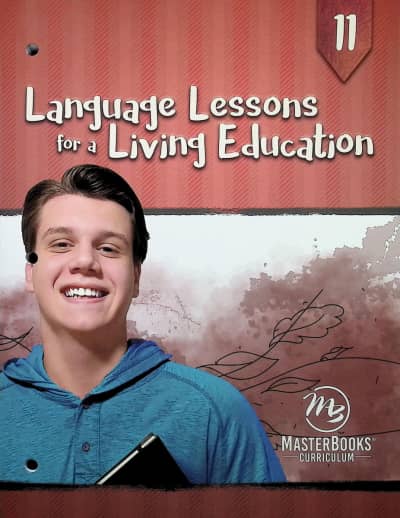
Language Lessons for a Living Education 11

SKU
052973
ISBN
9781683443292
Grade 11-12
Teaching Method
Traditional
Teacher-centered curriculum commonly used in classrooms that may include a text, teacher manual, tests, etc.
Charlotte Mason
A methodology based on the work of a 19th century educator who maintained that children learn best from literature (Living Books), not textbooks.
Classical
A methodology based on the Latin Trivium (three stages of learning), including the grammar stage (memorization and facts), logic stage (critical thinking), and rhetoric stage (developing/defending ideas).
Unit Study
A thematic or topical approach centered around one topic that integrates multiple subject areas.
Montessori (Discovery)
A methodology based on the work of a 20th century educator that emphasizes student and sensory-driven discovery learning and real-life applications.
Other
Other methodologies
Religious Content
Secular
Contains content contrary to common Christian beliefs (i.e. evolution).
Neutral
Avoids religious or theoretical topics or presents multiple viewpoints without preference.
Christian/Religious
Faith-based or including instructional religious content.
Learning Modality
Auditory
Learns through listening, talking out loud or reading out loud.
Visual
Learns through seeing, prefers written instructions and visual materials.
Kinesthetic/Tactile (Hands-On)
Learns through moving, doing and touching.
Multi-Sensory
Curriculum that employ a variety of activities/components.
Presentation
Sequential
Curriculum progresses through well-defined learning objectives. Emphasizes mastery before moving to the next topic.
Spiral
Topics and concepts are repeated from level to level, adding more depth at each pass and connecting with review.
Conceptual/Topical
Focus is on the “why,” often with a unifying concept as well as specific skills; coverage may be broader.
Teacher Involvement
Low Teacher Involvement
Student-led materials; parent acts as a facilitator.
Medium Teacher Involvement
A mix of teacher-led time and independent student work.
High Teacher Involvement
Teacher-led lessons; may utilize discussions, hands-on activities and working together.
Additional Materials Required
No other materials needed
Everything you need is included.
Other Materials Required
There are additional required resources that are a separate purchase.
Other Materials Optional
There are additional resources mentioned or recommended but are not absolutely necessary.
Consumable
Consumable
Designed to be written in; not reusable.
Non-Consumable
Not designed to be written in; reusable.
Our Price
$51.99 $51.99 $41.59
Rainbow Savings: $10.40

Product Overview

  • Personalized, challenging, open-and-go
  • Add your choice of literature for a complete English credit
  • Emphasizes critical thinking, logic, and communication that honors God
  • Teaches APA citation

Description

Build upon previous levels of Master Books courses while focusing on 5 types of communication: written, verbal, nonverbal/visual, active listening, and context (examining the audience and setting). While the course’s primary emphasis is written communication, students will also learn to work with other elements which influence the writing process. Your student is ready for this course if they can write a 5-paragraph essay with well-written paragraphs, use grammar properly, recognize abstract concepts, and use high school–level vocabulary. Students will refine their writing and analytical skills. Essay assignments are 7-10 paragraphs each, with one essay per quarter. Students will also focus on the steps to develop quality writing. At this level, students learn APA research format. This change from MLA requirements in Level 10 is intentional. Students will be well prepared for either writing and format style in college or their career.

Students follow a weekly pattern, with each day focusing on a different ELA task. Day 1 is a special feature focus (hymn, picture, quotation or Scripture study, and vocabulary). Day 2 is devoted to grammar and punctuation application; Day 3 develops communication skills, including logical reasoning. Day 4 analyzes worldview and literature. Each week ends with review on Friday.

This level emphasizes logic study by examining fallacies and literary devices. Clear communication is key. While strong, logical communication is emphasized, a biweekly feature focuses students on communication with God. Per quarter, students will work on one larger writing project. Instruction guides students step-by-step through different types of writing, including research; cause-effect; persuasive; book reviews; comparison/contrast; some creative writing; and a critical essay. Students practice time management and oral communication with projects. A Communication Clarity section focuses on avoiding communication blunders. At this level, the choice of added literature components is up to student and parent. The author recommends choosing challenging, but not overwhelming, additional reading for students to engage with and respond to.

User-friendly for the student and teacher, the text’s last 153 pages provide the teacher tools. This teacher-tools section can be removed from the book for your use. These tools help implement the course: extra-credit communication assignments, essay worksheets, citation notes, a spelling and vocabulary section, study sheets, answer key, and writing grading rubrics that will help assess such things as structure, vocabulary/word choice, grammar, and assignment expectations. Students will also need a few additional items: a notebook, Bible, dictionary, thesaurus, 3x5 index cards, and independent reading books of your choice. Scriptures are from NASB, ESV, NIV (2011), NKJV, and KJV. Schedule approximately 50 minutes, five days per week for 180 days. 534 pgs, sc. ~ Ruth
Publisher's Description of Language Lessons for a Living Education 11
Language lessons for a Living Education Level 11 equips upper-level high school students by refining their communication skills in preparation for college and/or career settings. A focus on logic in writing assists students in creating strong and persuasive essays and prepares them to share thoughts and opinions convincingly. Students learn and practice communication skills through essays, summaries, oral presentations, book reviews, grammar practice, and written prayers. Research skills are strengthened through research essays and application of the APA citation style. This course employs a variety of features preparing the student for quality communication throughout high school and beyond.

Category Description for Language Lessons for a Living Education

Language Lessons for a Living Education is a gentle, Charlotte Mason–inspired language arts program from Master Books®. It beautifully integrates composition, narration, dictation, handwriting, picture study, grammar, mechanics, vocabulary, and spelling into one cohesive literature-rich course while speaking with a strong biblical worldview. Using living books and activities, the program emphasizes oral narration, meaningful writing assignments, Scripture memorization, and other tasks. Skills are gently and progressively built over time. Lessons are relational, engaging, and designed to nurture all language arts skills while emphasizing godly character. These curriculum courses function as a complete language arts course when paired with quality living books. Some reading suggestions are provided, but the course expects you to add good literature to strengthen and maintain your student at or above grade level.

Getting Started

If your child needs a transitional phonics course, the publisher recommends using Foundations Phonics as a one-semester program either in Kindergarten or Grade 1 before beginning Language Lessons Level 1.

Program Overview

  • Level 1 introduces Language Arts skills with a short, gentle approach. This level can be taught either in one semester for older students or as a full year for younger students.
  • Levels 2–6 (Elementary): All levels are designed for one full school year (36 weeks). For Grades 2 and up, the program’s free placement guide helps you choose the best level based on your student’s needs. Lessons help students practice skills and build them gradually. Levels 3 through 5 also use 101 Favorite Stories from the Bible.
  • For lower grades, an additional Practice Makes Polished series is available and provides additional spelling, grammar, reading, and writing practice. See each grade level for this additional resource.
  • Levels 7–12 (Middle & High School): Each grade becomes more structured, increasing student independence and adding multidimensional writing demands. While written communication is emphasized, there’s also a focus on oral communication, including practical life application. Most levels will assign one specific additional resource that is highlighted weekly throughout the year. God’s Story is used in both Levels 7 and 8.

Each level comes in a single consumable 3-hole-punched Course Book, which serves as the student workbook and teacher guide. Lower grade levels include short teacher notes right in the lessons. Every level features a substantial Teacher’s Resource section at the back with answer keys, reproducible resources, optional games, copywork, grammar helps, quarterly assessments, and more. ~ Ruth

Details
More Information
Product Format:Paperback Book
Grades:11-12
Brand:Master Book Publishers
ISBN:9781683443292
Length in Inches:10.875
Width in Inches:8.375
Height in Inches:1.3125
Weight in Pounds:2.65
Videos
Reviews
Product Q&A