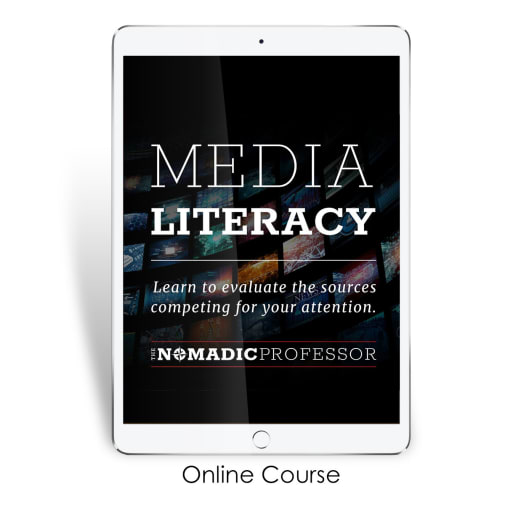
Media Literacy Online Course

SKU
052699
Grade 9-12
Teaching Method
Traditional
Teacher-centered curriculum commonly used in classrooms that may include a text, teacher manual, tests, etc.
Charlotte Mason
A methodology based on the work of a 19th century educator who maintained that children learn best from literature (Living Books), not textbooks.
Classical
A methodology based on the Latin Trivium (three stages of learning), including the grammar stage (memorization and facts), logic stage (critical thinking), and rhetoric stage (developing/defending ideas).
Unit Study
A thematic or topical approach centered around one topic that integrates multiple subject areas.
Montessori (Discovery)
A methodology based on the work of a 20th century educator that emphasizes student and sensory-driven discovery learning and real-life applications.
Other
Other methodologies
Religious Content
Secular
Contains content contrary to common Christian beliefs (i.e. evolution).
Neutral
Avoids religious or theoretical topics or presents multiple viewpoints without preference.
Christian/Religious
Faith-based or including instructional religious content.
Learning Modality
Auditory
Learns through listening, talking out loud or reading out loud.
Visual
Learns through seeing, prefers written instructions and visual materials.
Kinesthetic/Tactile (Hands-On)
Learns through moving, doing and touching.
Multi-Sensory
Curriculum that employ a variety of activities/components.
Presentation
Sequential
Curriculum progresses through well-defined learning objectives. Emphasizes mastery before moving to the next topic.
Spiral
Topics and concepts are repeated from level to level, adding more depth at each pass and connecting with review.
Conceptual/Topical
Focus is on the “why,” often with a unifying concept as well as specific skills; coverage may be broader.
Teacher Involvement
Low Teacher Involvement
Student-led materials; parent acts as a facilitator.
Medium Teacher Involvement
A mix of teacher-led time and independent student work.
High Teacher Involvement
Teacher-led lessons; may utilize discussions, hands-on activities and working together.
Additional Materials Required
No other materials needed
Everything you need is included.
Other Materials Required
There are additional required resources that are a separate purchase.
Other Materials Optional
There are additional resources mentioned or recommended but are not absolutely necessary.
Consumable
Consumable
Designed to be written in; not reusable.
Non-Consumable
Not designed to be written in; reusable.
Our Price
$175.00

Product Overview

  • One-semester, half-credit Elective Course for high school
  • Flexible pacing with video lectures, on-screen text, and guided notes!
  • Learn to spot right, center, and left-leaning slants in reporting

Important

Non-returnable. Is, or contains, a digital item.

Description

Equip students to navigate today’s complex media landscape with discernment and confidence. This one-semester online elective course teaches students to evaluate news, social media, advertising, and other information sources; recognize bias and logical fallacies; analyze rhetoric; and separate fact from fiction.

Designed as a one-semester, half-credit elective, this program guides students to complete approximately 70 hours of coursework through self-paced lessons, video lectures, guided notes, vocabulary practice, auto-graded quizzes, and interactive assignments. Each session takes 30–90 minutes to complete. The Instructor Guide includes additional guidance for documenting hours, assigning transcript credit, and using the rubrics for efficient grading.

Units Covered:

  • Unit 1: The Fundamentals — What is media literacy?
  • Unit 2: History — Where did “the media” come from?
  • Unit 3: The Political Landscape — What is the political spectrum?
  • Unit 4: Language — Bias and point of view, framing, political-speak, fallacies, persuasive techniques, artificial intelligence, and more.
  • Unit 5: Tools to read like a historian.

Students will complete an argumentative essay that requires them to respond persuasively to a set of sources addressing a specific question. The book So What? The Writer’s Argument by Kurt Schick and Laura Schubert is required to complete this assignment.

Publisher's Description of Media Literacy Online Course
This course is made in partnership with Ground News, the premier website and app for gathering all the world’s media in one place so you can compare coverage from the left, right, and center. This course is currently being “dripped” out a session at a time. See the course preview below for a view of what’s available now, and what’s still to come. Purchase the course now, and get instant access to new content as it becomes available!

Cut through the noise
Our Media Literacy course takes an innovative approach to navigating an increasingly complex world of information:
  • Follow today’s headlines and partisan news coverage with clear insight into the interests of your sources
  • Find the range of sources that will constitute your healthy news diet
  • Learn to understand and get behind the surface of language and images like a professional
  • Gain perspective on the political landscape of our information environment, and arm yourself and your students with lifelong skills for discernment and judgment
Details
More Information
Product Format:Other
Grades:9-12
Brand:The Nomadic Professor
Videos
Reviews
Product Q&A