
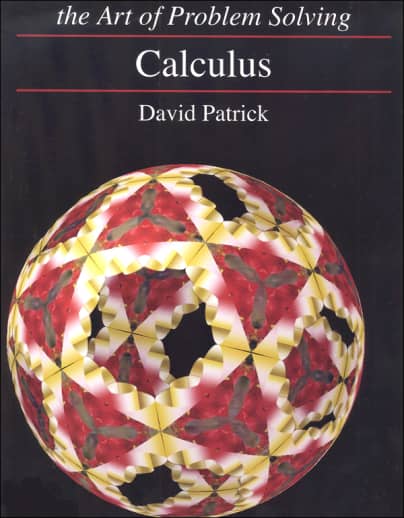
The Art of Problem Solving: Calculus Text

SKU
051932
ISBN
9781934124246
Grade 9-12
Neutral
Low Teacher Involvement
Multi-Sensory
No other materials needed
Sequential
Teaching Method
Traditional
Teacher-centered curriculum commonly used in classrooms that may include a text, teacher manual, tests, etc.
Charlotte Mason
A methodology based on the work of a 19th century educator who maintained that children learn best from literature (Living Books), not textbooks.
Classical
A methodology based on the Latin Trivium (three stages of learning), including the grammar stage (memorization and facts), logic stage (critical thinking), and rhetoric stage (developing/defending ideas).
Unit Study
A thematic or topical approach centered around one topic that integrates multiple subject areas.
Montessori (Discovery)
A methodology based on the work of a 20th century educator that emphasizes student and sensory-driven discovery learning and real-life applications.
Other
Other methodologies
Religious Content
Secular
Contains content contrary to common Christian beliefs (i.e. evolution).
Neutral
Avoids religious or theoretical topics or presents multiple viewpoints without preference.
Christian/Religious
Faith-based or including instructional religious content.
Learning Modality
Auditory
Learns through listening, talking out loud or reading out loud.
Visual
Learns through seeing, prefers written instructions and visual materials.
Kinesthetic/Tactile (Hands-On)
Learns through moving, doing and touching.
Multi-Sensory
Curriculum that employ a variety of activities/components.
Presentation
Sequential
Curriculum progresses through well-defined learning objectives. Emphasizes mastery before moving to the next topic.
Spiral
Topics and concepts are repeated from level to level, adding more depth at each pass and connecting with review.
Conceptual/Topical
Focus is on the “why,” often with a unifying concept as well as specific skills; coverage may be broader.
Teacher Involvement
Low Teacher Involvement
Student-led materials; parent acts as a facilitator.
Medium Teacher Involvement
A mix of teacher-led time and independent student work.
High Teacher Involvement
Teacher-led lessons; may utilize discussions, hands-on activities and working together.
Additional Materials Required
No other materials needed
Everything you need is included.
Other Materials Required
There are additional required resources that are a separate purchase.
Other Materials Optional
There are additional resources mentioned or recommended but are not absolutely necessary.
Consumable
Consumable
Designed to be written in; not reusable.
Non-Consumable
Not designed to be written in; reusable.
Our Price
$52.00
Bargain Version Available
Discover

Description

The texts are based on the premise that students learn math best by solving problems - lots of problems - and preferably difficult problems that they don't already know how to solve. Most sections, therefore, begin by presenting problems and letting students intuit solutions BEFORE explaining ways to solve them. Even if they find ways to answer the problems, they should read the rest of the section to see if their answer is correct and if theirs is the best or most efficient way to solve that type of problem. Textual instruction, then, is given in the context of these problems, explaining how to best approach and solve them.

Throughout the text there are also special, blue-shaded boxes highlighting key concepts, important things to retain (like formulas), warnings for potential problem-solving pitfalls, side notes, and bogus solutions (these demonstrate misapplications). There are exercises at the end of most sections to see if the student can apply what's been learned. Review problems at the end of each chapter test understanding for that chapter. If a student has trouble with these, he should go back and re-read the chapter. Each chapter ends with a set of Challenge Problems that go beyond the learned material. Successful completion of these sets demonstrates a high degree of mastery.

A unique feature in this series is the hints section at the back of the book. These are intended to give a little help to selected problems, usually the very difficult ones (marked with stars). In this way, students can get a little push in the right direction, but still have to figure out the solution for themselves. complete solutions and explanations to all the exercises, review problems and challenge problems are found in the separate solution manual (051931).

Publisher's Description of The Art of Problem Solving: Calculus Text

A comprehensive textbook covering single-variable calculus. Specific topics covered include limits, continuity, derivatives, integrals, power series, plane curves, and differential equations.

Calculus is part of the acclaimed Art of Problem Solving curriculum designed to challenge high-performing middle and high school students. Calculus covers all topics from a typical high school or first-year college calculus course, including: limits, continuity, differentiation, integration, power series, plane curves, and elementary differential equations. The text is written to challenge students at a much deeper level than a traditional high school or first-year college calculus course.

The book includes hundreds of problems, ranging from routine exercises to extremely challenging problems drawn from major mathematics competitions such as the Putnam Competition and the Harvard-MIT Math Tournament. Many of the problems have full, detailed solutions in the text, and the rest have full solutions in the accompanying Solutions Manual.

Paperback (2nd edition). Text: 336 pages. Solutions: 128 pages.

Category Description for The Art of Problem Solving Calculus

More intense than a normal high school or first-year college course, this is a full course in single-variable calculus.

Details
More Information
Product Format:Softcover Book
Grades:9-12
Brand:Art of Problem Solving
ISBN:9781934124246
Length in Inches:11
Width in Inches:8.4375
Height in Inches:1
Weight in Pounds:1.75
Videos
This product doesn't have a video
Reviews
Product Q&A