These icons are designed to help you quickly understand and learn important information about our products.
Teaching Method
Traditional
Teacher-centered curriculum commonly used in classrooms that may include a text, teacher manual, tests, etc.
Charlotte Mason
A methodology based on the work of a 19th century educator who maintained that children learn best from literature (Living Books), not textbooks.
Classical
A methodology based on the Latin Trivium (three stages of learning), including the grammar stage (memorization and facts), logic stage (critical thinking), and rhetoric stage (developing/defending ideas).
Unit Study
A thematic or topical approach centered around one topic that integrates multiple subject areas.
Montessori (Discovery)
A methodology based on the work of a 20th century educator that emphasizes student and sensory-driven discovery learning and real-life applications.
Other
Other methodologies
Religious Content
Secular
Contains content contrary to common Christian beliefs (i.e. evolution).
Neutral
Avoids religious or theoretical topics or presents multiple viewpoints without preference.
Christian/Religious
Faith-based or including instructional religious content.
Learning Modality
Auditory
Learns through listening, talking out loud or reading out loud.
Visual
Learns through seeing, prefers written instructions and visual materials.
Kinesthetic/Tactile (Hands-On)
Learns through moving, doing and touching.
Multi-Sensory
Curriculum that employ a variety of activities/components.
Presentation
Sequential
Curriculum progresses through well-defined learning objectives. Emphasizes mastery before moving to the next topic.
Spiral
Topics and concepts are repeated from level to level, adding more depth at each pass and connecting with review.
Conceptual/Topical
Focus is on the “why,” often with a unifying concept as well as specific skills; coverage may be broader.
Teacher Involvement
Low Teacher Involvement
Student-led materials; parent acts as a facilitator.
Medium Teacher Involvement
A mix of teacher-led time and independent student work.
High Teacher Involvement
Teacher-led lessons; may utilize discussions, hands-on activities and working together.
Additional Materials Required
No other materials needed
Everything you need is included.
Other Materials Required
There are additional required resources that are a separate purchase.
Other Materials Optional
There are additional resources mentioned or recommended but are not absolutely necessary.
Publisher's Description of Melissa & Doug Underwater Floor Puzzle
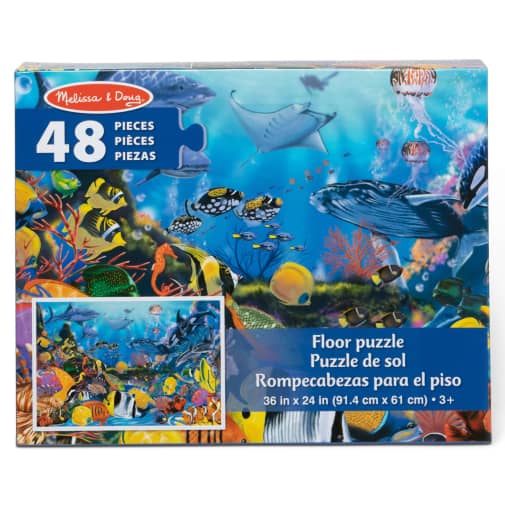
The jumbo Underwater Floor Puzzle features beautiful original artwork that depicts a deep ocean scene. Kids can learn about different kinds of fish and other creatures that make the ocean their home, as well as recognize some of their favorites including jellyfish, and sharks. The large floor puzzle measures an impressive two feet by three feet when it's assembled, and the 48 extra-thick cardboard pieces feature an easy-to-clean surface to keep it looking like new. Playing with this Underwater puzzle is a great way for kids to explore the hidden world of the ocean while developing their cognitive, physical, and emotional skills. When children work on puzzles, they are fine-tuning their gross motor skills, improving their hand-eye coordination, strengthening their problem-solving skills, and beginning to develop logic and critical thinking processes. This Melissa & Doug puzzle makes an exceptional gift for preschoolers and kids ages three and older for hands-on, screen-free play. Features
48 extra-thick cardboard pieces
Beautiful original artwork
Easy-Clean surface keeps puzzle looking new
Promotes hand-eye coordination and problem-solving skills
If you are looking for floor puzzles
with an extra element of fun, look no further! Melissa & Doug floor puzzles
have added a little pizazz and learning fun to the already fun floor puzzle
experience. The pieces are jumbo and made of sturdy cardboard. Each puzzle
theme has its own special fitting added activity.