These icons are designed to help you quickly understand and learn important information about our products.
Teaching Method
Traditional
Teacher-centered curriculum commonly used in classrooms that may include a text, teacher manual, tests, etc.
Charlotte Mason
A methodology based on the work of a 19th century educator who maintained that children learn best from literature (Living Books), not textbooks.
Classical
A methodology based on the Latin Trivium (three stages of learning), including the grammar stage (memorization and facts), logic stage (critical thinking), and rhetoric stage (developing/defending ideas).
Unit Study
A thematic or topical approach centered around one topic that integrates multiple subject areas.
Montessori (Discovery)
A methodology based on the work of a 20th century educator that emphasizes student and sensory-driven discovery learning and real-life applications.
Other
Other methodologies
Religious Content
Secular
Contains content contrary to common Christian beliefs (i.e. evolution).
Neutral
Avoids religious or theoretical topics or presents multiple viewpoints without preference.
Christian/Religious
Faith-based or including instructional religious content.
Learning Modality
Auditory
Learns through listening, talking out loud or reading out loud.
Visual
Learns through seeing, prefers written instructions and visual materials.
Kinesthetic/Tactile (Hands-On)
Learns through moving, doing and touching.
Multi-Sensory
Curriculum that employ a variety of activities/components.
Presentation
Sequential
Curriculum progresses through well-defined learning objectives. Emphasizes mastery before moving to the next topic.
Spiral
Topics and concepts are repeated from level to level, adding more depth at each pass and connecting with review.
Conceptual/Topical
Focus is on the “why,” often with a unifying concept as well as specific skills; coverage may be broader.
Teacher Involvement
Low Teacher Involvement
Student-led materials; parent acts as a facilitator.
Medium Teacher Involvement
A mix of teacher-led time and independent student work.
High Teacher Involvement
Teacher-led lessons; may utilize discussions, hands-on activities and working together.
Additional Materials Required
No other materials needed
Everything you need is included.
Other Materials Required
There are additional required resources that are a separate purchase.
Other Materials Optional
There are additional resources mentioned or recommended but are not absolutely necessary.
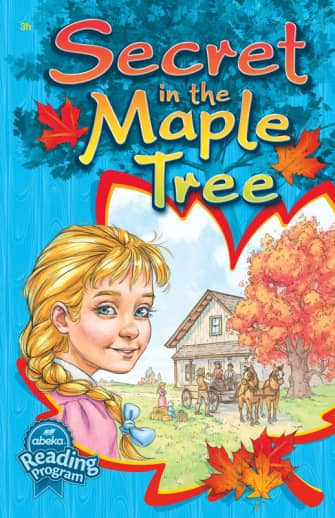
With this 8th reader in
the Abeka Grade 3 reading program, students will read a 19-chapter book about
Hilda who lived in Minnesota during the early 1900s. This is the third complete
narrative students read and study in this Abeka® Grade 3 reading program
(reader 3h). Although fictional, the story is based on the life of the author’s
mother-in-law. Students will become familiar with literary terms and be
introduced to book report creation, with tasks of summarizing each chapter into
a few sentences, and completing a main character analysis and a cause/effect
chart. You will find answers to the comprehension questions in the Reading
3 Answer Key with Literary Development and Enrichment Activities. This is the Homeschool Teacher Resource. 156
pgs, pb. ~ Ruth
Publisher's Description of Secret in the Maple Tree (Abeka)
Change is a constant theme in life, and Hilda has to learn how to adjust in Secret in the Maple Tree. This chapter book tells the story of 8-year old Hilda and her journey to gaining a new brother, learning forgiveness, and relying on God throughout the transitions in life. This revised edition includes chapter plot summary exercises, character web, and cause/effect activities that will help your child prepare for his book report. Complete with a glossary of challenging words for your child to reference, this novel promotes extended reading comprehension while enhancing character-building traits.
This level continues with the incremental
progression that was evident within the Abeka® Grade 2 reading program. Each reader in Grade
3 is designed with specific goals and builds upon the next. Silent reading will
be introduced and practiced. Three of the readers are complete narratives,
introducing students to continuing stories and chapter books. Books progress in
order: From Shore to Shore; My New Song (full narrative);
Through the Seasons; Among the Animals; Pilgrim Boy (full narrative);
Treats and Treasures; Heroes and Helpers; Secret in the Maple Tree; On the
Bright Side; The Swiss Family Robinson (full narrative);
Pilgrim's Progress: Christian's Journey (full narrative). You’ll find
answers to the comprehension questions in the Reading 3 Answer Key with
Literary Development and Enrichment Activities for all-in-one teacher guidance. See the Language Arts 3
Curriculum Homeschool Lesson Plans for
additional guidance concerning the reading program.