These icons are designed to help you quickly understand and learn important information about our products.
Teaching Method
Traditional
Teacher-centered curriculum commonly used in classrooms that may include a text, teacher manual, tests, etc.
Charlotte Mason
A methodology based on the work of a 19th century educator who maintained that children learn best from literature (Living Books), not textbooks.
Classical
A methodology based on the Latin Trivium (three stages of learning), including the grammar stage (memorization and facts), logic stage (critical thinking), and rhetoric stage (developing/defending ideas).
Unit Study
A thematic or topical approach centered around one topic that integrates multiple subject areas.
Montessori (Discovery)
A methodology based on the work of a 20th century educator that emphasizes student and sensory-driven discovery learning and real-life applications.
Other
Other methodologies
Religious Content
Secular
Contains content contrary to common Christian beliefs (i.e. evolution).
Neutral
Avoids religious or theoretical topics or presents multiple viewpoints without preference.
Christian/Religious
Faith-based or including instructional religious content.
Learning Modality
Auditory
Learns through listening, talking out loud or reading out loud.
Visual
Learns through seeing, prefers written instructions and visual materials.
Kinesthetic/Tactile (Hands-On)
Learns through moving, doing and touching.
Multi-Sensory
Curriculum that employ a variety of activities/components.
Presentation
Sequential
Curriculum progresses through well-defined learning objectives. Emphasizes mastery before moving to the next topic.
Spiral
Topics and concepts are repeated from level to level, adding more depth at each pass and connecting with review.
Conceptual/Topical
Focus is on the “why,” often with a unifying concept as well as specific skills; coverage may be broader.
Teacher Involvement
Low Teacher Involvement
Student-led materials; parent acts as a facilitator.
Medium Teacher Involvement
A mix of teacher-led time and independent student work.
High Teacher Involvement
Teacher-led lessons; may utilize discussions, hands-on activities and working together.
Additional Materials Required
No other materials needed
Everything you need is included.
Other Materials Required
There are additional required resources that are a separate purchase.
Other Materials Optional
There are additional resources mentioned or recommended but are not absolutely necessary.
Looking for
a way to talk to your children about complex topics? The Tuttle Twins take on
diversity, equity, and inclusion in a way that makes sense to kids. In this
book, the track team is working hard to do well in all their events. When a new
coach comes in with a questionnaire about their race and household income
(among other points), their hard work is set aside for a point system used to
even things out among the athletes. It’s a hard conversation about fairness and
what equality really means in the world. Historical references to Marxism
provide context for discussing socialism and communism. A short glossary and a few discussion
questions are provided in the back. You can download a free workbook to
reinforce the lessons. ~Sara
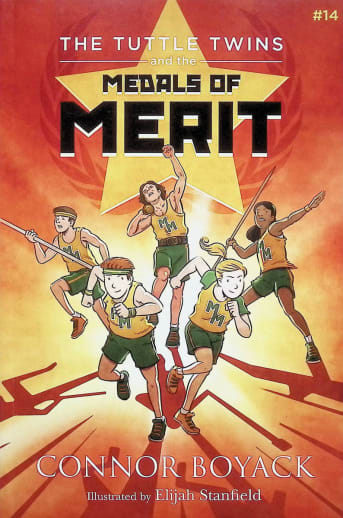
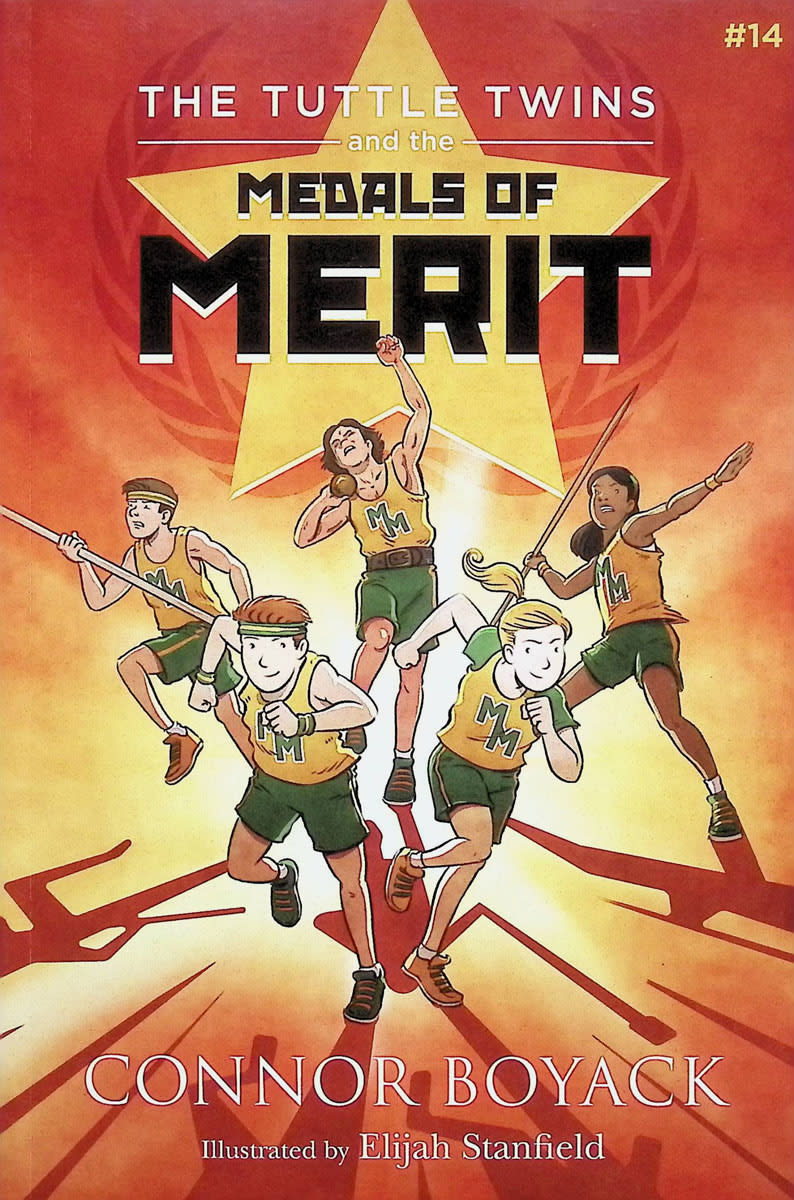
Publisher's Description of Tuttle Twins and the Medals of Merit #14
WHAT HAPPENS WHEN FAIRNESS IS FLIPPED ON ITS HEAD? Ethan and Emily Tuttle are about to find out at the most unusual track meet they’ve ever seen. The twins face a new challenge: a competition where effort and ability take a backseat to identity and circumstances.
For some people, striving for excellence doesn’t mean what it once did. But as Marxist ideas spread throughout society, can Ethan and Emily champion the cause of merit in a system bent on equal outcomes?
Despite a century of Marxist catastrophes throughout the world, a new brand of Marxism is rearing its ugly head and taking the world by storm. Join Ethan and Emily as they learn about these flawed ideas and how we can stop them from spreading in our day!
Read a fun story and learn cool stuff? Yes, please! Ethan and Emily Tuttle are 9-year-olds who love to learn new things. Their curiosity is contagious! Using colorful illustrations and engaging dialogue, young readers can follow their adventures and learn about a wide variety of topics along the way. The series has a conservative/libertarian point of view without coming across as a lecture. The target reading level for this series seems to be about Grade 4 or so. ~Sara