
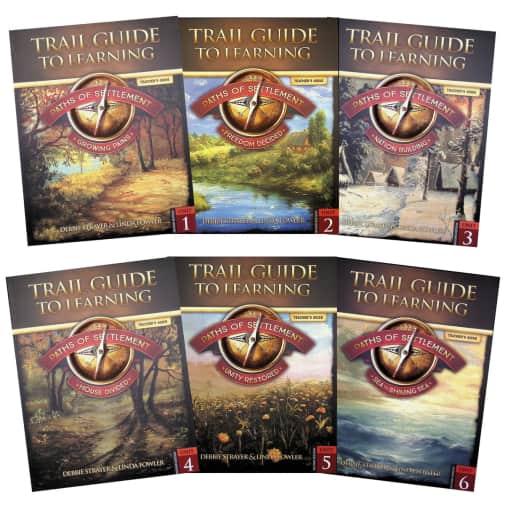
Formatted into six perfect bound units, Paths of Settlement continues the story of America, from the settling and growth of our nation and its government. Key events are examined: Revolutionary War, War of 1812, Civil War and Westward Expansion, as are the leaders who exemplified freedom and citizenship. Each six-week unit offers a different focus: Growing Pains, Freedom Decided, Nation Building, House Divided, Unity Restored and Sea to Shining Sea. Additional required resources include student notebook pages, the unit specific literature resources, and the Core Resources used through all units. Core Resources include: National Geographic Pocket Guide to the Weather of North America, Explorer's Guide to Rocks and Minerals, United States History Atlas, Desk Atlas of the United States, Eat Your Way through the USA, Profiles from History Volume 2, Petit Picasso (Spicebox) Water Color, State Notebook with Stickers, Discovering America's Founders Drive through History DVD, Rock Study Kit, U.S. Presidents Flashcards, USA PlaceMap, Large Outline Map of the U.S., and the Mark-it Timeline of History. There are a couple no longer available items that are considered Core and may be found online including Wee-Sing America CD (free on YouTube), and USA Activity CD (now a download from the publisher's website).
Paths of Settlement 2nd Edition (6 Unit Set)
Description
Paths of Settlement is the second step on the Trail Guide to Learning. Key events studied include the Colonial Period, the Revolutionary War, the war of 1812, the Civil War, and Westward Expansion. Learn about the accomplishments of great Americans such as George Washington and Patrick Henry who built upon the trial blazed by brave explorers. Their actions teach us the principles of freedom and citizenship - founding and expanding our country, strengthening us in times of war and binding us together in times of struggle. This full one-year course is targeted for grades 4-6, but the lessons can be easily adapted for 3rd and 7th grades, as well.
Activities include period crafts, cooking, watercolor painting, state studies, making a wind gauge, and more.
The second edition is a fully revamped version with improvements, updated games, and some color pages. It includes six books corresponding to each of the six units. Each book includes a section of color and perforated pages with activities, instructions, and game cards in the back. Student pages are available separately in your choice of printed pages by unit and grade, or all grades in digital format.
Required student notebook pages are available for each grade level and are an integral part of this curriculum. Notebook pages provide maps, charts, space for copywork or dictation and any other template page needed throughout the year. Student Notebooks are not included with the teachers guides.
This program has been revised and is now formatted into six perfectbound units. Student notebook pages are now a separate purchase by grade level. Please see the "Resources" category to the left to find required resources needed for the course.
| Product Format: | Other |
|---|---|
| Grades: | 4-6 |
| Brand: | Geography Matters |
| Author: | Debbie Strayer & Linda Fowler |
| ISBN: | 9781931397629 |
| Length in Inches: | 11 |
| Width in Inches: | 8.625 |
| Height in Inches: | 2.625 |
| Weight in Pounds: | 9.75 |