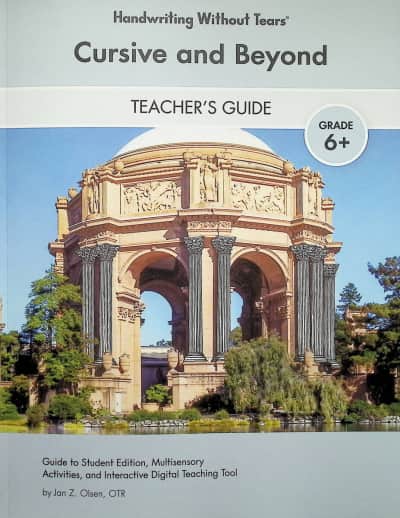
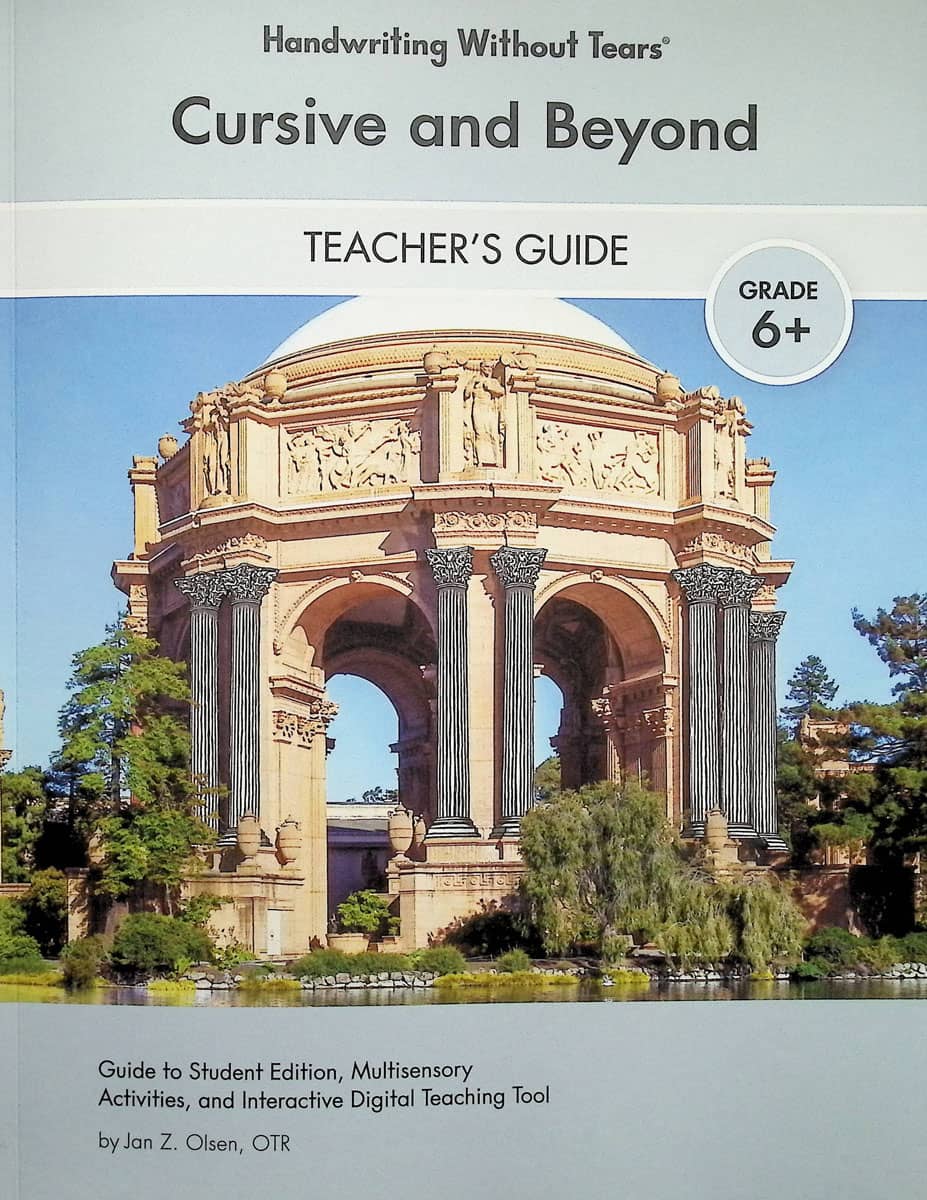
Handwriting Without Tears Cursive and Beyond 2025 Edition Teacher's Guide
SKU
048056
ISBN
9798885664820
Grade 6
These icons are designed to help you quickly understand and learn important information about our products.
Teaching Method
Traditional
Teacher-centered curriculum commonly used in classrooms that may include a text, teacher manual, tests, etc.
Charlotte Mason
A methodology based on the work of a 19th century educator who maintained that children learn best from literature (Living Books), not textbooks.
Classical
A methodology based on the Latin Trivium (three stages of learning), including the grammar stage (memorization and facts), logic stage (critical thinking), and rhetoric stage (developing/defending ideas).
Unit Study
A thematic or topical approach centered around one topic that integrates multiple subject areas.
Montessori (Discovery)
A methodology based on the work of a 20th century educator that emphasizes student and sensory-driven discovery learning and real-life applications.
Other
Other methodologies
Religious Content
Secular
Contains content contrary to common Christian beliefs (i.e. evolution).
Neutral
Avoids religious or theoretical topics or presents multiple viewpoints without preference.
Christian/Religious
Faith-based or including instructional religious content.
Learning Modality
Auditory
Learns through listening, talking out loud or reading out loud.
Visual
Learns through seeing, prefers written instructions and visual materials.
Kinesthetic/Tactile (Hands-On)
Learns through moving, doing and touching.
Multi-Sensory
Curriculum that employ a variety of activities/components.
Presentation
Sequential
Curriculum progresses through well-defined learning objectives. Emphasizes mastery before moving to the next topic.
Spiral
Topics and concepts are repeated from level to level, adding more depth at each pass and connecting with review.
Conceptual/Topical
Focus is on the “why,” often with a unifying concept as well as specific skills; coverage may be broader.
Teacher Involvement
Low Teacher Involvement
Student-led materials; parent acts as a facilitator.
Medium Teacher Involvement
A mix of teacher-led time and independent student work.
High Teacher Involvement
Teacher-led lessons; may utilize discussions, hands-on activities and working together.
Additional Materials Required
No other materials needed
Everything you need is included.
Other Materials Required
There are additional required resources that are a separate purchase.
Other Materials Optional
There are additional resources mentioned or recommended but are not absolutely necessary.
This is an incredible resource for parents with a middle school student struggling with handwriting. You will need the student book (sku 048057) as well, but this treasure trove will help you help them on their cursive journey! This Teacher’s Guide has guidance for every task in the student book. While some resources are classroom-oriented, the language in the Teacher Guide is parent-friendly and explains the reasons behind the struggle. Kids fuss about something when it is difficult, and parents can easily assume they are being obstinate or even lazy. Using plain language, this guide explains occupational therapy techniques and how to use them to help your learner every day. Take your time and keep in mind it is taking a lot more effort on your student’s part than you may realize. Margin notes help you with this as well as having reduced student pages in the Teacher’s Guide. There may be some classroom language that does not apply to a one-on-one environment, but don’t let that stop you from benefitting from the handwriting experts at Handwriting Without Tears. 126pp ~Sara
Publisher's Description of Handwriting Without Tears Cursive and Beyond 2025 Edition Teacher's Guide
The Cursive and Beyond Teacher’s Guide is designed to
minimize prep time. Lessons include explicit cursive handwriting instruction
with exact language for teaching each lesson. The multisensory activities,
differentiation strategies, ideas for multilingual learners, and progress
monitoring suggestions are also included on the lesson pages. Intentional
connections to grade level literacy and technology skills support learning to
ensure literacy success:
Literacy
Connection includes grammar, comprehension, vocabulary, writing and
morphology
Tech
Connection includes keyboarding, note-taking tools, grammar tools, and
process writing tools
Teach
It includes best practices, A Click Aways, and guidance on using classroom
resources
Digital
Teaching provides reminders about digital teacher and student resources
for each lesson
Over the first 6 weeks, students
review letters grouped together by formation by immediately using them in
words. They practice applying these words in capitals, sentences, and
paragraphs. “Pause and Practice” sections happen every ten or so pages, where
students will “translate” the provided print paragraph into their own cursive. Students
will then work on writing fluency, aiming for “fast and neat” handwriting. All
handwriting is practiced in context and some particularly fun topics include
developing their own signature, learning Greek and Latin roots, and tackling
unique paragraph-length writing assignments. Aligns with Science of Reading.