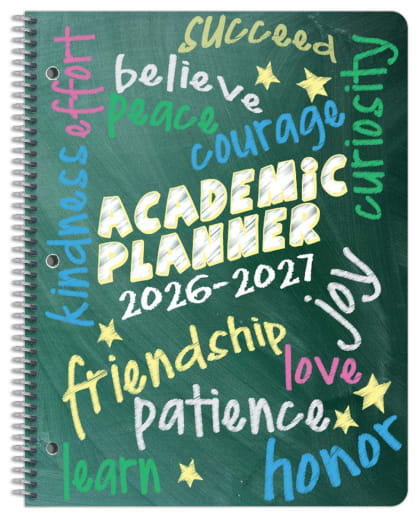
Classic Elementary Matrix Planner July 1, 2026 - June 29, 2027 (8.5"x11")
SKU
046251
Grade 3-5
These icons are designed to help you quickly understand and learn important information about our products.
Teaching Method
Traditional
Teacher-centered curriculum commonly used in classrooms that may include a text, teacher manual, tests, etc.
Charlotte Mason
A methodology based on the work of a 19th century educator who maintained that children learn best from literature (Living Books), not textbooks.
Classical
A methodology based on the Latin Trivium (three stages of learning), including the grammar stage (memorization and facts), logic stage (critical thinking), and rhetoric stage (developing/defending ideas).
Unit Study
A thematic or topical approach centered around one topic that integrates multiple subject areas.
Montessori (Discovery)
A methodology based on the work of a 20th century educator that emphasizes student and sensory-driven discovery learning and real-life applications.
Other
Other methodologies
Religious Content
Secular
Contains content contrary to common Christian beliefs (i.e. evolution).
Neutral
Avoids religious or theoretical topics or presents multiple viewpoints without preference.
Christian/Religious
Faith-based or including instructional religious content.
Learning Modality
Auditory
Learns through listening, talking out loud or reading out loud.
Visual
Learns through seeing, prefers written instructions and visual materials.
Kinesthetic/Tactile (Hands-On)
Learns through moving, doing and touching.
Multi-Sensory
Curriculum that employ a variety of activities/components.
Presentation
Sequential
Curriculum progresses through well-defined learning objectives. Emphasizes mastery before moving to the next topic.
Spiral
Topics and concepts are repeated from level to level, adding more depth at each pass and connecting with review.
Conceptual/Topical
Focus is on the “why,” often with a unifying concept as well as specific skills; coverage may be broader.
Teacher Involvement
Low Teacher Involvement
Student-led materials; parent acts as a facilitator.
Medium Teacher Involvement
A mix of teacher-led time and independent student work.
High Teacher Involvement
Teacher-led lessons; may utilize discussions, hands-on activities and working together.
Additional Materials Required
No other materials needed
Everything you need is included.
Other Materials Required
There are additional required resources that are a separate purchase.
Other Materials Optional
There are additional resources mentioned or recommended but are not absolutely necessary.
A planner that helps an elementary student accomplish
their goals step-by-step. Some features of this planner include:
Monthly calendar with special events and
monthly goals and an activity page next to it.
Dated
weeks laid out over 2 pages with 6 titles subject line and two open spaces
(reading, spelling, language arts, math, science, and social studies).
Each
week includes a place for 22 spelling words, weekly goals, and a fact for the
week.
The appendix in the back covers arts, color
wheel, character, success tips for homework and test-taking, spelling rules,
sentence structure, healthy choices, animal and plant cells diagrams, transfer
of energy, math charts, and the government of the US.
The
inside back cover is a sturdy measurement page with metric, English to metric,
metric to English, temperatures, formulas, and formula key. A ruler with cm
runs along the side from 1-15. The back cover shows the years 2024-2027 by
month with a ruler along the side for 1-10 inches and a place for important
dates.
Publisher's Description of Classic Elementary Matrix Planner July 1, 2026 - June 29, 2027 (8.5"x11")
Empower students with the Classic Datebook! This datebook is designed to
cultivate skills in goal setting and time management throughout the
academic year. The Classic datebook for elementary students uses the
onTRAC® planning method to help students skillfully tackle both
immediate and future planning requirements.