Take a card, play it on top of another
card on the table, cover one or two leaf spaces, and try to get the
largest area of connected leaves of your color. That's how easy it is
to play Autumn! Collecting leaves from the garden has never been so fun.
Autumn
arrives and the landscape turns orange and ochre. Little by little the
trees are losing their leaves, which fall to the ground forming carpets
of color. You and your companion could collect the leaves from the
garden, but first you think of something more fun: you will choose a
type of leaf and after a few movements with the rake, the winner will be
whoever is able to create the largest area with his group. Shall we
start?
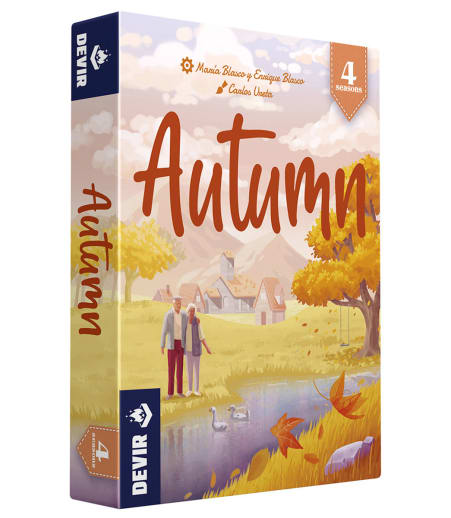
Designed by María Blasco and Enrique Blasco (better known
as Brote de juegos) and illustrated by Carlos Ureta, Autumn is a game
from the 4 seasons saga that joins the Devir pocket collection. If you
already know Winter, a title by the same authors and which is also part
of the saga, this game will be very familiar to you. With only 18 cards
that show four groups of leaves of two different colors, Autumn allows
quick games for 1 or 2 players, for ages 8 and up.
If you are too
lazy to read and learn rules, you will not suffer with this game since
you must remember very few rules. To begin, shuffle all the cards and
place them forming a deck with the leaves hidden. Reveal the first card
and place it on the table. The starting player (chosen at random)
reveals another card and plays it on top of the first. The second
player, before starting the turn, chooses the color of leaves each
player will play with: red or yellow. After this decision, the same
player reveals a new card, plays it and passes the turn. The game
continues normally with both players alternating turns until the deck of
cards is exhausted.
The most important rule to remember is that
the cards are always played on top of the others on the table, in the
same sense: it is possible to rotate it 180 degrees, but not 90. When
placing the card, one or two spaces of leaves must be covered. The
overlapping spaces can be of any color, they do not have to match.
Once
all the cards have been placed, whoever has the largest area
of connected leaf spaces of their color will win the game. Leaf spaces
are only considered connected if they are orthogonally adjacent; that
is, in contact on the sides, not the corners (diagonal spaces are not
considered connected). Anyway, the winner still can't celebrate the
victory! Autumn is designed to play three-round games. After finishing
the third, add up and compare the number of spaces each player gets to
see who the winner is.
On the other hand, the solitaire mode
offers us three different challenges: Garden, Balance and Two. In this
mode, the game is played with both colors at the same time, also trying
to create areas with spaces of leaves of the same color. Depending on
the challenge chosen, we will score in one way or another. In the Garden
challenge, at the end, the three areas that contain the most leaves are
chosen (regardless of their color) and the number of spaces in each one
is counted. The score for that game is the smallest of these three
numbers. In the Balance challenge, you must get three areas, with the
same number of spaces in each one. And finally, in Challenge Two, you
will try to get only two areas, with no unconnected colored spaces
outside of either of those two areas.
Autumn is the perfect
companion for any trip. With very few components, it offers a very
entertaining challenge both to play as a couple and to play alone. The
pocket collection is also characterized by its low cost, within reach of
all budgets. Let yourself be caught up in the colors of autumn and
start playing with the leaves!