Established on March 1, 1872, Yellowstone was the world’s first national park
Yellowstone is home to more than 500 active geysers, including Old Faithful
About 6,000 American bison live in Yellowstone
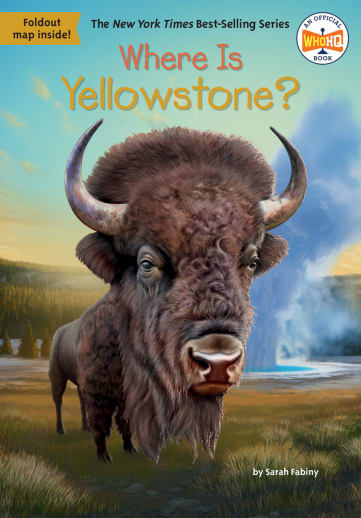
Which famous national park features a geyser that shoots water 185 feet into the air and thousands of American bison? Journey into the history of Yellowstone and its famous wildlife, canyons, rivers, forests, and more in this illustrated book for young readers!
From the #1 New York Times Best-Selling Who Was? series comes Where Is?, a series that tells the stories of world-famous landmarks and natural wonders and features a fold-out map!
Established in 1857 as the first national park in the United States, Yellowstone has been drawing visitors to its beautiful landscape for over 150 years. Before it became a national park, the region was home to Native Americans for over 11,000 years, including the Shoshone, Lakota, Crow, Blackfoot, Flathead, Bannok, and Nez Perce tribes. Today, tourists come to the park from all over the world to camp and to visit the famous Old Faithful geyser and the Yellowstone Caldera, the largest super volcano in North America. The many animals that live in Yellowstone include bison, black and grizzly bears, elk, wolves, and more than three hundred species of birds. Yellowstone is so large that it has land in three different states — Wyoming, Montana, and Idaho. Learn the rich history of one of America’s most beloved national parks in this book perfect for young explorers.
Where is Yellowstone?
SKU
045132
ISBN
9780593660881
Grade 3-7
These icons are designed to help you quickly understand and learn important information about our products.
Teaching Method
Traditional
Teacher-centered curriculum commonly used in classrooms that may include a text, teacher manual, tests, etc.
Charlotte Mason
A methodology based on the work of a 19th century educator who maintained that children learn best from literature (Living Books), not textbooks.
Classical
A methodology based on the Latin Trivium (three stages of learning), including the grammar stage (memorization and facts), logic stage (critical thinking), and rhetoric stage (developing/defending ideas).
Unit Study
A thematic or topical approach centered around one topic that integrates multiple subject areas.
Montessori (Discovery)
A methodology based on the work of a 20th century educator that emphasizes student and sensory-driven discovery learning and real-life applications.
Other
Other methodologies
Religious Content
Secular
Contains content contrary to common Christian beliefs (i.e. evolution).
Neutral
Avoids religious or theoretical topics or presents multiple viewpoints without preference.
Christian/Religious
Faith-based or including instructional religious content.
Learning Modality
Auditory
Learns through listening, talking out loud or reading out loud.
Visual
Learns through seeing, prefers written instructions and visual materials.
Kinesthetic/Tactile (Hands-On)
Learns through moving, doing and touching.
Multi-Sensory
Curriculum that employ a variety of activities/components.
Presentation
Sequential
Curriculum progresses through well-defined learning objectives. Emphasizes mastery before moving to the next topic.
Spiral
Topics and concepts are repeated from level to level, adding more depth at each pass and connecting with review.
Conceptual/Topical
Focus is on the “why,” often with a unifying concept as well as specific skills; coverage may be broader.
Teacher Involvement
Low Teacher Involvement
Student-led materials; parent acts as a facilitator.
Medium Teacher Involvement
A mix of teacher-led time and independent student work.
High Teacher Involvement
Teacher-led lessons; may utilize discussions, hands-on activities and working together.
Additional Materials Required
No other materials needed
Everything you need is included.
Other Materials Required
There are additional required resources that are a separate purchase.
Other Materials Optional
There are additional resources mentioned or recommended but are not absolutely necessary.
Consumable
Consumable
Designed to be written in; not reusable.
Non-Consumable
Not designed to be written in; reusable.
Our Price
$7.99 $7.99 $6.25
Rainbow Savings: $1.74
Description
Publisher's Description of Where is Yellowstone?
Category Description for Who HQ: Where Is? Series
Joining "Who is/Who was," this new series takes children on an exciting journey to learn the geography and history of renowned natural and man-made locations. Engagingly written with abundant black and white drawings, the stories are sprinkled with topical fun facts. For example, in Where is the White House? "Only one president was married in the White House-Grover Cleveland. President Richard Nixon's daughter, Tricia, held her wedding in the White House Rose Garden in 1971. Delivered on airplane, her wedding dress had its own seat." Some titles include evolutionary content. Each soft cover book includes a colorful, double-sided map that measures approx. 9"x 7.5". 108 pgs, SC. ~ Deanne
Details
| Product Format: | Paperback Book |
|---|---|
| Grades: | 3-7 |
| Brand: | Penguin Workshop |
| ISBN: | 9780593660881 |
| Length in Inches: | 7.625 |
| Width in Inches: | 5.375 |
| Height in Inches: | 0.25 |
| Weight in Pounds: | 0.25 |
Videos
Reviews