
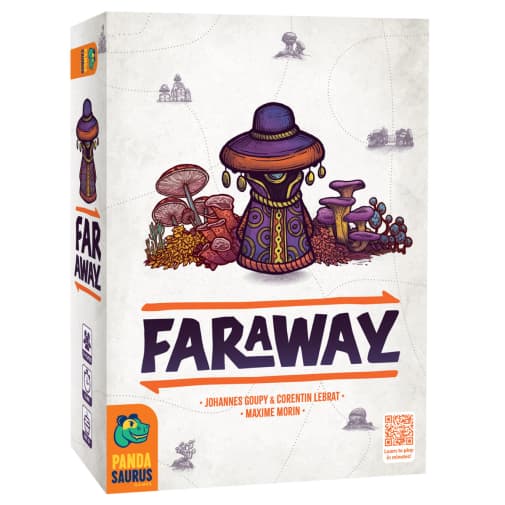
Faraway Game

SKU
044761
Grade 5-AD
Teaching Method
Traditional
Teacher-centered curriculum commonly used in classrooms that may include a text, teacher manual, tests, etc.
Charlotte Mason
A methodology based on the work of a 19th century educator who maintained that children learn best from literature (Living Books), not textbooks.
Classical
A methodology based on the Latin Trivium (three stages of learning), including the grammar stage (memorization and facts), logic stage (critical thinking), and rhetoric stage (developing/defending ideas).
Unit Study
A thematic or topical approach centered around one topic that integrates multiple subject areas.
Montessori (Discovery)
A methodology based on the work of a 20th century educator that emphasizes student and sensory-driven discovery learning and real-life applications.
Other
Other methodologies
Religious Content
Secular
Contains content contrary to common Christian beliefs (i.e. evolution).
Neutral
Avoids religious or theoretical topics or presents multiple viewpoints without preference.
Christian/Religious
Faith-based or including instructional religious content.
Learning Modality
Auditory
Learns through listening, talking out loud or reading out loud.
Visual
Learns through seeing, prefers written instructions and visual materials.
Kinesthetic/Tactile (Hands-On)
Learns through moving, doing and touching.
Multi-Sensory
Curriculum that employ a variety of activities/components.
Presentation
Sequential
Curriculum progresses through well-defined learning objectives. Emphasizes mastery before moving to the next topic.
Spiral
Topics and concepts are repeated from level to level, adding more depth at each pass and connecting with review.
Conceptual/Topical
Focus is on the “why,” often with a unifying concept as well as specific skills; coverage may be broader.
Teacher Involvement
Low Teacher Involvement
Student-led materials; parent acts as a facilitator.
Medium Teacher Involvement
A mix of teacher-led time and independent student work.
High Teacher Involvement
Teacher-led lessons; may utilize discussions, hands-on activities and working together.
Additional Materials Required
No other materials needed
Everything you need is included.
Other Materials Required
There are additional required resources that are a separate purchase.
Other Materials Optional
There are additional resources mentioned or recommended but are not absolutely necessary.
Consumable
Consumable
Designed to be written in; not reusable.
Non-Consumable
Not designed to be written in; reusable.
Our Price
$29.95 $29.95 $24.95
Rainbow Savings: $5.00

Description

Explore a mysterious continent with 2-6 players where time moves forward on each of your turns while you seek specific resources to fulfill the goals you lay out as your journey progresses.  There are two types of cards used in Faraway.  Region Cards are displayed in a central area and are the backbone of the game.  Sanctuary Cards are in a stack next to Region Cards and players may draw them when/if they meet the requirement needed to obtain them.

Gameplay: 

  1. Exploration - Players start with three Region cards in their hand. Each turn, players choose one of these cards to place down in front of them and to the right of their previous played card. Play continues until all players have placed eight cards.  Region cards have a number referred to as the “exploration duration” in their upper left-hand corner.  Next to this number, there may be clue symbols.  Cards may also contain wonders (uddu stones, chimera, or thistle symbols) in their upper right-hand corner.  Finally, there will be different types of quests on the lower right of these cards, and many will have a pre-requisite that requires specific symbols be present to earn fame points.  The goal in laying out these cards is to complete quests to earn fame points.   
  2. Gain Sanctuary Cards – If the last placed Region card had a higher “exploration duration” number than the previous card, players may draw a Sanctuary card, and an additional card for each clue symbol found on both the Region card and previously earned Sanctuary cards.  Sanctuary cards contain quests that award points, symbols to help meet quest goals on Region cards, and clue symbols to earn extra Sanctuary cards.  
  3. End of Exploration phase – Starting with the player with the lowest “exploration duration” number just played and going in ascending order, players choose one new Region card from the display to add to their hand.  Next, they choose one of the Sanctuary cards they just obtained to add to their play area below their Region cards.  Finally, new Region cards are chosen for the display, unless the 8th round of play is complete.  

After eight rounds of play, the game ends and scoring proceeds as follows:  All players flip all Region cards facedown and one at a time, moving from right to left, reveal and score fame points using both Sanctuary cards and only previously revealed Region cards.  When all eight of the Region cards are scored, calculate points for Sanctuary cards and the person with the most points wins the game!

This is one of the most unique card games that I have played, mostly because of the way it is scored in the opposite direction from the order in which cards were played.  Although a quick game with a 15-minute playtime per player and an easy-to-learn set of rules, it is really a brain-burner to produce scores on each Region card.  There is some luck involved, which depends on the available Region cards a player can draw and whether they have the first choice of the displayed cards in a round.  With a range of 2-6 players, this game works well with various sizes of groups.   I recommend Faraway for its compact size, affordable price, and replay value. 2-6 players, 15-30 minutes. - - - Marsha


Publisher's Description of Faraway Game
The land in this mysterious continent regularly shifts, twists, and reforms itself, making any attempt at mapping it obsolete. The only way one can master Alula is by walking it time and time again to make one's own atlas. Travel this ever changing-world, meet its inhabitants, and gain more Fame than your competitors.

Over the course of the game you will play a row of 8 cards in front of you from left to right. These cards represent the Regions you will come across while exploring the lands. Characters on these cards will grant you Fame if you later fulfill the conditions they demand. However at the end of the game, you walk back the way you just explored, scoring cards in the opposite order you played them. The player with the most Fame after scoring Regions and Sanctuaries wins!
Details
More Information
Product Format:Other
Grades:5-AD
Brand:Pandasaurus Games
EAN/UPC:850029278986
Length in Inches:7.25
Width in Inches:5.375
Height in Inches:1.875
Weight in Pounds:0.7063
Videos
This product doesn't have a video
Reviews
Product Q&A